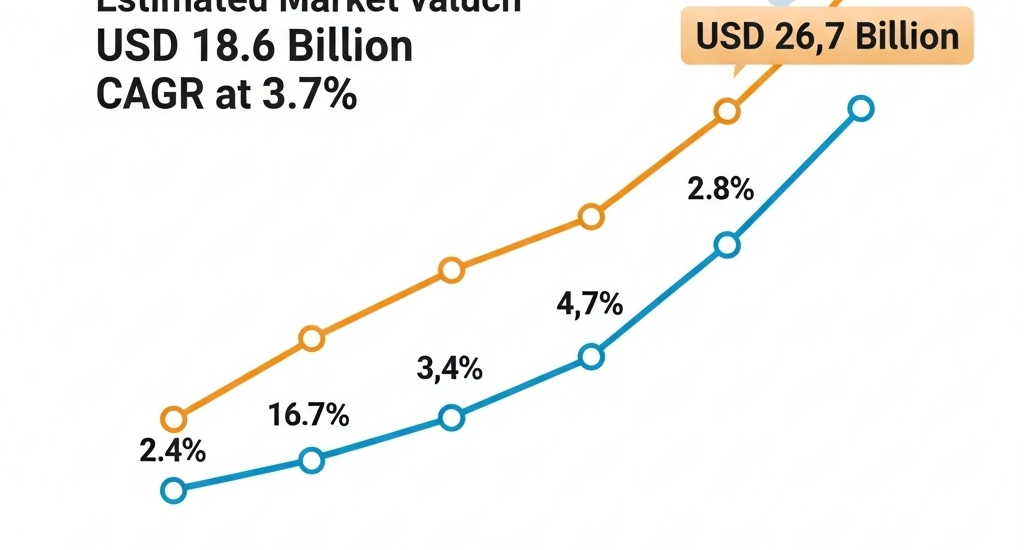
The global chronic wound care market is estimated to be valued at USD 18.6 billion in 2025 and is projected to reach USD 26.7 billion by 2035, registering a compound annual growth rate (CAGR) of 3.7% over the forecast period.
The chronic wound care market is rapidly evolving due to the rising prevalence of conditions like diabetes, obesity, and aging populations. Chronic wounds, which do not follow a normal healing trajectory, demand advanced care solutions that extend beyond traditional treatments. This market includes products such as dressings, devices, and biologics specifically designed to manage non-healing wounds.
Healthcare systems worldwide are investing in specialized wound care facilities, increasing the adoption of innovative treatment options. The chronic wound care market is gaining traction with a focus on patient-centric and cost-effective therapies. Governments and private institutions are also working toward enhancing reimbursement policies and expanding research, accelerating growth in this sector.
Get Sample Report: – https://www.futuremarketinsights.com/reports/sample/rep-gb-16277
Size & Trends
The chronic wound care market has witnessed steady growth in recent years and is projected to continue expanding. This growth is driven by an aging global population, increasing lifestyle-related diseases, and the demand for more effective wound management technologies.
- The global market is anticipated to surpass significant valuation benchmarks in the coming years.
- Key trends include the rising use of telemedicine and remote monitoring tools in chronic wound treatment.
- The demand for advanced wound dressings and negative pressure wound therapy (NPWT) systems is climbing.
- Integration of artificial intelligence and data analytics in wound assessment tools is reshaping treatment approaches.
- Increasing awareness campaigns are leading to early diagnosis and more effective intervention.
Challenges and Opportunities
Despite strong momentum, the chronic wound care market faces several hurdles. Understanding these challenges alongside emerging opportunities offers a clearer picture of the market landscape.
Challenges:
- High treatment costs limit access, particularly in low-income and rural areas.
- Lack of awareness and education about chronic wound care practices hampers early intervention.
- Variability in clinical practices across regions affects standardization of care.
- Reimbursement policies remain inconsistent, especially in developing economies.
Opportunities:
- Rising healthcare spending and government initiatives are boosting market development.
- Technological innovations are creating smarter, more efficient wound care solutions.
- Increasing focus on outpatient and homecare settings opens new revenue streams.
- Partnerships between biotech firms and healthcare providers promote product innovation and accessibility.
Market Share by Geographical Region
The chronic wound care market shows varying performance across global regions, influenced by healthcare infrastructure, economic conditions, and disease prevalence.
- North America holds a substantial share due to high awareness, advanced healthcare systems, and favorable reimbursement structures.
- Europe follows closely with strong investments in chronic disease management and a robust aging population.
- Asia-Pacific is emerging as a high-growth region, supported by improving medical infrastructure and increasing diabetic population.
- Latin America and Middle East & Africa are gradually entering the market due to healthcare reforms and international support.
Each region presents unique dynamics and growth levers, making geographic strategy a critical component for stakeholders in the chronic wound care market.
Top Companies
A number of global companies are shaping the competitive landscape of the chronic wound care market. These key players focus on product innovation, strategic mergers, and expansion into emerging markets.
- Smith & Nephew – Known for its broad range of wound care products including advanced dressings and NPWT systems.
- 3M (formerly Acelity) – Offers innovative solutions in surgical and chronic wound management.
- Mölnlycke Health Care – Specializes in evidence-based wound care and infection prevention products.
- Coloplast – Provides personalized wound care solutions with a strong focus on user-friendly designs.
- ConvaTec Group – Delivers integrated wound care solutions with emphasis on homecare and long-term care facilities.
- Integra LifeSciences – Focuses on regenerative technologies and biologics for chronic wounds.
- Medline Industries – Offers a comprehensive portfolio of wound care supplies tailored for all care settings.
These companies continually invest in R&D and global partnerships to maintain their competitive edge in the chronic wound care market.
Explore In-Depth Analysis-Click Here to Access the Report:- https://www.futuremarketinsights.com/reports/chronic-wound-care-market
Segmentation Outlook
The chronic wound care market can be segmented by product type, wound type, end-user, and distribution channel. Understanding these segments enables better targeting and service delivery across various patient needs.
By Product Type:
- Advanced wound dressings (foam, hydrocolloid, alginate, etc.)
- Negative pressure wound therapy (NPWT) devices
- Biologics (growth factors, skin substitutes)
- Traditional wound care products
By Wound Type:
- Diabetic foot ulcers
- Pressure ulcers
- Venous leg ulcers
- Surgical and traumatic wounds
By End-User:
- Hospitals and clinics
- Homecare settings
- Long-term care facilities
- Ambulatory surgical centers
By Distribution Channel:
- Direct tenders
- Retail pharmacies
- Online platforms
- Distributors and wholesalers