

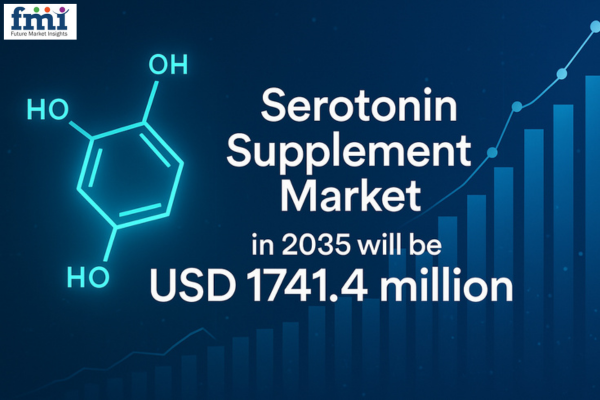
The global serotonin supplement market is projected to witness steady growth over the next decade, driven by increasing mental health awareness and the rising demand for natural mood-boosting alternatives. In 2025, the serotonin supplement market is expected to generate revenue of USD 1,031.4 million. With a forecasted compound annual growth rate (CAGR) of 5.2% between 2025 and 2035, the market is estimated to reach USD 1,741.4 million by 2035.
Serotonin supplements are widely recognized for their ability to help regulate mood, appetite, and sleep by supporting serotonin levels in the brain. The growing prevalence of stress, anxiety, and sleep disorders—particularly in urban populations—has led to a surge in consumer interest in these supplements. Additionally, the global inclination toward non-pharmaceutical and plant-based solutions for mental well-being continues to fuel demand.
Increasing consumer preference for clean-label, natural products, especially those derived from botanical sources such as 5-HTP (5-hydroxytryptophan) and tryptophan, has significantly boosted the market appeal. These supplements are available in various formats, including capsules, powders, and gummies, making them accessible and user-friendly for a wide range of demographics.
Uncover Essential Data – Get a Sample Copy Instantly: https://www.futuremarketinsights.com/reports/sample/rep-gb-19383
Key Takeaways from the Serotonin Supplement Market Report:
- The serotonin supplement market is anticipated to grow from USD 1,031.4 million in 2025 to USD 1,741.4 million by 2035.
- A consistent CAGR of 5.2% is projected during the 2025–2035 forecast period.
- Rising awareness of natural alternatives to antidepressants and anxiolytics is a key growth driver.
- Online retail and e-commerce platforms are contributing significantly to the market expansion.
- Asia Pacific and North America are expected to remain key regions due to increasing demand for mental health supplements.
Market Dynamics
Drivers:
The increasing burden of mental health issues globally has prompted consumers to seek safer, natural solutions. Serotonin supplements provide a viable non-prescription alternative to pharmaceuticals, appealing to those looking for holistic well-being. Additionally, the proliferation of online health education and wellness influencers has further enhanced consumer awareness of serotonin’s benefits, positively influencing purchasing decisions.
Challenges:
Despite growth, the market faces challenges in regulatory approvals and consumer skepticism regarding supplement efficacy. Varying international guidelines around dietary supplements can also hinder seamless global expansion for some manufacturers.
Opportunities:
As mental wellness becomes a central theme in healthcare and lifestyle discussions, there is a growing opportunity to expand product portfolios to include more targeted, functional blends. Formulations that combine serotonin-boosting ingredients with adaptogens, vitamins, and nootropics may attract a broader customer base.
Recent Developments in the Market
- Formulation Advancements: Companies are investing in advanced delivery systems such as time-release capsules and bioavailability-enhancing technologies.
- Expansion of Product Lines: Leading players have introduced serotonin supplements that blend botanical extracts with mood-enhancing micronutrients like magnesium, B-vitamins, and L-theanine.
- Collaborations and Partnerships: Market players are entering partnerships with mental health organizations and wellness platforms to promote product credibility and consumer trust.
Key Benefits for Stakeholders
- Manufacturers: Opportunity to innovate and introduce premium, evidence-backed formulations.
- Retailers: Rising demand in e-commerce presents new distribution channels.
- Consumers: Access to natural alternatives that support emotional and cognitive health without prescription.
- Investors: Robust CAGR and increasing awareness make this a high-potential sector for investment.
The Complete Picture Awaits – Download the Full Report: https://www.futuremarketinsights.com/reports/serotonin-supplement-market
Competitive Analysis
The serotonin supplement market is moderately fragmented, with several established and emerging players competing on innovation, branding, and distribution. Companies are leveraging clean-label formulations and advanced marketing strategies to differentiate their offerings. Some notable developments include:
- Launch of vegan and allergen-free serotonin supplements to cater to specific dietary needs.
- Use of influencer and social media marketing to reach Gen Z and millennial consumers.
- Development of subscription-based models for consistent customer retention.
Key players in the serotonin supplement market include
- Natural Stacks
- Dr. Maxwell
- Vital Nutritions
- Twinlab
- Amrita Nutrition
- Zhou Nutrition
- Quality of Life
- BrainMD
- LIDTKE
Country-wise Market Insights
United States (CAGR: 4.6%)
The U.S. dominates the serotonin supplement market in North America, backed by high mental health awareness, a strong dietary supplement industry, and growing e-commerce.
Germany (CAGR: 4.8%)
Germany represents a leading market in Europe, driven by its preference for natural health solutions and stringent regulatory focus on supplement quality.
China (CAGR: 5.6%)
Rapid urbanization, growing health consciousness, and a large population base contribute to China’s high growth potential in the serotonin supplement space.
Japan (CAGR: 5.1%)
The Japanese market is driven by an aging population seeking holistic solutions for sleep and cognitive support.
India (CAGR: 6.3%)
India showcases the fastest growth rate among the leading countries, fueled by rising stress levels in urban areas, greater supplement accessibility, and increasing disposable incomes.
Explore Food Supplement and Nutrition Industry Analysis: https://www.futuremarketinsights.com/industry-analysis/food-supplement-and-nutrition
Key Segmentation
By Functionality:
The market is segmented into depression relief, insomnia relief, appetite gaining, mood disorder treatment, weight loss, and cognitive health improvement.
By Form:
These include tablets/pills, capsules, liquid, powder, gummies/chewable, and others.
By Sales Channel:
These include hypermarkets/supermarkets, specialty stores, e-commerce, drug stores & pharmacies, health & wellness stores, convenience stores, and departmental stores.
By Region:
The market is segmented as North America, Latin America, Western Europe, Eastern Europe, East Asia, South Asia & Pacific, Central Asia, Russia and Belarus, Balkan & Baltic Countries, Middle East and Africa.




