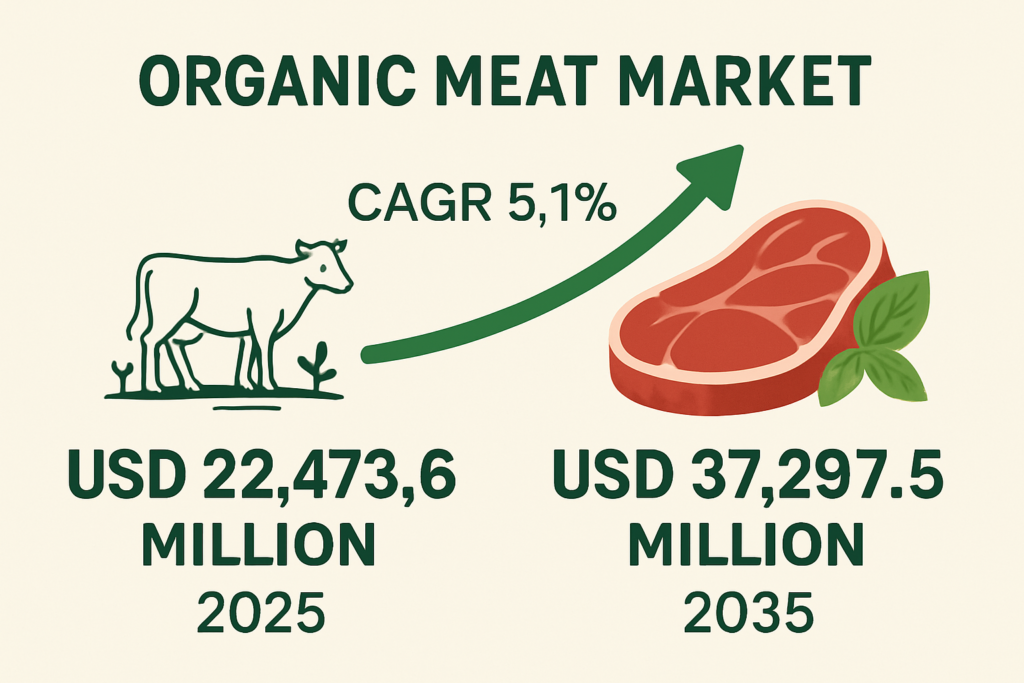
The global organic meat market is on a steady upward trajectory, driven by rising consumer awareness around health, sustainability, and ethical food production. As more people turn towards clean-label and environmentally friendly diets, organic meat is emerging as the protein of choice for a significant global demographic. According to the latest market analysis, the organic meat market is expected to grow from USD 22,473.6 million in 2025 to USD 37,297.5 million by 2035, registering a CAGR of 5.1% over the forecast period.
Explore Key Trends in the Market: Request Your Sample Report: https://www.futuremarketinsights.com/reports/sample/rep-gb-2502
Market Trends Highlighted:
Several key trends are shaping the organic meat landscape globally. Firstly, there is a surge in demand for antibiotic-free and hormone-free meats, driven by growing health awareness. Consumers, particularly in North America and Europe, are actively seeking ethically raised livestock products that align with sustainability goals. Secondly, e-commerce platforms specializing in organic and natural foods have expanded the accessibility of organic meat, especially in countries like South Korea and the United Kingdom. Lastly, the emphasis on animal welfare and environmental responsibility has catalyzed the expansion of organic certification programs and government-backed initiatives supporting organic farming practices.
Surge in Market Demand: Explore Comprehensive Trends and Analysis in Our Full Report: https://www.futuremarketinsights.com/reports/organic-meat-market
Recent Developments:
- Retail Expansion: Major supermarket chains across North America and Europe have increased shelf space for organic meats, complemented by specialty organic food stores and farm-direct sales channels.
- Online Sales Growth: The convenience of online shopping has accelerated organic meat sales, particularly in urban regions of Asia, where health-conscious millennials are driving demand.
- Certification Programs: Stricter organic certification standards, especially in the European Union under the Common Agricultural Policy (CAP), continue to boost consumer confidence and market stability.
Key Takeaways of the Report:
- The organic meat market is projected to grow at a CAGR of 5.1% from 2025 to 2035, driven by health-conscious consumers and regulatory support.
- Poultry and beef dominate global sales due to their versatility and widespread acceptance.
- Ethical considerations, including animal welfare, traceability, and environmental impact, are major purchase drivers.
- Expansion in e-commerce and specialty retail outlets is broadening consumer access to organic meat products worldwide.
Market Drivers:
- Rising Health Consciousness: Growing awareness of the health risks associated with antibiotic-laden meats is prompting consumers to shift toward organic options.
- Sustainability Focus: Organic farming’s reduced environmental impact resonates with eco-conscious buyers, especially in Europe and North America.
- Government Support: Subsidies, tax benefits, and stringent certification processes in regions like the EU encourage both production and consumption of organic meat.
- Increased Transparency: Demand for traceability and transparency in sourcing practices has pushed brands to adopt clear labelling and certification, enhancing consumer trust.
Regional Insights:
- North America (United States):
The United States is poised to lead the global organic meat market, fueled by growing awareness of ethical sourcing, antibiotic-free production, and health benefits. Supermarkets, specialty butchers, and organic sections in mainstream retail continue to expand offerings. The CAGR for the U.S. organic meat market stands at 4.9% from 2025 to 2035. - Europe (United Kingdom & EU):
In the UK, ethical consumption and sustainability concerns are primary market drivers, with diverse offerings of organic pork, mutton, and poultry available both in-store and online. The country’s organic meat market is projected to grow at a 4.7% CAGR. The wider European Union market benefits from CAP subsidies and stringent certification norms, showing a 4.8% CAGR. Germany, France, and the Netherlands are key contributors to regional growth. - Asia-Pacific (Japan & South Korea):
Japan is witnessing gradual growth in organic meat consumption as dietary preferences shift toward cleaner proteins. Urban centers and wellness-focused consumers are driving demand, reflected in a projected 4.6% CAGR. South Korea’s market, meanwhile, is expanding at 4.9% CAGR, thanks to heightened concerns over food safety and a thriving e-commerce sector catering to health-conscious younger demographics.
Country-wise CAGR Analysis (2025-2035):
| Country | CAGR (%) |
| United States | 4.9% |
| United Kingdom | 4.7% |
| European Union | 4.8% |
| Japan | 4.6% |
| South Korea | 4.9% |
Competition Outlook:
The organic meat market remains moderately fragmented, with a mix of global brands, regional organic producers, and specialty butchers. Leading players are investing in vertical integration, expanding organic livestock farms, and enhancing supply chain transparency to meet consumer demand. Additionally, collaborations between farmers’ cooperatives and retail chains are helping to ensure consistent product quality and availability. Key market players are also leveraging digital marketing and direct-to-consumer platforms to strengthen brand engagement and loyalty.
Company Profile
-
- Neat Meat Company
- Aurelian Supplier
- Organic Prairie
- River Ford Organic Farmers
- Swillington Organic Farm
- Evers Field
- Good Herdsmen
- Danish Crown Organic
- Meyer Natural Foods
- Well Hung Meat Company
 Explore Meat, Poultry & Seafood Industry Analysis: https://www.futuremarketinsights.com/industry-analysis/meat-poultry-and-seafood
Key Segmentations – Organic Meat Market
By meat type:
- Beef
- Pork
- Poultry
- Mutton
By distribution channel:
- Online
- Supermarkets
- Retail shops
- Specialty meat shops
- Health and natural stores
By region:
- North America
- Western Europe
- Latin America
- Eastern Europe
- Africa and the Middle east
- Asia Pacific