

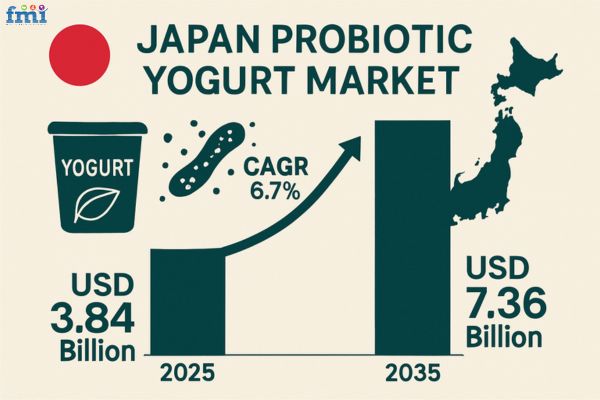
 The Japan probiotic yogurt market is undergoing a significant transformation, fueled by evolving consumer perceptions around health and wellness. Estimated at USD 3.84 billion in 2025, the market is forecasted to grow at a steady CAGR of 6.7%, reaching an impressive USD 7.36 billion by 2035. This growth underscores the increasing demand for gut-health-enhancing foods among Japan’s aging population.
Unveil Market Trends: Get Your Sample Report Now: https://www.futuremarketinsights.com/reports/sample/rep-gb-18230
Market Trends Highlighted:
Proactive Health Consumption:
Japanese consumers are increasingly adopting a preventive approach to their health, leading to a surge in demand for functional foods like probiotic yogurt that offer tangible wellness benefits.
Science-Backed Product Demand:
There is heightened consumer preference for probiotic yogurts backed by clinical studies, with strains demonstrating proven gut health, immune function, and digestive benefits.
Aging Demographics Driving Growth:
Japan’s aging society is a significant driver, with elderly consumers actively seeking products that can support digestion, boost immunity, and improve overall well-being.
Fusion of Tradition with Modern Wellness:
Probiotic yogurt in Japan resonates with both traditional fermented food culture and modern health consciousness, providing a strong emotional and nutritional appeal to a wide demographic.
Expansion of Flavor Varieties and Packaging Innovation:
Manufacturers are increasingly introducing new flavors, low-sugar options, and convenient packaging formats to attract busy, health-conscious consumers and broaden market reach.
Growing Need for Market Insights: Access Our Full Report for Thorough Analysis and Trends: https://www.futuremarketinsights.com/reports/demand-and-trend-analysis-of-probiotic-yogurt-in-japan
Key Takeaways of the Report:
- The Japan probiotic yogurt market is expected to grow from USD 3.84 billion in 2025 to USD 7.36 billion by 2035, exhibiting a CAGR of 6.7%.
- Growth is predominantly driven by Japan’s aging population and the rising focus on preventive healthcare through functional foods.
- Clinically supported probiotic strains are increasingly sought after by consumers, elevating product differentiation and brand trust.
- The market is seeing a surge in product innovation, focusing on taste diversity, low-sugar formulations, and sustainable, convenient packaging to cater to modern lifestyles.
- Elderly and middle-aged consumers form the core target group, supported by growing interest from younger demographics focused on digestive health and immune resilience.
Regional Market Outlook:
Japan remains one of the leading markets for probiotic yogurt in Asia-Pacific, bolstered by a well-established culture of fermented foods. Urban regions such as Tokyo, Osaka, and Yokohama exhibit particularly strong demand, driven by busy lifestyles and higher disposable incomes.
Meanwhile, suburban and rural areas are witnessing steady growth due to increased health education campaigns and expanding retail availability of probiotic products.
 Competition Outlook:
The Japan probiotic yogurt market is moderately fragmented with both domestic and international players vying for market share. Leading brands are focusing on enhancing R&D efforts to develop new probiotic strains backed by scientific validation, aiming to address specific health concerns like digestive wellness, immunity, and metabolic health.
Key Market Players
- Meiji
- Danone
- General Mills Inc.
- Arla Foods
- Lifeway Foods, Inc.
- BioGaia AB
- Lallemand Inc.
- i-Health Inc.
- Chr. Hansen Holding A/S
- Danisco A/S
Explore Dairy and Dairy Products Industry Analysis: https://www.futuremarketinsights.com/industry-analysis/dairy-and-dairy-products
Key Segments
By Product Type:
The segmentation is into Drinkable and Spoonable Yogurt.
By Source Type:
The segmentation is Animal-based, Plant-based, Soy Milk, Almond Milk, Coconut Milk, and Others.
By Nature Type:
The segmentation is into Organic and Conventional Yogurt.
By Flavor Type:
The segmentation is into Regular or Unflavored and Flavored, with subcategories such as Vanilla, Strawberry, Blueberry, Peach, and Other Flavors.
By Fat Content:
The segmentation is into Regular or Whole Milk, Low-fat, and Fat-free options.
By Sales Channel:
The segmentation is into Hypermarkets or Supermarkets, Convenience Stores, Specialty Stores, Online Retailers, Wholesalers, Grocery Stores, and Other Retail Formats.
By Key City/Province:
The report covers Kanto, Chubu, Kinki, Kyushu & Okinawa, Tohoku, and the Rest of Japan.




