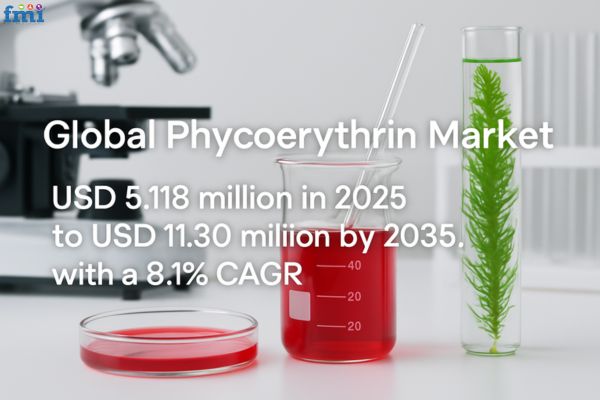
 The global phycoerythrin market is poised for robust growth in the coming decade, expanding from an estimated USD 4.79 million in 2024 to approximately USD 11.30 million by 2035. Registering a CAGR of 8.1% during the forecast period, this market is gaining traction as industries increasingly turn to natural, sustainable alternatives to synthetic compounds. Phycoerythrin’s unique properties—ranging from vibrant pigmentation to superior fluorescence—are accelerating its adoption across biotechnology, pharmaceuticals, food & beverage, and cosmetic sectors.
With an expanding consumer preference for clean-label products and bio-based ingredients, phycoerythrin is emerging as a key player in global supply chains, particularly as both a colorant and functional reagent in diagnostic applications.
Gain Valuable Market Knowledge: Request a Sample Report:https://www.futuremarketinsights.com/reports/sample/rep-gb-10723
Market Trends Highlighted:
Growing Demand for Natural Colorants: Consumers globally are gravitating toward natural and sustainable products, propelling phycoerythrin’s application in the food and cosmetic industries as a safe, vibrant colorant.
Technological Advancements in Extraction: The buffer extraction process is gaining significant market share, accounting for approximately 55% of production methods due to its ability to maintain protein integrity while maximizing fluorescence stability.
Fluorescent Marker Use Expanding in Diagnostics: Phycoerythrin’s superior fluorescence is finding increasing applications in bio-imaging, flow cytometry, and advanced clinical diagnostics.
Surge in Biotechnology Applications: Academic and clinical research organizations globally are incorporating phycoerythrin in assays and protein labeling, further broadening market opportunities.
Growing Need for Market Insights: Access Our Full Report for Thorough Analysis and Trends: https://www.futuremarketinsights.com/reports/phycoerythrin-market
Developments:
- Process Innovations: Companies are investing in improved extraction techniques to boost purity and yield. The buffer extraction process remains dominant due to its ability to efficiently retain high-quality phycoerythrin for sensitive applications.
- Strategic Collaborations: Major producers are partnering with biotechnology firms to develop specialized formulations for clinical research and diagnostics.
- Regional Expansion: Manufacturers in Asia-Pacific, particularly India and China, are rapidly scaling up production capacities to meet international demand, focusing on affordability and supply reliability.
Key Takeaways of the Report:
- The phycoerythrin market is expected to more than double between 2025 and 2035.
- Natural colorant trends across F&B and cosmetics sectors are key drivers for growth.
- Biotechnology and clinical diagnostics represent emerging high-growth application areas.
- Asia-Pacific, led by India and China, dominates cost-effective production, while North America and Europe specialize in high-purity, research-grade formulations.
- Buffer extraction technology holds a commanding share due to its optimal balance of purity, stability, and scalability.
Market Drivers:
- Rising Demand for Natural & Clean-label Products: Across food, cosmetics, and supplements, consumers are increasingly wary of synthetic ingredients, fueling demand for phycoerythrin as a naturally derived colorant.
- Expanding Clinical Research Activities: With the rise of personalized medicine, diagnostic labs and biotech firms are leveraging phycoerythrin’s fluorescent properties for high-precision assays and advanced diagnostic reagents.
- Technological Advancements in Extraction: Innovations in extraction and purification methods are reducing production costs while ensuring high purity levels, making phycoerythrin suitable for critical applications in healthcare and pharmaceuticals.
- Sustainable Production Practices: Growing emphasis on environmentally friendly sourcing is pushing industries toward algal-derived pigments, positioning phycoerythrin as a favored alternative.
Regional Insights:
- Asia-Pacific: India and China have emerged as leaders in phycoerythrin production, offering cost-effective, large-scale supply for global markets. Both countries benefit from abundant access to raw materials (such as red algae) and favorable production economics.
- North America: The United States spearheads high-purity production targeted at biotech and clinical research, driven by strong R&D investments and demand from pharmaceutical companies.
- Europe: Germany is making strides in producing pharmaceutical-grade phycoerythrin, emphasizing regulatory compliance and premium formulations for diagnostic applications.
- Japan: Focuses on cutting-edge research applications, with a significant portion of production allocated to bio-imaging and medical assays.
Country-wise CAGR Analysis (2025-2035):
- India: Expected CAGR of 9.3%, driven by expanding production facilities and export potential.
- China: Projected CAGR of 8.9%, fueled by government incentives for bio-based production industries.
- United States: Estimated CAGR of 7.5%, largely attributed to biotech and diagnostic demand.
- Germany: Forecast CAGR of 7.2%, with a focus on pharmaceutical-grade refinement.
- Japan: CAGR of 6.8%, as specialized R&D efforts push niche market applications.
Competition Outlook:
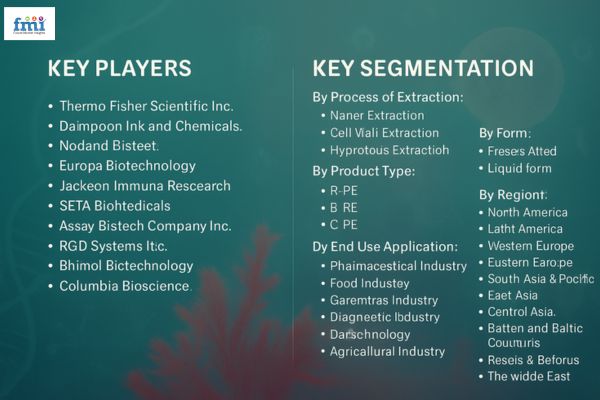
The global phycoerythrin market remains moderately fragmented, with both established and emerging players competing for market share. Key competitive strategies include investment in high-purity production techniques, regional expansion, and product innovation for tailored end-use applications.
 Explore Functional Food Ingredients Industry Analysis: https://www.futuremarketinsights.com/industry-analysis/functional-food-ingredients