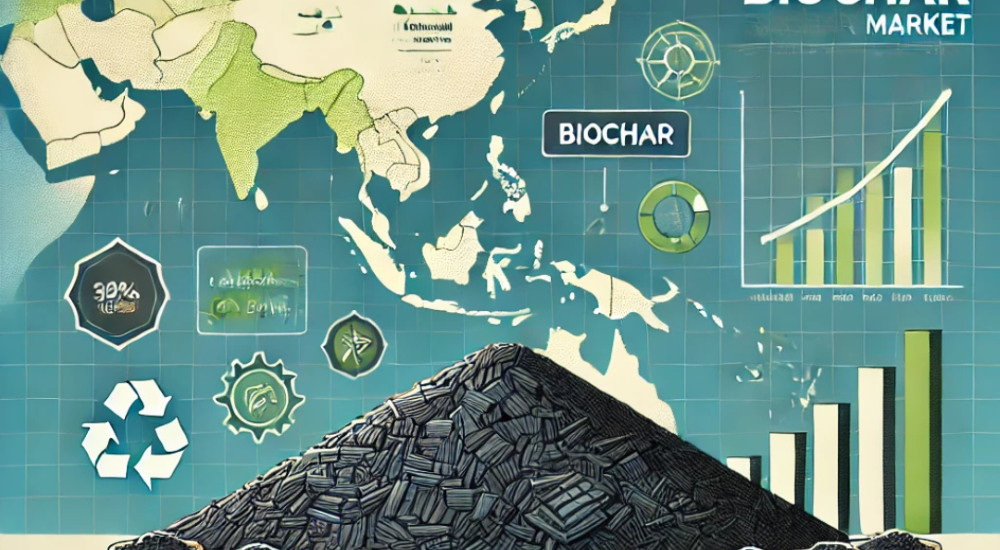
The Asia Pacific biochar market will grow rapidly over the upcoming years, achieving a value of USD 715.8 million by 2024. In the following year 2025, it will witness growth at an annual rate of 10.5% with its value rising to USD 798.2 million. At this rate and from 2025 to 2035, it will drive a strong compound annual growth of 11.5% in the region that pushes the demand up to USD 2,370.5 million by the year 2035.
Biochar, a charcoal-like material from pyrolysis of organic biomass under limited oxygen conditions, is rich in carbon and has been associated with various environmental advantages, such as improved soil health and carbon sequestration. Biochar has gained the focus of agriculture as an alternative green agricultural input to enhance soil fertility, improve water-holding capacity, reduce chemical fertilizer use, and is also finding its scope in various sectors, like water treatment, carbon capture, and livestock farming.
Sustainability and Environmental Benefits
In addition to agricultural uses, biochar plays a significant role in combating climate change. Carbon sequestration properties reduce the emission of greenhouse gases. Hence, it is considered a useful tool in global carbon mitigation. The generation of biochar is also sustainable because it can be produced using renewable biomass, and in the process, several by-products emerge such as bio-oil and syngas.
Key Drivers of the Asia Pacific Biochar Market Growth
- Soil Health and Fertility Improvement
This increases soil structure, enhances moisture retention, and improves nutrient availability, hence making biochar a vital tool in enhancing soil health. With intensive farming practices facing many Asia Pacific countries with degradation, erosion, and nutrient depletion, the increasing use of biochar is an avenue to restore fertility in soils supporting sustainable farming and crop yields. - Water Scarcity and Irrigation Efficiency
Many countries within the region suffer from water scarcity and erratic rainfalls. One of the prime advantages of using biochar lies in its ability to increase soil water retention. Biochar helps retain soil moisture, improves water use efficiency, reduces the need for irrigation, and ensures the productivity of crops during drought. This is extremely important for countries like India and China and a large part of Southeast Asia. - Climate Change Mitigation Through Carbon Sequestration
Carbon sequestration plays a vital role in which biochar can lock carbon dioxide within the soil for hundreds and even thousands of years. As such, governments and industries are constantly finding ways to reverse climate change; this is when the tool, known as biochar, helps control greenhouse gases by reducing emission in countries looking forward to becoming less carbon, and China and Japan are examples. - Government Support and Environmental Regulations
The increasing regulatory pressure to green up agricultural inputs and climate-friendly technologies leads to a high demand for biochar. In most Asia Pacific countries, governments are actively encouraging the adoption of sustainable farming practices through different strategies, where biochar has emerged as a solution for reducing chemical fertilizers and enhancing soil quality, which has led to further adoption of biochar in agriculture. - Awareness of Environmental and Health Benefits
The increasing awareness about the environmental and health benefits of biochar among farmers, industrialists, and the general public through its role in reducing greenhouse gas emissions, improvement of soil quality, and organic alternatives to chemical fertilizers is leading to increased demand. This increased awareness is boosting the uptake of biochar across the region, particularly in environmentally conscious markets like Japan and South Korea.
Regional Insights
- China: With a projected CAGR of 9.5% from 2025 to 2035, China’s biochar market is expanding rapidly, fueled by its agricultural sector’s need for sustainable soil health solutions.
- India: India’s biochar market is expected to grow at a CAGR of 8.7% from 2025 to 2035, driven by the demand for water-efficient farming solutions in water-scarce regions.
- Japan: Japan’s biochar market is projected to grow at a CAGR of 7.9% from 2025 to 2035, as the agricultural sector increasingly embraces biochar for its environmental and productivity benefits.
- South Korea: South Korea’s biochar market is set to grow at a CAGR of 8.3% from 2025 to 2035, with a focus on eco-friendly farming practices and improved soil management.
Key Players of Biochar Industry
- Pacific Biochar
- Airex Energy
- Arsta Eco
- Carbon Gold
- Products, Inc.
- Carbofex
- Supreme, LLC
- Bio Energy Earth Systems
- Farm2energy
- Biochar Products, Inc.
Get Strategic Guidance from Our Analyst Contact us on: +1-347-918-3531
Segmentation of the Asia Pacific Biochar Market
- By Technology
- Pyrolysis: Dominates the market with a share of 71.5% in 2025, offering high-carbon-content biochar that enhances soil fertility, water retention, and nutrient availability.
- Gasification: A growing method in biochar production, providing an alternative to pyrolysis with some differences in energy efficiency and product characteristics.
- Other Technologies: Includes emerging methods for biochar production with varying efficiencies and environmental impacts.
- By Application
- Agriculture: The largest and fastest-growing segment, projected to hold 75.4% of the market share in 2025. Biochar is used for soil amendment, improving fertility, water retention, and reducing chemical fertilizer dependence.
- Water Treatment: Biochar is increasingly used for its filtration properties, helping remove contaminants from water and improve water quality in industrial applications.
- Carbon Capture: Biochar’s carbon sequestration properties are leveraged in carbon capture technologies, aiding in the reduction of greenhouse gases in various industries.
- Animal Farming: Used in livestock farming for odor control and promoting health benefits for animals.
- Others: Includes niche applications in industries like construction, energy, and pharmaceuticals.
- By Market Type
- Commercial Scale: Large-scale production and use of biochar in industries and large farms where it is used for multiple applications, from agriculture to industrial use.
- Small-Scale: Local and small-scale farms adopting biochar for improving soil quality and increasing crop yields, especially in emerging markets with budget constraints.
About Future Market Insights (FMI)
Future Market Insights, Inc. (ESOMAR certified, recipient of the Stevie Award, and a member of the Greater New York Chamber of Commerce) offers profound insights into the driving factors that are boosting demand in the market. FMI stands as the leading global provider of market intelligence, advisory services, consulting, and events for the Packaging, Food and Beverage, Consumer Technology, Healthcare, Industrial, and Chemicals markets. With a vast team of over 400 analysts worldwide, FMI provides global, regional, and local expertise on diverse domains and industry trends across more than 110 countries.
Contact Us:
Future Market Insights Inc.
Christiana Corporate, 200 Continental Drive,
Suite 401, Newark, Delaware – 19713, USA
T: +1-347-918-3531
For Sales Enquiries: sales@futuremarketinsights.com
Website: https://www.futuremarketinsights.com
LinkedIn| Twitter| Blogs | YouTube