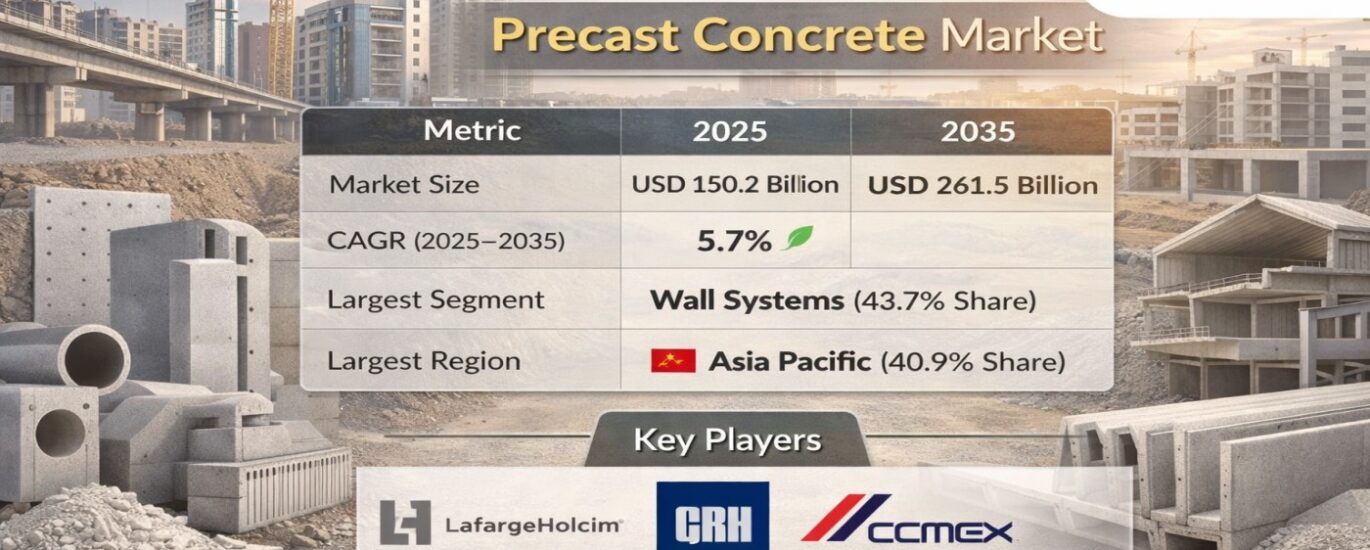
The global precast concrete market is witnessing steady expansion, driven by the growing need for efficient, durable, and sustainable construction solutions across residential, commercial, and infrastructure sectors. With the market projected to grow from USD 150.2 billion in 2025 to USD 261.5 billion by 2035 at a CAGR of 5.7%, precast concrete is rapidly transitioning from a traditional construction material into a strategic building system that supports modern construction demands.
Market Growth Drivers
- Rapid Adoption of Modular Construction
One of the most significant growth drivers is the increasing adoption of modular and off-site construction techniques. Precast concrete components such as walls, slabs, and beams are manufactured in controlled factory environments and assembled on-site, enabling:
- Faster project completion timelines
- Reduced dependency on on-site labor
- Improved quality control and precision
- Minimal weather-related delays
This approach is particularly beneficial for urban housing projects, commercial complexes, and infrastructure developments, where speed and efficiency are critical.
- Rising Demand for Affordable Housing
Governments across emerging economies are prioritizing affordable housing initiatives, creating strong demand for cost-effective and scalable construction solutions. Precast concrete enables:
- Mass production of standardized building components
- Lower construction costs through reduced material wastage
- Faster delivery of large-scale housing projects
This is especially evident in rapidly urbanizing regions where population growth is driving housing shortages.
- Infrastructure Development and Urbanization
Global infrastructure investments in transportation, utilities, and public facilities are significantly boosting demand. Precast concrete is widely used in:
- Bridges and tunnels
- Railway and metro systems
- Road barriers and retaining walls
- Utility and drainage systems
Its high durability, structural strength, and long service life make it ideal for infrastructure projects requiring minimal maintenance.
- Sustainability and Green Building Initiatives
The construction industry is under increasing pressure to reduce its environmental impact. Precast concrete supports sustainability goals through:
- Reduced material waste due to controlled manufacturing
- Lower energy consumption on construction sites
- Integration of recycled aggregates and supplementary cementitious materials
- Enhanced thermal efficiency through insulated wall systems
Get detailed market forecasts, competitive benchmarking, and pricing trends: https://www.futuremarketinsights.com/reports/sample/rep-gb-11579
Key Market Trends
- Dominance of Wall Systems
Wall systems represent the largest product segment, accounting for a significant share of the market. Their popularity stems from:
- Structural versatility and load-bearing capabilities
- Integration of insulation for energy-efficient buildings
- Faster installation compared to traditional methods
Insulated wall systems are gaining traction due to their ability to reduce energy consumption and improve indoor comfort, making them essential for modern construction.
- Growth of Residential Applications
The residential sector dominates the market, driven by:
- Increasing urban population
- Demand for multi-family housing units
- Expansion of affordable housing programs
Precast concrete is widely used in high-rise and mid-rise residential buildings, offering speed, consistency, and cost efficiency.
- Technological Advancements
Innovations in manufacturing and design are transforming the market, including:
- Automation and robotics in precast production
- Integration with Building Information Modeling (BIM)
- Development of lightweight and high-performance concrete
- Adoption of 3D printing technologies
These advancements are improving precision, scalability, and customization capabilities, making precast solutions more versatile.
- Shift Toward Low-Carbon Materials
There is a growing emphasis on low-carbon concrete formulations, including:
- Use of alternative binders
- Carbon capture technologies
- Reduced cement content
Manufacturers are investing in sustainable production methods to meet regulatory requirements and attract environmentally conscious customers.
Regional Market Insights
Asia Pacific
Asia Pacific dominates the global market due to rapid urbanization, infrastructure expansion, and government-led housing initiatives. Countries like India and China are key contributors, supported by:
- Large-scale construction projects
- Growing industrialization
- Strong demand for cost-effective building solutions
North America
North America is experiencing robust growth, particularly in the United States, driven by:
- Federal infrastructure funding
- Housing shortages
- Adoption of modular construction technologies
The region also benefits from advanced manufacturing capabilities and high adoption of automation.
Europe
Europe shows steady growth, supported by:
- Stringent sustainability regulations
- Adoption of energy-efficient building practices
- Increasing use of precast in modular construction
Countries such as Germany and the United Kingdom are focusing on low-carbon construction and modernization of infrastructure.
Market Challenges
Despite strong growth prospects, the market faces several challenges:
- High initial investment for precast manufacturing facilities
- Transportation and logistics costs, especially for large components
- Limited flexibility for complex architectural designs
- Competition from alternative construction materials like steel and engineered wood
Opportunities for Growth
The precast concrete market offers numerous opportunities, including:
- Expansion into smart city and infrastructure projects
- Development of customized and high-performance building components
- Increased adoption in industrial and commercial construction
- Integration with digital technologies for improved project management
Additionally, the rising demand for sustainable and energy-efficient buildings is expected to create long-term growth potential.
Competitive Landscape
The market is highly competitive, with leading players focusing on:
- Expanding production capacity
- Enhancing product innovation
- Strengthening distribution networks
- Offering integrated construction solutions
Companies are also investing in automation, sustainability, and advanced materials to maintain a competitive edge.
Future Outlook
The precast concrete market is set to experience sustained growth through 2035, driven by:
- Increasing adoption of modular construction
- Rising infrastructure investments
- Growing emphasis on sustainability
- Technological advancements in manufacturing
As the construction industry evolves, precast concrete will play a crucial role in delivering faster, safer, and more efficient building solutions, positioning itself as a cornerstone of modern construction practices worldwide.
About Future Market Insights (FMI)
Future Market Insights, Inc. (ESOMAR certified, recipient of the Stevie Award, and a member of the Greater New York Chamber of Commerce) offers profound insights into the driving factors that are boosting demand in the market. FMI stands as the leading global provider of market intelligence, advisory services, consulting, and events for the Packaging, Food and Beverage, Consumer Technology, Healthcare, Industrial, and Chemicals markets. With a vast team of over 400 analysts worldwide, FMI provides global, regional, and local expertise on diverse domains and industry trends across more than 110 countries.
Contact Us:
Future Market Insights Inc.
Christiana Corporate, 200 Continental Drive,
Suite 401, Newark, Delaware – 19713, USA
T: +1-347-918-3531
For Sales Enquiries: sales@futuremarketinsights.com
Website: https://www.futuremarketinsights.com
LinkedIn| Twitter| Blogs | YouTube