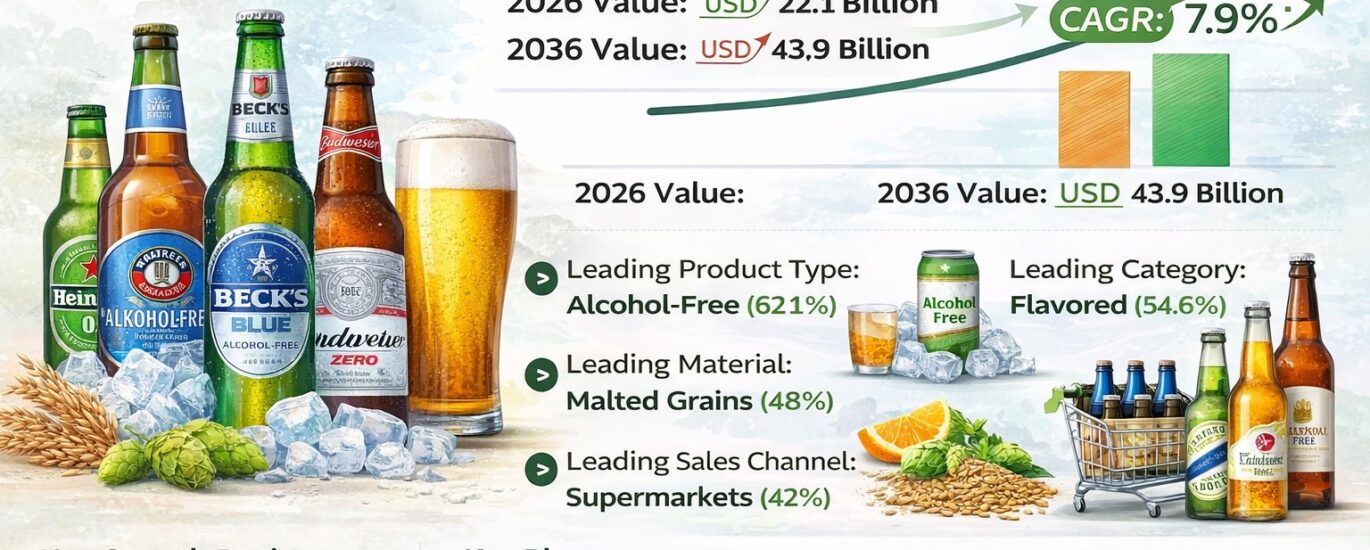
The global non-alcoholic beer market is projected to grow from USD 22.1 billion in 2026 to USD 43.9 billion by 2036, registering a CAGR of 7.9% during the forecast period.
Growth is being driven by the rising popularity of the sober curious movement, increasing health consciousness, and growing demand for premium alcohol-free beverages that replicate the taste and social experience of traditional beer.
Get detailed market forecasts, competitive benchmarking, and pricing trends: https://www.futuremarketinsights.com/reports/sample/rep-gb-14405
Market Overview
The non-alcoholic beer market is undergoing rapid transformation as consumers increasingly seek healthier lifestyles without compromising on social drinking occasions.
The category has moved beyond traditional “near-beer” products and now includes premium alcohol-free lagers, IPAs, wheat beers, flavored variants, and functional beverages infused with electrolytes, adaptogens, and nootropics.
By 2030, the market is expected to surpass USD 30.0 billion, supported by innovation in brewing methods, growing retail availability, and rising participation in trends such as Dry January and Sober October.
Key Growth Drivers
The primary growth driver is the shift toward wellness-focused lifestyles. Gen Z and Millennial consumers are increasingly reducing alcohol consumption while seeking high-quality alternatives that fit into social settings.
Manufacturers are improving product quality through technologies such as vacuum distillation and reverse osmosis, which allow alcohol removal while preserving the flavor and aroma compounds that define beer.
Speak to Analyst : Customize insights for your business strategy – https://www.futuremarketinsights.com/customization-available/rep-gb-14405
Supply Chain and Pricing Trends
The non-alcoholic beer supply chain includes grain suppliers, breweries, dealcoholization technology providers, distributors, retailers, and hospitality channels.
- Malted grains remain the dominant raw material, accounting for 48.0% of the market.
- Manufacturers increasingly invest in local dealcoholization hubs to improve supply chain resilience and reduce transportation costs.
- Breweries are focusing on predictive maintenance and equipment efficiency to maintain profitability in capital-intensive production processes.
Segment Analysis
By product type, alcohol-free beer dominates with a 62.1% share in 2026 due to strong demand from consumers seeking 0.0% ABV products.
By category, flavored non-alcoholic beer accounts for 54.6% of total demand, supported by rising popularity among younger consumers who prefer fruit-infused, citrus, berry, and sweeter taste profiles.
Manufacturers are increasingly introducing functional ingredients, specialty yeast strains, and sustainable packaging to strengthen brand differentiation and consumer appeal.
Regional Outlook
North America remains a high-growth market due to strong demand for craft alcohol-free beers, premium wellness beverages, and year-round sober-curious trends. The United States is expected to grow at a CAGR of 7.1%.
Europe continues to dominate due to high consumer awareness, strong brewing traditions, and growing preference for alcohol-free alternatives. Germany is projected to grow at 6.8%, followed by the UK at 6.5% and France at 6.3%.
Unlock 360° insights for strategic decision making and investment planning – https://www.futuremarketinsights.com/checkout/14405
Competitive Landscape
The non-alcoholic beer market is highly competitive, with global brewers and specialist alcohol-free brands focusing on flavor innovation, premium positioning, and advanced brewing technology.
Key players include: Anheuser-Busch InBev, Heineken N.V., Carlsberg A/S, Suntory Beer, Big Drop Brewing Co., Athletic Brewing, and Erdinger Weibbrau.
Future Outlook
The non-alcoholic beer market is expected to remain one of the fastest-growing categories in the global beverage industry. Future growth opportunities are likely to focus on premium alcohol-free beers, functional brewing, sustainable packaging, digital marketing, and new flavor development.
Despite challenges such as regulatory labeling differences, production complexity, and pricing pressure, the market outlook remains highly positive as consumers increasingly prioritize wellness, moderation, and premium beverage experiences.
About FMI
Future Market Insights (FMI) is a globally recognized provider of market intelligence, delivering actionable insights across industries including food and beverage, healthcare, chemicals, and advanced manufacturing. Through a combination of primary research, proprietary data models, and in-depth analysis, FMI empowers business leaders, investors, and policymakers to make informed strategic decisions in an increasingly complex global marketplace.
Contact Us
Future Market Insights Inc.
Christiana Corporate, 200 Continental Drive,
Suite 401, Newark, Delaware – 19713, USA
T: +1-347-918-3531
For Sales Enquiries: sales@futuremarketinsights.com
Website: https://www.futuremarketinsights.com
LinkedIn | Twitter | Blogs | YouTube