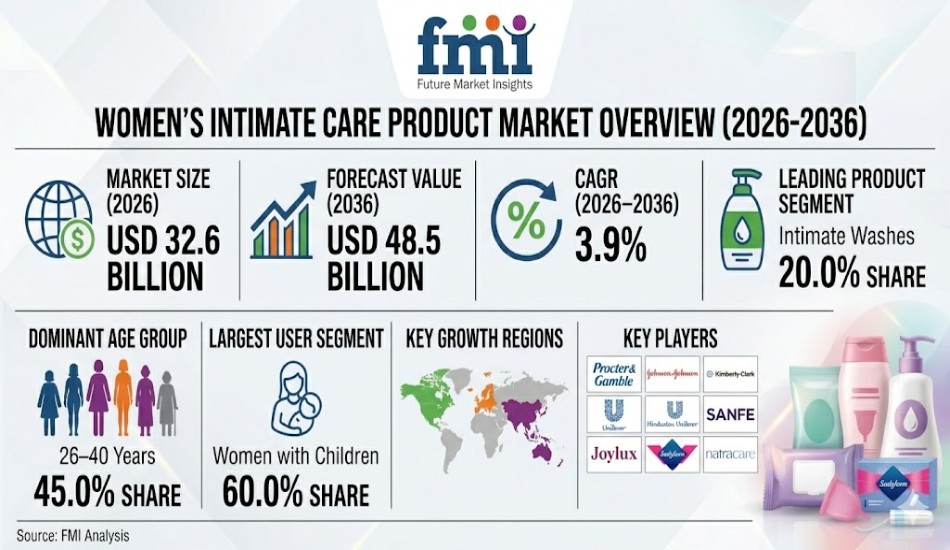
The global women’s intimate care product market is entering a sustained growth phase, driven by increasing awareness of personal hygiene, wellness-focused lifestyles, and the growing adoption of natural and organic formulations. According to industry analysis, the market is valued at USD 32.6 billion in 2026 and is projected to reach USD 48.5 billion by 2036, expanding at a CAGR of 3.9% over the forecast period.
This growth reflects a gradual but consistent transformation in consumer behavior, where intimate hygiene is becoming an essential component of daily self-care routines rather than a niche or occasional need.
Market Snapshot: Women’s Intimate Care Product Market
Key Market Metrics
- Market Size (2026): USD 32.6 Billion
- Forecast Value (2036): USD 48.5 Billion
- CAGR (2026–2036): 3.9%
- Leading Product Segment: Intimate Washes (20.0% share)
- Dominant Age Group: 26–40 Years (45.0% share)
- Largest User Segment: Women with Children (60.0% share)
- Key Growth Regions: North America, Europe, Asia Pacific
- Key Players: Procter & Gamble, Johnson & Johnson, Unilever, Kimberly-Clark, Hindustan Unilever, SANFE, Joylux, Bodyform, Natracare
Discover Growth Opportunities in the Market – Get Your Sample Report Now: https://www.futuremarketinsights.com/reports/sample/rep-gb-11016
Growth Dynamics and Demand Drivers
The market is witnessing steady momentum as awareness around intimate hygiene continues to grow globally. Educational campaigns, social media influence, and increased openness around women’s health topics are encouraging consumers to adopt dedicated intimate care products.
Rising disposable incomes, particularly in emerging economies, are enabling women to invest more in personal care and wellness products. At the same time, the growing preference for natural, organic, and chemical-free formulations is reshaping product development strategies across the industry.
Additionally, lifestyle changes, including increased workforce participation among women and urbanization, are contributing to higher demand for convenient and effective hygiene solutions such as wipes, washes, and menstrual care products.
Segment Insights
By Product Type
- Intimate washes dominate with a 20.0% market share, driven by daily hygiene needs and pH-balanced formulations
- Wipes and gels are gaining traction due to convenience and portability
- Menstrual care products, including reusable solutions, are expanding rapidly
By Age Group
- The 26–40 years segment leads with 45.0% share, driven by health awareness and higher purchasing power
- Younger consumers (20–25 years) are increasingly adopting preventive hygiene practices
- Demand among older age groups is supported by health and comfort needs
By User Demographics
- Women with children dominate with a 60.0% share, driven by postnatal care and hygiene awareness
- Growing adoption among women without children due to lifestyle and wellness trends
By Sales Channel
- Offline channels (supermarkets, pharmacies) remain dominant
- Online platforms are expanding rapidly due to accessibility and product education
- Direct-to-consumer brands are gaining traction among younger consumers
Supply Chain and Industry Structure
The supply chain is evolving toward safety, transparency, and regulatory compliance. Manufacturers are increasingly sourcing natural ingredients such as plant-based extracts and organic cotton while focusing on dermatologically tested and hypoallergenic formulations.
Leading companies are investing in R&D to develop products that minimize irritation, maintain pH balance, and enhance comfort. At the same time, sustainable packaging and biodegradable materials are becoming key differentiators.
Distribution networks are highly diversified, spanning retail stores, pharmacies, e-commerce platforms, and subscription-based models, ensuring broad product accessibility.
Pricing and Value Trends
The market is transitioning toward a value-driven pricing model, where consumers prioritize product safety, ingredient quality, and long-term health benefits over low cost.
Premium products emphasize:
- Organic and chemical-free formulations
- Dermatological safety
- Sustainable packaging
Meanwhile, mass-market brands focus on affordability and accessibility, ensuring penetration across price-sensitive regions.
Competitive Landscape
The competitive landscape is characterized by the presence of established global players alongside emerging niche brands.
Major companies such as Procter & Gamble, Johnson & Johnson, and Unilever dominate through strong product portfolios and global distribution networks. These players focus on innovation, safety, and expanding their digital presence.
At the same time, emerging brands are gaining market share by offering:
- Eco-friendly and organic products
- Biodegradable packaging
- Direct-to-consumer engagement
Strategic initiatives such as partnerships, acquisitions, and product diversification are intensifying competition across both premium and mass segments.
Regional Analysis
North America & Europe (Mature Markets)
- High consumer awareness and product accessibility
- Strong demand for organic and eco-friendly solutions
- Regulatory frameworks promoting product safety
Asia Pacific (High Growth Region)
- Rapid growth driven by rising disposable incomes and urbanization
- Increasing awareness of women’s health and hygiene
- Strong demand in countries like India and China
Other Emerging Markets
- Mexico and parts of Latin America witnessing steady growth
- Government-led awareness campaigns supporting adoption
- Cultural shifts gradually reducing stigma around intimate hygiene
Future Outlook and Opportunities
The women’s intimate care product market is expected to witness consistent expansion through 2036, supported by innovation and evolving consumer preferences.
Key Opportunities Include:
- Expansion of organic and chemical-free product lines
- Growth in reusable and sustainable menstrual care solutions
- Increased penetration in emerging markets
- Digital engagement and personalized product offerings
- Integration of dermatological and wellness-focused innovations
Conclusion
The women’s intimate care product market is undergoing a gradual but meaningful transformation, driven by rising awareness, evolving lifestyles, and the shift toward natural and safe hygiene solutions.
As societal norms continue to evolve and conversations around women’s health become more open, the market is poised for steady growth. With increasing emphasis on comfort, safety, and sustainability, intimate care products are becoming an essential pillar of modern personal care routines worldwide.
Why FMI: https://www.futuremarketinsights.com/why-fmi
About Future Market Insights (FMI)
Future Market Insights, Inc. (FMI) is an ESOMAR-certified, ISO 9001:2015 market research and consulting organization, trusted by Fortune 500 clients and global enterprises. With operations in the U.S., UK, India, and Dubai, FMI provides data-backed insights and strategic intelligence across 30+ industries and 1200 markets worldwide.
Contact Us:
Future Market Insights Inc.
Christiana Corporate, 200 Continental Drive,
Suite 401, Newark, Delaware – 19713, USA
T: +1-347-918-3531
For Sales Enquiries: sales@futuremarketinsights.com
Website: https://www.futuremarketinsights.com
LinkedIn| Twitter| Blogs | YouTube