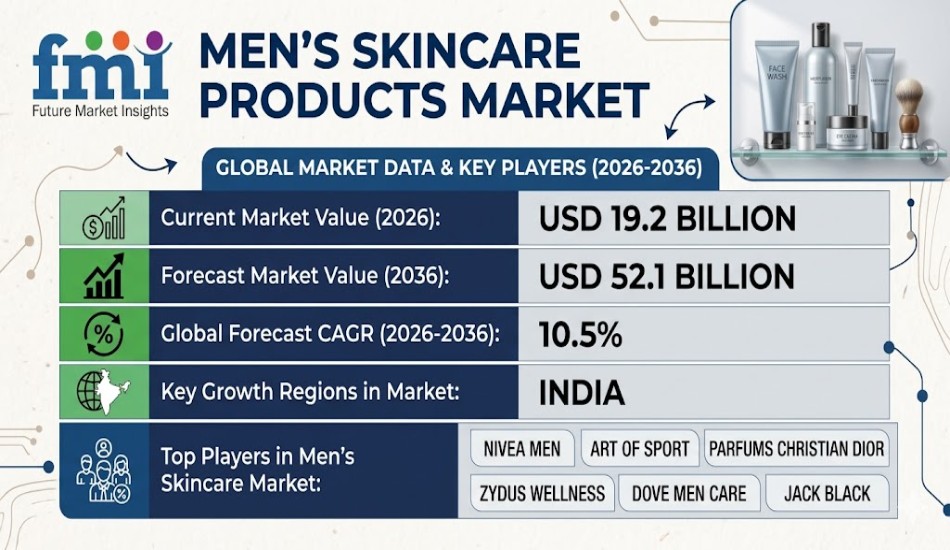
The global men’s skincare products market is entering a sustained growth phase, driven by shifting grooming behaviors, increasing awareness of skin health, and expanding product accessibility. According to industry analysis, the market is valued at USD 19.2 billion in 2026 and is projected to reach USD 52.1 billion by 2036, expanding at a CAGR of 10.5% over the forecast period.
This steady growth reflects a structural shift in consumer behavior, where skincare is becoming an integral part of men’s daily routines rather than a niche or occasional practice.
Market Snapshot: Men’s Skincare Products Market
Key Market Metrics
- Market Size (2026): USD 19.2 Billion
- Forecast Value (2036): USD 52.1 Billion
- CAGR (2026–2036): 10.5%
- Leading Product Segment: Moisturizers & Creams (36% share)
- Dominant Skin Type: Oily Skin (34% share)
- Key Growth Region: Asia Pacific (led by India & China)
- Key Players: Nivea Men, Art of Sport, Parfums Christian Dior, Zydus Wellness, Dove Men Care, Jack Black, Every Man Jack, Harry’s, L’Oréal Men Expert, Beiersdorf AG
Discover Growth Opportunities in the Market – Get Your Sample Report Now: https://www.futuremarketinsights.com/reports/sample/rep-gb-8283
Growth Dynamics and Demand Drivers
The market is witnessing strong momentum as men increasingly adopt structured skincare routines focused on hydration, protection, and targeted treatment. What was once limited to basic grooming has evolved into a multi-step skincare approach influenced by digital media, celebrity endorsements, and social acceptance.
Rising awareness of issues such as acne, sun damage, aging, and sensitivity is encouraging men to explore specialized products. The influence of social media and grooming influencers is playing a critical role in normalizing skincare routines among younger consumers.
Additionally, the expansion of e-commerce and direct-to-consumer platforms has significantly improved product accessibility and education, enabling brands to reach new demographics more effectively.
Segment Insights
By Product Type
- Moisturizers & creams dominate with a 36% market share, driven by daily usability and multifunctional benefits
- Face washes, sunscreens, and serums are gaining traction due to increased routine complexity
- Anti-aging and beard care products are expanding in premium segments
By Skin Type
- Oily skin leads with 34% share, reflecting high demand for oil-control and acne-prevention solutions
- Increasing demand for products tailored to sensitive and combination skin
- Growth in targeted formulations addressing specific male skin concerns
By Distribution Channel
- Supermarkets and hypermarkets remain dominant due to widespread availability
- Online retail is rapidly expanding, driven by convenience and product awareness
- Specialty stores and pharmacies support premium and dermatological product growth
Supply Chain and Industry Structure
The men’s skincare products market features a diversified supply chain involving raw material suppliers, manufacturers, and multi-channel distributors. Companies are leveraging global manufacturing networks while optimizing costs through regional production hubs, particularly in Southeast Asia.
Large players such as Beiersdorf AG and L’Oréal are investing heavily in R&D to develop high-performance formulations tailored to male skin characteristics. At the same time, emerging brands are focusing on natural ingredients and sustainable sourcing.
E-commerce and direct-to-consumer strategies are reshaping distribution, allowing brands to engage directly with consumers and personalize offerings.
Pricing and Value Trends
Pricing strategies are evolving across both premium and mass segments. Premium brands emphasize advanced formulations, dermatological validation, and brand positioning, while mass-market players focus on affordability and ease of use.
Value perception is increasingly linked to product effectiveness, ingredient transparency, and long-term skin benefits rather than price alone. Entry-level products are gaining traction in emerging markets, while premiumization continues in developed regions.
Competitive Landscape
The competitive landscape is marked by strong participation from global leaders and niche brands. Companies such as Nivea Men, L’Oréal Men Expert, and Dove Men Care dominate through extensive distribution networks and brand recognition.
At the same time, brands like Every Man Jack and Jack Black are differentiating through natural formulations and targeted marketing strategies. Premium players such as Parfums Christian Dior continue to cater to luxury segments with high-end skincare solutions.
Innovation, product differentiation, and targeted marketing are key strategies shaping competition in this evolving market.
Regional Analysis
Asia Pacific (Emerging Growth Hub)
- India (13.9% CAGR): Driven by rising middle class and grooming awareness
- China (11.9% CAGR): Growth fueled by digital commerce and evolving consumer habits
North America
- Mature market with strong demand for premium and performance-driven products
- Growth supported by high awareness and influencer-driven trends
Europe
- Stable growth driven by product innovation and regulatory compliance
- High demand for dermatologically tested and sustainable formulations
Other Markets
- South Korea and Japan show steady growth with advanced skincare adoption
- Australia reflects rising awareness and demand for sun protection products
Future Outlook and Opportunities
The men’s skincare products market is expected to continue expanding as grooming norms evolve and skincare becomes mainstream among male consumers.
Key opportunities include:
- Development of targeted solutions for male-specific skin concerns
- Expansion of natural, herbal, and clean-label formulations
- Growth in emerging markets with increasing disposable incomes
- Integration of digital tools for personalized skincare recommendations
- Innovation in multifunctional and simplified skincare routines
Conclusion
The rise of men’s skincare products reflects a broader cultural and behavioral shift toward self-care, wellness, and appearance consciousness among male consumers. As awareness grows and product offerings expand, skincare is becoming a fundamental component of men’s daily routines.
With strong growth projected through 2036, the market is set to become a significant pillar of the global personal care industry, driven by innovation, accessibility, and evolving consumer expectations.
Why FMI: https://www.futuremarketinsights.com/why-fmi
About Future Market Insights (FMI)
Future Market Insights, Inc. (FMI) is an ESOMAR-certified, ISO 9001:2015 market research and consulting organization, trusted by Fortune 500 clients and global enterprises. With operations in the U.S., UK, India, and Dubai, FMI provides data-backed insights and strategic intelligence across 30+ industries and 1200 markets worldwide.
Contact Us:
Future Market Insights Inc.
Christiana Corporate, 200 Continental Drive,
Suite 401, Newark, Delaware – 19713, USA
T: +1-347-918-3531
For Sales Enquiries: sales@futuremarketinsights.com
Website: https://www.futuremarketinsights.com
LinkedIn| Twitter| Blogs | YouTube