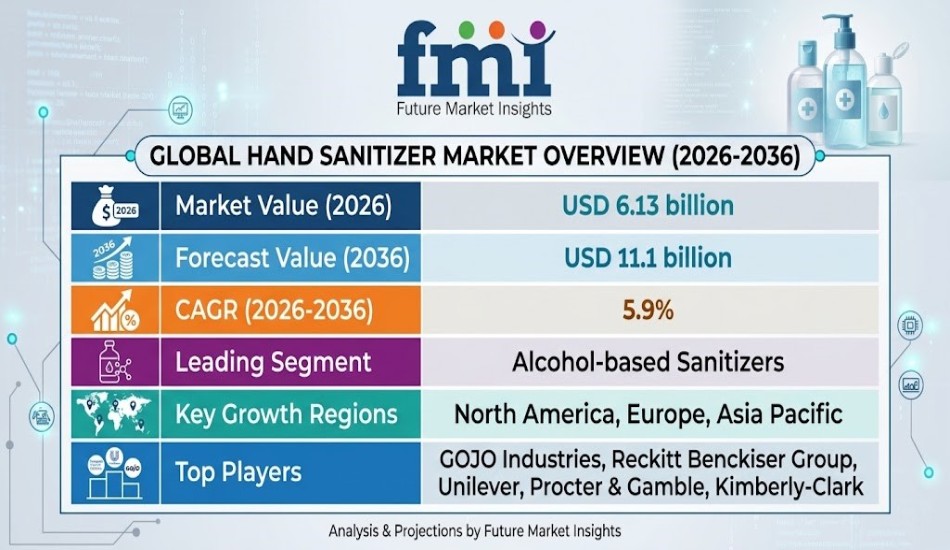
The global hand sanitizer market is entering a steady growth phase, supported by sustained hygiene awareness, institutional demand, and the normalization of portable sanitation solutions across daily routines. According to industry analysis, the market is valued at USD 6.13 billion in 2026 and is projected to reach USD 11.1 billion by 2036, expanding at a CAGR of 5.9% over the forecast period.
This growth reflects a long-term behavioral shift where hand hygiene has become a permanent component of personal care, workplace safety, and public health infrastructure, extending well beyond pandemic-driven demand.
Market Snapshot: Hand Sanitizer Market
Key Market Metrics
- Market Size (2026): USD 6.13 Billion
- Forecast Value (2036): USD 11.1 Billion
- CAGR (2026–2036): 5.9%
- Leading Product Segment: Alcohol-Based Sanitizers
- Leading Format: Gel-Based Sanitizers (~43% share)
- Dominant Packaging Type: Bottles (53% share)
- Largest Sales Channel: Retail Stores (47% share)
- Fastest-Growing Region: Asia Pacific (led by China & India)
- Key Players: GOJO Industries, Reckitt Benckiser, Unilever, Procter & Gamble, Kimberly-Clark
Discover Growth Opportunities in the Market – Get Your Sample Report Now: https://www.futuremarketinsights.com/reports/sample/rep-gb-707
Growth Dynamics and Demand Drivers
The hand sanitizer market continues to expand as hygiene practices remain deeply embedded in consumer behavior across both personal and institutional environments. What began as a pandemic necessity has evolved into a daily-use essential across healthcare, retail, education, transportation, and corporate sectors.
Rising awareness around infection prevention, coupled with government-backed hygiene campaigns, is driving consistent demand. The portability and convenience of hand sanitizers make them a preferred solution for on-the-go sanitation, particularly in urban environments with high population density.
Institutional adoption remains a major growth pillar, with hospitals, schools, offices, and public facilities maintaining strict hygiene protocols. Additionally, increasing global travel and shared public spaces are reinforcing the need for accessible sanitization solutions.
Manufacturers are also innovating with moisturizing ingredients, skin-friendly formulations, and eco-conscious packaging to address concerns related to frequent usage and environmental impact.
Segment Insights
By Product Type
- Gel-based sanitizers lead with ~43% share due to ease of use, controlled application, and quick-drying properties
- Liquid and foam variants cater to institutional and bulk-use applications
- Spray and wipe formats are gaining traction for surface-level and multi-purpose sanitization
By Active Ingredient
- Alcohol-based sanitizers dominate due to proven germ-killing efficiency
- Non-alcoholic variants are expanding, targeting sensitive skin and frequent-use consumers
- Increasing demand for dermatologically tested and skin-safe formulations
By Packaging Type
- Bottled packaging dominates with 53% share due to convenience and durability
- Growth in pump bottles and touchless dispensers for institutional use
- Rising demand for eco-friendly and refillable packaging solutions
By Sales Channel
- Retail stores lead with 47% share due to accessibility and impulse purchases
- E-commerce platforms are rapidly expanding through convenience and bulk buying options
- Direct B2B and institutional sales are growing steadily
Supply Chain and Industry Structure
The hand sanitizer supply chain is evolving toward scalable, compliant, and innovation-driven production. Key raw materials such as alcohol, glycerin, and packaging components are sourced globally, with manufacturers focusing on quality consistency and regulatory compliance.
Major companies like Unilever, Procter & Gamble, and Reckitt Benckiser leverage large-scale production capabilities and strong distribution networks to maintain market leadership. Meanwhile, regional manufacturers and private-label brands are expanding their footprint through cost-effective solutions and localized production.
Distribution channels are highly diversified, spanning retail outlets, pharmacies, e-commerce platforms, and institutional procurement systems. The integration of automated dispensing systems is further enhancing supply chain efficiency in commercial environments.
Pricing and Value Trends
Pricing in the hand sanitizer market is stabilizing following pandemic-induced volatility. The market is shifting toward a value-driven model, where affordability, product effectiveness, and skin compatibility are key decision factors.
Mass-market brands emphasize cost efficiency and accessibility, while premium players focus on added benefits such as moisturizing properties, fragrance customization, and eco-friendly packaging.
Bulk purchasing by institutions and businesses is also influencing pricing strategies, encouraging manufacturers to offer scalable and refill-based solutions.
Competitive Landscape
The competitive landscape is moderately consolidated, with global leaders maintaining strong positions through brand recognition, innovation, and distribution reach.
- GOJO Industries (Purell) leads in institutional markets with hospital-grade solutions
- Reckitt Benckiser (Dettol, Lysol) dominates through trusted hygiene brands
- Unilever (Lifebuoy) and Procter & Gamble (Safeguard) focus on mass-market accessibility
- Emerging players differentiate through natural ingredients, Ayurvedic formulations, and eco-friendly packaging
Companies are increasingly investing in touchless technologies, sustainable materials, and skin-friendly innovations to stay competitive.
Regional Analysis
Asia Pacific (High Growth Hub)
- China (7.5% CAGR): Driven by government hygiene mandates and urbanization
- India (7.2% CAGR): Growth supported by public health initiatives and affordability
North America
- United States (6.8% CAGR): Mature market driven by institutional demand and high hygiene awareness
Europe
- Germany (6.7% CAGR): Strong focus on dermatological safety and regulatory compliance
- France (6.6% CAGR): Demand for premium, skin-nourishing formulations
- United Kingdom (6.5% CAGR): Growth driven by eco-friendly and refillable solutions
Future Outlook and Opportunities
The hand sanitizer market is expected to maintain steady growth as hygiene remains a non-negotiable aspect of modern living. The industry is transitioning from emergency-driven demand to routine-based consumption.
Key Opportunities Include:
- Development of alcohol-free and skin-sensitive formulations
- Expansion of eco-friendly and refillable packaging solutions
- Growth in touchless and automated dispensing systems
- Increasing penetration in emerging markets with public health initiatives
- Integration of skincare benefits into sanitizing products
Manufacturers that can balance effectiveness, skin safety, sustainability, and affordability will be best positioned for long-term success.
Conclusion
The evolution of the hand sanitizer market reflects a permanent shift toward hygiene-first lifestyles across the globe. While growth has moderated post-pandemic, the category remains essential, supported by institutional demand and everyday consumer use.
With consistent innovation and expanding applications, hand sanitizers are set to remain a core pillar of global hygiene practices, ensuring steady growth and market relevance through 2036.
Why FMI: https://www.futuremarketinsights.com/why-fmi
About Future Market Insights (FMI)
Future Market Insights, Inc. (FMI) is an ESOMAR-certified, ISO 9001:2015 market research and consulting organization, trusted by Fortune 500 clients and global enterprises. With operations in the U.S., UK, India, and Dubai, FMI provides data-backed insights and strategic intelligence across 30+ industries and 1200 markets worldwide.
Contact Us:
Future Market Insights Inc.
Christiana Corporate, 200 Continental Drive,
Suite 401, Newark, Delaware – 19713, USA
T: +1-347-918-3531
For Sales Enquiries: sales@futuremarketinsights.com
Website: https://www.futuremarketinsights.com
LinkedIn| Twitter| Blogs | YouTube