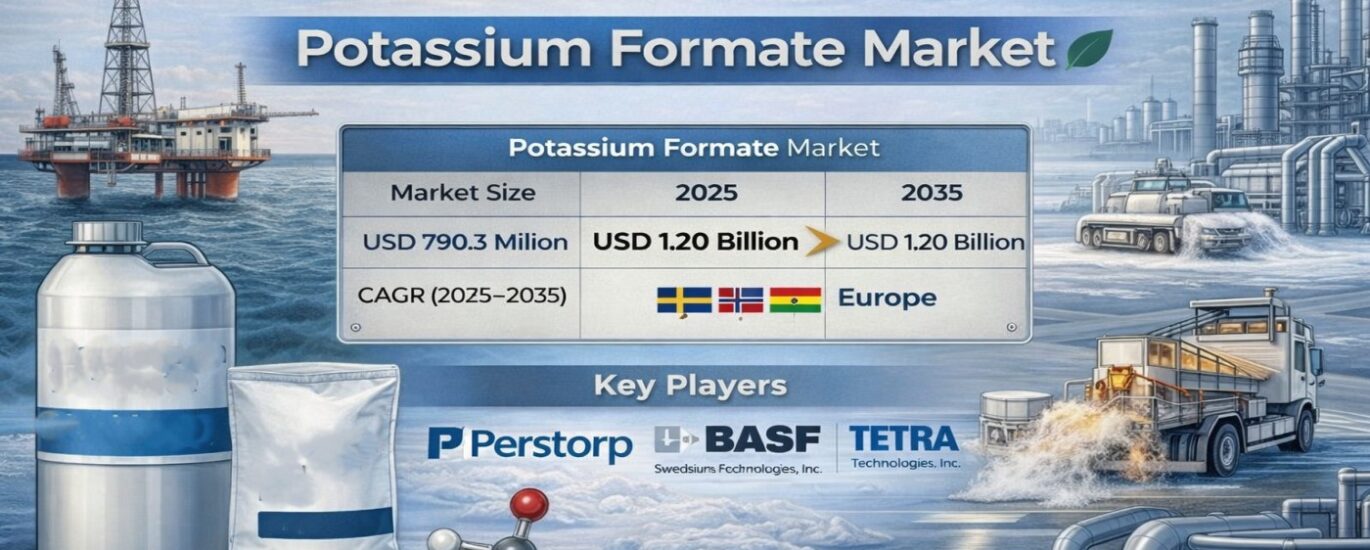
The global Potassium Formate market is projected to grow from USD 790.3 million in 2025 to USD 1,204 million by 2035, registering a CAGR of 4.3% over the forecast period. Growth is being driven by increasing adoption across oilfield drilling fluids, environmentally friendly de-icing solutions, and industrial heat transfer applications.
The market is transitioning from a niche specialty chemical segment to a strategic industrial solution, supported by rising demand for high-density clear brines, biodegradable de-icers, and non-corrosive thermal fluids.
Key Market Drivers
- Expansion of Offshore Drilling and HPHT Wells
- Rising deepwater and HPHT drilling activities
- Strong demand for clear brine completion fluids
- Increased focus on wellbore stability and formation protection
- Shift Toward Sustainable De-icing Solutions
- Growing adoption of biodegradable alternatives to chloride-based de-icers
- Increasing regulatory pressure on environmental safety and infrastructure protection
- Rising demand from airports and municipal winter maintenance programs
- Growth in Industrial Thermal Management
- Expanding use in district heating systems and HVAC applications
- Demand for low-corrosion, high-efficiency heat transfer fluids
- Increased need for freeze protection in industrial processes
Market Segmentation Analysis
By Form
- Liquid Form – dominant (~63% share)
- Solid Form
Liquid potassium formate leads due to ease of handling, faster deployment, and compatibility with industrial systems.
By Application
- Drilling Fluids – 47.0% (leading segment)
- De-icing – 33.0%
- Heat Transfer Fluids – 14.0%
- Others
By End Use
- Oil & Gas – 49.0% share (dominant)
- Airports & Municipal Services
- Industrial HVAC/Refrigeration
- Chemicals & Process Industries
Get detailed market forecasts, competitive benchmarking, and pricing trends: https://www.futuremarketinsights.com/reports/sample/rep-gb-9834
Supply Chain Analysis (Who Supplies Whom)
The potassium formate market operates through a highly integrated specialty chemical value chain:
Upstream
- Formic acid producers and potassium derivatives suppliers
Midstream Manufacturers
- Key companies such as Perstorp Holding AB, BASF SE, and TETRA Technologies, Inc.
Distribution & Service Providers
- Oilfield service companies
- Chemical distributors and blending facilities
End Users
- Oil & gas operators
- Airports and municipal authorities
- Industrial HVAC and process industries
Pricing Trends and Cost Dynamics
- Pricing is influenced by formic acid feedstock costs
- Premium pricing for high-density drilling fluid formulations
- Increasing demand for eco-friendly products supporting margin expansion
However, competition from lower-cost chloride and acetate alternatives continues to impact pricing dynamics.
Regional Analysis
Dominant Region: Europe
- Strong presence of North Sea offshore drilling operations
- Advanced airport de-icing infrastructure
- High adoption of environmentally compliant chemicals
Key Growth Regions
- North America – shale drilling and winter maintenance demand
- Middle East – offshore and sour gas drilling expansion
Top Growth Countries
- United Kingdom (4.8% CAGR)
- Norway (4.7% CAGR)
- Canada (4.5% CAGR)
- United States (4.4% CAGR)
Competitive Landscape
The market is moderately consolidated, with top players holding 46–52% market share.
Leading Players
- Perstorp Holding AB (~15% share leader)
- BASF SE
- TETRA Technologies, Inc.
Key Innovators and Competitors
- ADDCON GmbH
- Clariant AG
- Hawkins, Inc.
Regional Specialists
- Eastman Chemical Company
- Dynalene, Inc.
- Boryszew S.A.
Key Trends Shaping the Market
- Rapid adoption of formate-based clear brines in offshore drilling
- Increasing demand for biodegradable and low-corrosion de-icing chemicals
- Growth in liquid formulations for operational efficiency
- Rising focus on bio-based feedstocks and sustainability certifications
Market Restraints and Risks
- Volatility in raw material (formic acid) pricing
- Competition from alternative de-icing and drilling chemistries
- Performance limitations in extreme temperature conditions
- Dependence on oil & gas industry cycles
Investment Opportunities
- Expansion of liquid potassium formate production capacity
- Development of bio-based and low-carbon formulations
- Growth in offshore drilling and HPHT applications
- Increasing adoption in smart winter maintenance systems
Future Outlook
The potassium formate market is expected to witness steady, application-driven growth, supported by:
- Expansion in offshore oil and gas activities
- Rising environmental regulations in de-icing applications
- Increasing demand for advanced thermal management solutions
Future growth will be shaped by:
- Sustainability innovation and bio-based production
- Integration with advanced drilling technologies
- Expansion into new industrial applications
As industries move toward performance efficiency and environmental responsibility, potassium formate will continue to emerge as a critical multi-functional chemical across energy, infrastructure, and industrial sectors.