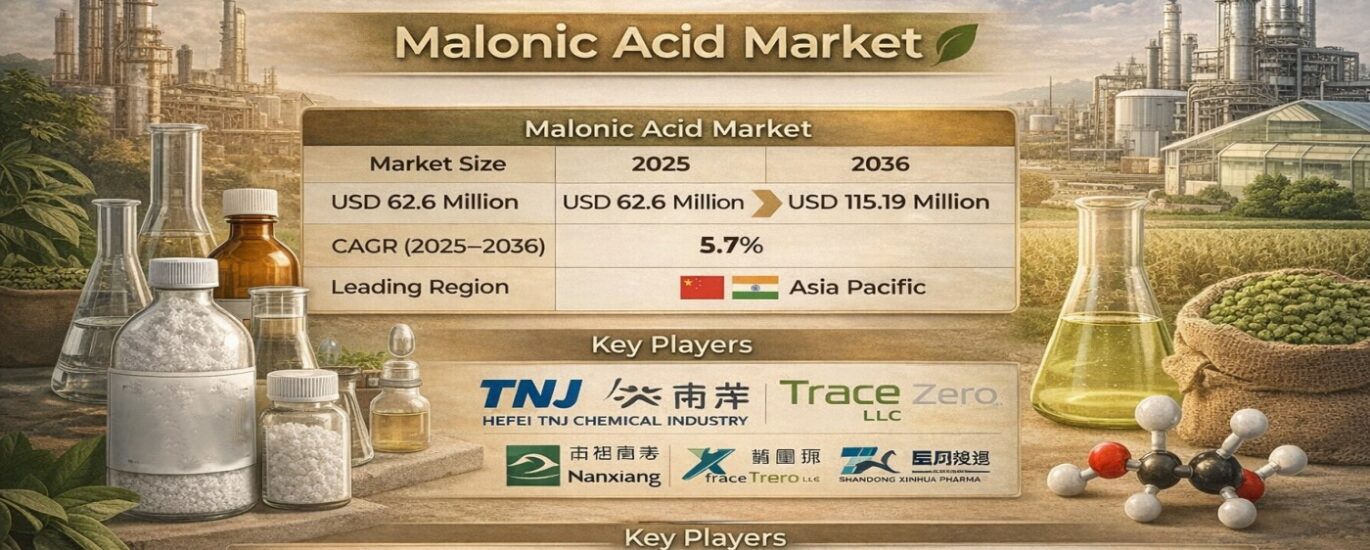
The global Malonic Acid market is projected to grow from USD 62.60 million in 2025 to USD 115.19 million by 2036, registering a steady CAGR of 5.7% during the forecast period. Growth is primarily driven by rising demand for pharmaceutical intermediates, expansion of specialty chemicals, and increasing adoption of bio-based chemical production routes.
The market remains a specialty fine chemicals segment, where purity certification, regulatory compliance, and sustainable production economics play a critical role in shaping competitive positioning.
Key Market Drivers
- Rising Pharmaceutical Intermediate Demand
Malonic acid is a key C3 building block widely used in:
- API synthesis
- Barbiturates and cardiovascular drug precursors
- Specialty pharmaceutical intermediates
The rapid expansion of contract manufacturing organizations (CMOs), especially in Asia, is significantly boosting demand.
- Growth in Bio-Based and Green Chemistry Solutions
- Increasing adoption of bio-based malonic acid
- Strong demand from Europe’s sustainability-driven chemical sector
- Growing need for low-carbon and renewable feedstocks
- Stable Demand from Polymer and Resin Applications
Technical-grade malonic acid ensures:
- Consistent demand from polymer and specialty resin production
- Cost-effective usage in industrial synthesis applications
Get detailed market forecasts, competitive benchmarking, and pricing trends: https://www.futuremarketinsights.com/reports/sample/rep-gb-655
Market Segmentation Analysis
By Grade
- Technical Grade – 48.2% share (dominant)
- Pharmaceutical Grade
- Food Grade
Technical grade leads due to cost efficiency and wide industrial applicability.
By Application
- Pharmaceutical Intermediates – 29.8% share (leading)
- Polymers & Specialty Resins
- Agrochemicals
- Food Additives
By Material Route
- Synthetic – 86.0% share (dominant)
- Bio-based – emerging high-growth segment
Supply Chain Analysis (Who Supplies Whom)
The malonic acid market follows a multi-tier chemical supply chain:
Upstream
- Petrochemical feedstock suppliers (acetyl cyanide routes)
- Renewable feedstock providers for bio-based production
Midstream Manufacturers
- Key producers such as Hefei TNJ Chemical Industry, Trace Zero LLC, and Shandong Xinhua Pharma
Distribution Layer
- Specialty chemical distributors and reagent suppliers
End Users
- Pharmaceutical manufacturers
- Polymer and resin producers
- Agrochemical companies
Pricing Trends and Cost Dynamics
- Prices are influenced by petrochemical feedstock volatility
- Pharmaceutical-grade products command premium pricing
- Bio-based variants achieve higher margins due to sustainability value
However, the relatively small market size limits large-scale price fluctuations, keeping the market stable.
Regional Analysis
Dominant Region: Asia Pacific
- Driven by China and India manufacturing expansion
- Strong growth in API production and chemical exports
Key Growth Markets
- China (6.3% CAGR) – pharmaceutical and export hub
- India (6.0% CAGR) – API integration and generics growth
- South Korea (5.5%) – specialty chemicals and materials innovation
Mature Markets
- United States, Germany, UK, Japan
- Focus on high-purity applications and green chemistry
Competitive Landscape
The market is fragmented, with innovation and certification acting as key differentiators.
Leading Players
- Hefei TNJ Chemical Industry (≈12% market share leader)
- Trace Zero LLC
- Shanghai Nanxiang Reagent Co., Ltd.
- TATEYAMA KASEI Co., Ltd.
- Columbus Chemical Industries, Inc.
Other Key Participants
- HeBei ChengXin
- Shandong Xinhua Pharma
- Merck KGaA
- Thermo Fisher Scientific
Key Trends Shaping the Market
- Shift toward pharmaceutical-grade certification (USP, EP, BP)
- Rapid growth in bio-based production technologies
- Expansion of specialty polymer and biodegradable material applications
- Increasing importance of quality documentation and compliance speed
Market Restraints and Risks
- Competition from alternative chemical intermediates
- Feedstock price volatility
- High qualification time for pharmaceutical-grade suppliers
- Limited scalability due to niche market size
Investment Opportunities
- Bio-based malonic acid production technologies
- Expansion of pharmaceutical-grade manufacturing capacity
- Growth in Asia Pacific chemical manufacturing hubs
- Development of specialty applications in polymers and coatings
Future Outlook
The global malonic acid market is expected to evolve as a high-value, niche specialty chemical segment, supported by:
- Strong pharmaceutical intermediate demand
- Rising adoption of green chemistry solutions
- Increasing need for high-purity and certified chemical inputs
Future growth will depend on:
- Speed of regulatory certification
- Adoption of bio-based production
- Expansion of advanced material applications
Malonic acid will continue to play a critical role as a versatile chemical building block, particularly in pharmaceutical synthesis and sustainable materials innovation.