The global thermoplastic tape market is entering a phase of steady and strategic growth, fueled by rising demand for lightweight, high-performance, and recyclable materials across key industries. From aerospace engineering to automotive manufacturing and renewable energy systems, thermoplastic tapes are increasingly becoming a preferred solution for structural reinforcement and advanced composite applications.
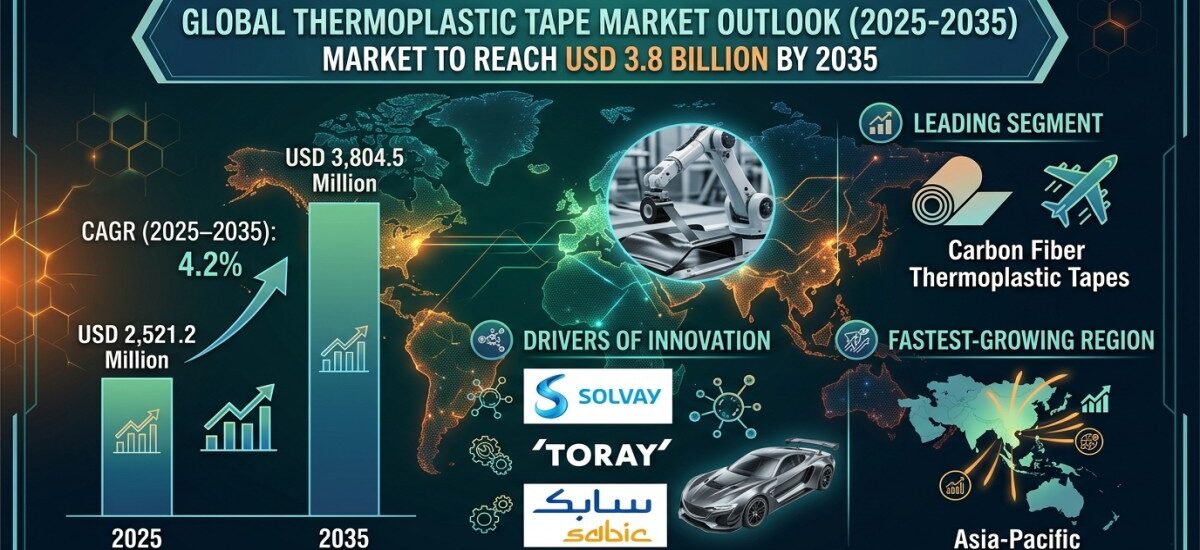
According to industry projections, the market is expected to grow from USD 2,521.2 million in 2025 to USD 3,804.5 million by 2035, registering a CAGR of 4.2%. This growth trajectory reflects a broader shift toward sustainable materials and efficient manufacturing processes.
Market Overview: Why Thermoplastic Tapes Are Gaining Momentum
Thermoplastic tapes are composed of continuous fibers such as carbon, glass, or aramid embedded within thermoplastic resin matrices. These materials offer a powerful combination of strength, flexibility, recyclability, and impact resistance, making them ideal for high-performance applications.
Unlike traditional thermoset composites, thermoplastic tapes can be reheated, reshaped, and recycled, aligning well with circular economy principles. Additionally, their compatibility with automated manufacturing processes such as automated tape placement (ATP) and automated fiber placement (AFP) makes them highly attractive for industries focused on speed and efficiency.
Key Market Metrics
- Market Size (2025): USD 2,521.2 Million
- Forecast Value (2035): USD 3,804.5 Million
- CAGR (2025–2035): 4.2%
- Leading Segment: Carbon Fiber Thermoplastic Tapes
- Fastest-Growing Region: Asia-Pacific
Get detailed market forecasts, competitive benchmarking, and pricing trends:
https://www.futuremarketinsights.com/reports/sample/rep-gb-10478
Key Demand Drivers
- Lightweighting Across Industries
One of the most significant growth drivers is the global push toward lightweight materials. In industries such as aerospace and automotive, reducing weight directly improves fuel efficiency and reduces emissions. Thermoplastic tapes provide high strength-to-weight ratios, making them ideal for structural components.
- Sustainability and Circular Manufacturing
As environmental regulations tighten, manufacturers are increasingly adopting recyclable and low-emission materials. Thermoplastic tapes offer reprocessability and lower VOC emissions, positioning them as a sustainable alternative to thermosets.
- Automation and High-Speed Production
The integration of automation in manufacturing processes is boosting the adoption of thermoplastic tapes. Technologies like robotic tape laying and thermoforming enable faster production cycles, reducing labor costs and increasing scalability.
- Expanding Applications in Emerging Sectors
From electric vehicle (EV) battery casings to wind turbine blades and sports equipment, thermoplastic tapes are finding new applications across industries that demand durability, corrosion resistance, and design flexibility.
Regional Analysis
Asia-Pacific: The Growth Engine
Asia-Pacific is expected to dominate the thermoplastic tape market during the forecast period. Rapid industrialization, expanding automotive production, and infrastructure development in countries like China, Japan, and South Korea are key growth contributors.
The region also benefits from strong manufacturing ecosystems and increasing investments in lightweight materials for transportation and electronics.
North America: Innovation and Aerospace Leadership
North America remains a key market driven by aerospace and automotive innovation. The United States, in particular, is witnessing increased adoption of thermoplastic composites in aircraft structures and EV components.
Advanced manufacturing technologies and strong R&D capabilities further support market growth in this region.
Europe: Sustainability-Driven Adoption
Europe continues to lead in sustainability initiatives, with strict environmental regulations encouraging the use of recyclable materials. Countries like Germany, France, and the Netherlands are integrating thermoplastic tapes into automotive, wind energy, and construction applications.
Segmentation Insights
By Thickness
The 0.21–0.40 mm segment dominates the market, accounting for 46.3% share in 2025. This thickness range offers an optimal balance between flexibility and structural strength, making it suitable for a wide range of applications.
By Material Type
Carbon fiber-based thermoplastic tapes lead the market with a 52.1% share, owing to their superior mechanical properties, including high stiffness, fatigue resistance, and thermal stability.
By End Use
Key industries driving demand include:
- Aerospace
- Automotive
- Building & Construction
- Industrial Goods
- Oil & Gas
Supply Chain Overview
The thermoplastic tape market operates within a complex and integrated supply chain:
- Raw Material Suppliers: Provide fibers (carbon, glass) and thermoplastic resins (PEEK, PA, PP).
- Tape Manufacturers: Convert materials into reinforced tapes using advanced extrusion and impregnation processes.
- OEMs and Fabricators: Use tapes in composite parts for aerospace, automotive, and industrial applications.
- Recycling Ecosystem: Supports circular production through reuse and repurposing of materials.
Unlock 360° insights for strategic decision making and investment planning: https://www.futuremarketinsights.com/checkout/10478
Competitive Landscape
The market is moderately consolidated, with leading players focusing on innovation, sustainability, and automation.
Key Players and Market Share:
- Solvay S.A. (18–22%)
- Toray Industries, Inc. (14–18%)
- Evonik Industries AG (10–14%)
- SABIC (8–12%)
- Teijin Limited (6–9%)
- Other players (25–30%)
Strategic Focus Areas:
- Development of recyclable and bio-based thermoplastics
- Expansion of carbon fiber-reinforced tape production
- Integration of automation technologies
- Partnerships with OEMs for customized solutions
Technology and Innovation Trends
The market is witnessing rapid technological advancements, including:
- Automated Tape Laying (ATL) and Fiber Placement (AFP)
- Robotic Tape Winding Systems
- Hybrid Molding and 3D Printing Integration
- Embedded Sensors for Smart Composites
- Digital Twin Simulations for Material Performance
These innovations are enhancing production efficiency, reducing waste, and enabling more complex and high-performance designs.
Challenges in the Market
Despite strong growth potential, the market faces several challenges:
- High Processing Temperatures: Advanced thermoplastics require precise thermal control.
- Cost Constraints: Raw materials and machinery remain expensive compared to conventional alternatives.
- Material Compatibility Issues: Integration with existing manufacturing systems can be complex.
- Adoption Barriers for SMEs: Smaller manufacturers may struggle with capital investment requirements.
Opportunities and Investment Outlook
- Electric Vehicles and Energy Storage
Thermoplastic tapes are increasingly used in EV battery casings and structural components, offering significant growth opportunities.
- Wind Energy Expansion
The demand for lightweight and durable materials in wind turbine blades is driving adoption in renewable energy sectors.
- Circular Economy Initiatives
Growing emphasis on recyclability and sustainability is creating opportunities for bio-based and reusable thermoplastic materials.
- Advanced Manufacturing Technologies
Investments in automation and smart manufacturing systems are expected to enhance productivity and reduce costs.
Speak to Analyst: Customize insights for your business strategy: https://www.futuremarketinsights.com/customization-available/rep-gb-10478
Future Outlook (2025–2035)
The thermoplastic tape market is set to evolve from a niche composite material segment into a mainstream solution for high-performance and sustainable manufacturing.
Key trends shaping the future include:
- Increased adoption of bio-based thermoplastics
- Growth of smart and multifunctional composites
- Expansion into medical, electronics, and energy sectors
- Integration of AI and digital manufacturing technologies
By 2035, companies that prioritize innovation, sustainability, and automation will gain a competitive edge in this rapidly evolving market.
Why FMI: https://www.futuremarketinsights.com/why-fmi
About Future Market Insights (FMI)
Future Market Insights, Inc. (FMI) is an ESOMAR-certified, ISO 9001:2015 market research and consulting organization, trusted by Fortune 500 clients and global enterprises. With operations in the U.S., UK, India, and Dubai, FMI provides data-backed insights and strategic intelligence across 30+ industries and 1200 markets worldwide.
Contact Us:
Future Market Insights Inc., Christiana Corporate, 200 Continental Drive, Suite 401, Newark, Delaware – 19713, USA
T: +1-347-918-3531
For Sales Enquiries: sales@futuremarketinsights.com
Website: https://www.futuremarketinsights.com
LinkedIn| Twitter| Blogs | YouTube