The global proteome balms market is experiencing rapid expansion, fueled by advancements in protein-based skincare, increasing demand for clinically validated formulations, and rising consumer awareness of skin barrier health. According to Future Market Insights (FMI), the market is valued at USD 1.1 billion in 2026 and is projected to reach USD 3.6 billion by 2036, growing at a CAGR of 12.7% over the forecast period.
Demand is accelerating as consumers shift toward scientifically backed skincare solutions that deliver targeted, long-term skin repair at the molecular level. Proteome balms, enriched with peptides, bioengineered proteins, and plant-based actives, are increasingly positioned within the cosmeceutical segment, bridging the gap between cosmetics and dermatological treatments.
“Interest in proteome-based skincare reflects a broader move toward respecting skin biology and delivering functional efficacy rather than temporary results,” noted industry experts, highlighting the growing importance of protein science in next-generation skincare innovation.
Major beauty and personal care companies are investing heavily in molecular research, peptide engineering, and advanced delivery systems, while emerging brands focus on clean formulations, sustainability, and dermatologist-backed positioning. As proteome balms become integrated into both daily skincare routines and professional dermatology practices, repeat usage and premiumization are expected to sustain strong market growth through 2036.
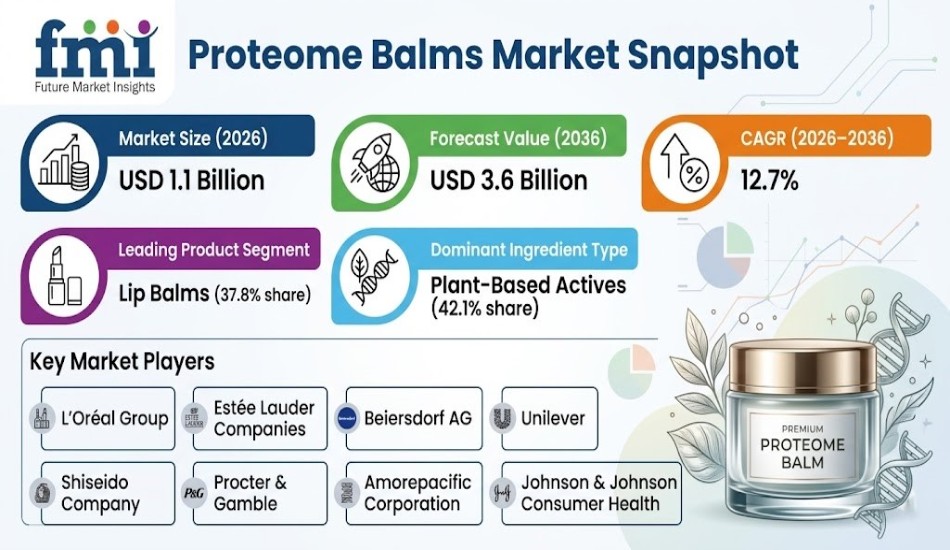
Proteome Balms Market Snapshot
Key Market Metrics
- Market Size (2026): USD 1.1 Billion
- Forecast Value (2036): USD 3.6 Billion
- CAGR (2026–2036): 12.7%
- Leading Product Segment: Lip Balms (37.8% share)
- Dominant Ingredient Type: Plant-Based Actives (42.1% share)
- Key Players: L’Oréal Group, Estée Lauder Companies, Beiersdorf AG, Unilever, Shiseido Company, Procter & Gamble, Amorepacific Corporation, Johnson & Johnson Consumer Health
Discover Growth Opportunities in the Market – Get Your Sample Report Now : https://www.futuremarketinsights.com/reports/sample/rep-gb-31830
Growth Dynamics and Demand Drivers
The market’s expansion is driven by a growing emphasis on skin barrier science and demand for high-performance skincare solutions. Consumers are increasingly seeking products that support collagen production, enhance skin resilience, and address underlying biological processes rather than providing surface-level hydration.
Technological advancements in peptide synthesis and protein bioengineering are enabling stable and effective incorporation of complex proteins into balm formats. Additionally, professional endorsement from dermatologists and aestheticians is strengthening consumer trust and accelerating adoption across both medical-grade and retail channels.
Sustainability trends are also contributing to growth, with bioengineered proteins produced via fermentation offering ethical and environmentally responsible alternatives to traditional ingredients.
Segment Insights
By Product Type:
- Lip balms dominate with a 37.8% share due to high usage frequency and strong consumer habits.
- Skin repair and therapeutic balms are gaining traction in dermatology-led applications.
- Anti-aging and multi-functional balms are expanding in premium skincare segments.
By Ingredient Type:
- Plant-based actives lead (42.1% share), driven by clean beauty trends.
- Proteomic peptides and bioengineered proteins are gaining momentum in professional and high-performance segments.
- Hybrid formulations combining natural and synthetic actives are increasing.
By Application:
- Face care leads with a 39.4% share, supported by demand for targeted skincare.
- Lip care remains a high-volume segment due to frequent reapplication.
- Medical skin repair applications are expanding through dermatology channels.
Regional Outlook
- Asia Pacific: Fastest-growing region, led by China (17.1% CAGR) and India (15.9%), driven by premium skincare adoption and biotech advancements.
- Europe: Germany (14.6% CAGR) emphasizes scientific validation and regulatory rigor.
- North America: United States (12.1% CAGR) shows steady growth supported by data-driven skincare innovation.
- Latin America: Brazil (13.3% CAGR) benefits from increasing adoption of protein-based health solutions.
- Other Markets: United Kingdom (10.8%) reflects steady, value-driven adoption patterns.
Competitive Landscape
The proteome balms market is highly competitive, with global leaders focusing on integrating advanced skin biology into product development. Companies are shifting from traditional cosmetic formulations toward precision skincare powered by proteomics and biotechnology.
Leading players such as L’Oréal Group, Estée Lauder, and Beiersdorf are investing in molecular research, while innovation is increasingly centered around peptide engineering, diagnostic integration, and personalized skincare solutions.
Emerging brands are differentiating through transparency, sustainability, and direct-to-consumer strategies, intensifying competition across both retail and professional channels.
Recent Developments
- January 2026: Beiersdorf partnered with a leading research institute to advance microbiome and proteome-based skincare innovations.
- June 2025: Shiseido introduced advanced delivery technology to enhance ingredient penetration and retention.
- Ongoing investments in peptide engineering and protein stabilization technologies are reshaping product performance standards.
Market Definition
The proteome balms market includes topical skincare products formulated with protein-based active ingredients such as peptides, bioengineered proteins, and plant protein extracts. These products are designed for skin barrier repair, anti-aging, and therapeutic applications across consumer and professional channels.
The market excludes basic emollient balms without functional protein content, non-balm skincare formats, pharmaceutical dermatology treatments, and beauty devices.
Future Outlook
The proteome balms market is set to become a key segment within advanced skincare, driven by scientific innovation, clinical validation, and consumer demand for biologically effective products. Growth will be supported by advancements in peptide engineering, delivery systems, and large-scale proteomics research.
Companies that successfully combine efficacy, sustainability, and scientific credibility are expected to capture long-term value, positioning proteome balms as a cornerstone of next-generation skincare through 2036.
Why FMI: https://www.futuremarketinsights.com/why-fmi
About Future Market Insights (FMI)
Future Market Insights, Inc. (FMI) is an ESOMAR-certified, ISO 9001:2015 market research and consulting organization, trusted by Fortune 500 clients and global enterprises. With operations in the U.S., UK, India, and Dubai, FMI provides data-backed insights and strategic intelligence across 30+ industries and 1200 markets worldwide.
Contact Us:
Future Market Insights Inc.
Christiana Corporate, 200 Continental Drive,
Suite 401, Newark, Delaware – 19713, USA
T: +1-347-918-3531
For Sales Enquiries: sales@futuremarketinsights.com
Website: https://www.futuremarketinsights.com
LinkedIn| Twitter| Blogs | YouTube