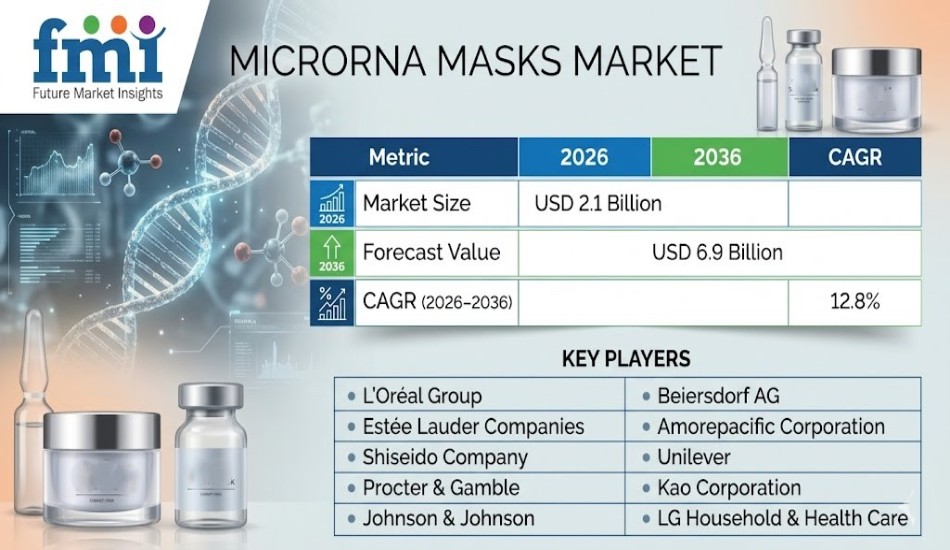
The global microRNA masks market is experiencing rapid expansion, driven by breakthroughs in RNA therapeutics, precision skincare, and increasing consumer demand for biologically advanced beauty solutions. According to Future Market Insights (FMI), the market is valued at USD 2.1 billion in 2026 and is projected to reach USD 6.9 billion by 2036, growing at a robust CAGR of 12.8% over the forecast period.
Demand is accelerating as the skincare industry shifts toward gene-expression modulation and epigenetic treatments, positioning microRNA masks as a next-generation category capable of addressing complex skin concerns at the cellular level.
“MicroRNAs represent previously unexplored disease targets where pharmacological approaches could lead to novel therapies,” notes Nobel Laureate David Baltimore, underscoring the scientific credibility driving this market forward. This perspective reflects the growing acceptance of microRNA masks as foundational platforms rather than niche innovations.
MicroRNA Masks Market Snapshot
Key Market Metrics
- Market Size (2026): USD 2.1 Billion
- Forecast Value (2036): USD 6.9 Billion
- CAGR (2026–2036): 12.8%
- Leading Product Segment: Bio-cellulose masks (38.4% share)
- Dominant Technology: Nanocarrier-based microRNA (42.7% share)
- Key Players: L’Oréal Group, Estée Lauder Companies, Shiseido Company, Procter & Gamble, Johnson & Johnson, Beiersdorf AG, Amorepacific Corporation, Unilever, Kao Corporation, LG Household & Health Care
Discover Growth Opportunities in the Market – Get Your Sample Report Now : https://www.futuremarketinsights.com/reports/sample/rep-gb-31822
Growth Dynamics and Demand Drivers
The market’s strong growth trajectory is fueled by rising consumer awareness of epigenetic skincare, where treatments target underlying biological aging processes rather than surface-level effects. MicroRNA masks enable post-transcriptional gene regulation, offering reversible and multi-pathway control over skin repair, collagen synthesis, and pigmentation.
Advancements in nanocarrier delivery systems have overcome earlier limitations related to molecule stability and penetration. These technologies allow microRNA to reach dermal layers effectively, improving efficacy and enabling commercial scalability.
Additionally, the shift toward personalized skincare is accelerating demand. Brands are leveraging genetic insights and AI-driven formulation to develop customized microRNA combinations, transforming masks into precision therapeutic solutions.
Segment Insights
By Product Type
- Bio-cellulose masks dominate with a 38.4% share, driven by superior hydration retention and delivery efficiency.
- Hydrogel and sheet masks offer convenience and widespread consumer familiarity.
- Cream and gel masks are gaining traction in premium and professional segments.
By Technology
- Nanocarrier-based microRNA leads with 42.7% share, ensuring stability and controlled release.
- Synthetic microRNA supports scalability and precision targeting.
- Natural and encapsulated formats appeal to clean-label and time-release preferences.
By Application
- Anti-aging remains the primary use case, followed by skin repair, pigmentation control, and inflammation management.
By Distribution Channel
- Online retail is expanding rapidly due to product education and accessibility.
- Specialty beauty stores and dermatology clinics support premium positioning and professional endorsement.
- Pharmacies enhance credibility through medical association.
Regional Outlook
- Asia Pacific: Fastest-growing region, led by China (17.4% CAGR) and India (16.1% CAGR) due to rising biotech adoption and digital beauty ecosystems.
- Europe: Germany (14.8% CAGR) benefits from strong regulatory frameworks and scientific validation.
- North America: United States (12.2% CAGR) driven by clinical research and consumer sophistication.
- Latin America: Brazil (13.5% CAGR) supported by strong beauty culture and salon integration.
- United Kingdom: 10.9% CAGR, driven by premium skincare demand and education-led retail.
Competitive Landscape
The microRNA masks market is becoming increasingly competitive, with established beauty conglomerates integrating biotechnology capabilities to maintain leadership. Companies are investing heavily in clinical validation, biomarker analysis, and advanced delivery systems.
- L’Oréal Group is advancing biomarker-based personalization technologies.
- Estée Lauder Companies is leveraging patented microRNA research for anti-aging innovation.
- Shiseido, Unilever, and Amorepacific are expanding biotech-driven skincare portfolios.
Emerging biotech firms and startups are intensifying competition by introducing AI-driven formulations and nanofiber delivery systems, pushing the market toward precision-engineered skincare solutions.
Recent Developments
- 2024–2025: Increased investment in nanocarrier encapsulation technologies for improved stability and penetration.
- 2025: Expansion of clinical collaborations between cosmetic brands and dermatology research institutions.
- 2026: Adoption of AI-driven formulation platforms to accelerate product development and personalization.
Market Definition
The microRNA masks market includes topical skincare products designed to deliver microRNA molecules that modulate gene expression for therapeutic and cosmetic applications such as anti-aging, skin repair, and pigmentation control.
It covers bio-cellulose, hydrogel, sheet, and cream-based masks utilizing nanocarrier, synthetic, natural, or encapsulated microRNA technologies, distributed through retail and professional channels.
Excluded: Conventional masks without microRNA, ingestible supplements, dermatological procedures, and non-commercial research applications.
Future Outlook
The microRNA masks market is poised to become a core segment within advanced cosmeceuticals, driven by the convergence of biotechnology, AI, and personalized skincare. Growth will be supported by declining production costs, regulatory acceptance of gene-modulating claims, and expanding clinical evidence.
As the industry evolves, companies that deliver clinically validated, scalable, and precision-targeted solutions will capture significant long-term value, transforming microRNA masks from luxury innovations into mainstream skincare essentials by 2036.
Why FMI: https://www.futuremarketinsights.com/why-fmi
About Future Market Insights (FMI)
Future Market Insights, Inc. (FMI) is an ESOMAR-certified, ISO 9001:2015 market research and consulting organization, trusted by Fortune 500 clients and global enterprises. With operations in the U.S., UK, India, and Dubai, FMI provides data-backed insights and strategic intelligence across 30+ industries and 1200 markets worldwide.
Contact Us:
Future Market Insights Inc.
Christiana Corporate, 200 Continental Drive,
Suite 401, Newark, Delaware – 19713, USA
T: +1-347-918-3531
For Sales Enquiries: sales@futuremarketinsights.com
Website: https://www.futuremarketinsights.com
LinkedIn| Twitter| Blogs | YouTube