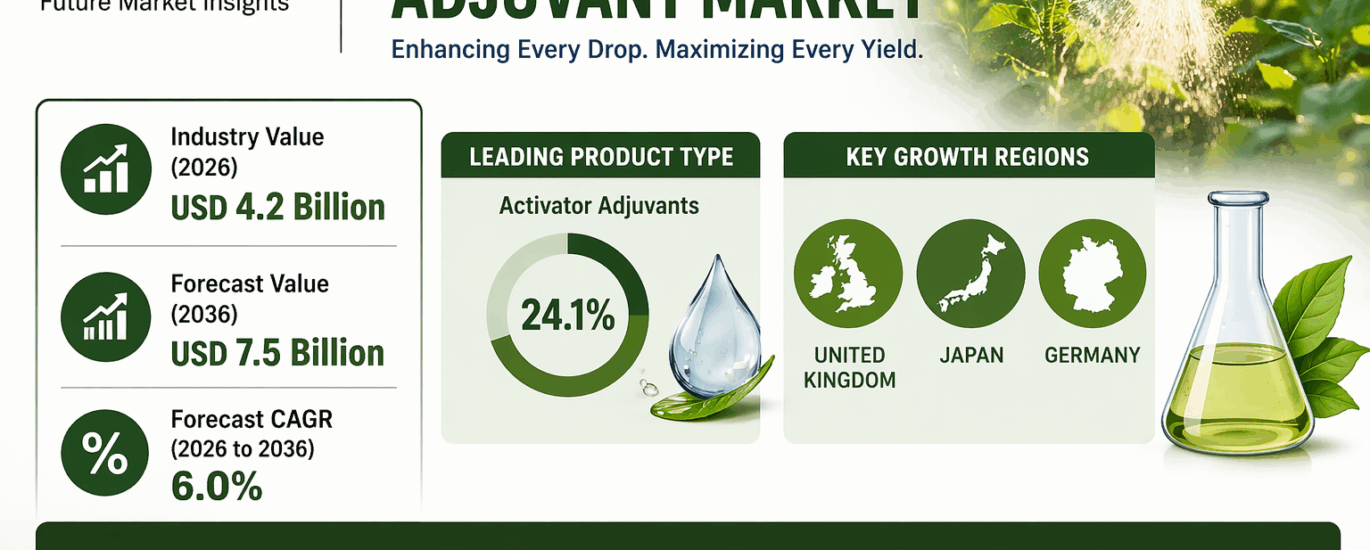
The global agricultural adjuvant market is projected to reach USD 4.2 billion in 2026 and expand beyond USD 7.5 billion by 2036, registering a CAGR of 6.0% during the forecast period. Growth is being driven by rising demand for spray efficiency, precision agriculture technologies, and stricter environmental regulations governing pesticide use. Agricultural adjuvants are increasingly used to improve wetting, spreading, retention, and penetration of crop protection products, helping farmers reduce waste while improving field performance.
The market is also benefiting from the shift toward sustainable farming practices. Manufacturers are investing in biodegradable, low-toxicity, and bio-based adjuvant formulations that meet stricter residue, soil persistence, and aquatic toxicity standards. Demand is particularly strong in export-oriented crop segments where growers face tighter compliance requirements for chemical inputs.
Get detailed market forecasts, competitive benchmarking, and pricing trends: https://www.futuremarketinsights.com/reports/sample/rep-gb-14281
Growing Importance of Precision Agriculture
Precision agriculture is becoming one of the strongest demand drivers for agricultural adjuvants. Technologies such as drone spraying, variable-rate application, section control, and smart irrigation systems require highly consistent spray performance. Adjuvants help optimize droplet size, reduce drift, improve deposition, and maintain coverage under changing field conditions.
Growers are increasingly using adjuvants as a core part of crop protection programs rather than as optional additives. The ability to improve spray efficiency and reduce the need for repeat applications is becoming more valuable as labor, fuel, and pesticide costs continue to rise.
Activator Adjuvants Remain the Largest Product Segment
Activator adjuvants are expected to hold 24.1% of the market in 2026, making them the leading product category. Their dominance comes from their ability to improve spray wetting, spreading, retention, and penetration on plant surfaces. These products are particularly valuable in difficult conditions such as waxy leaves, dense canopies, and high humidity environments.
Polymer-based spreaders and stickers are also improving rainfastness and droplet adhesion, allowing pesticides to remain effective even after rainfall. This is making activator adjuvants increasingly important in high-value crops and precision spraying programs.
Speak to Analyst: Customize insights for your business strategy – https://www.futuremarketinsights.com/customization-available/rep-gb-14281
Fruits and Vegetables Lead Crop Demand
Fruits and vegetables are expected to account for 35.2% of agricultural adjuvant demand in 2026. These crops require frequent spray programs, strict residue management, and uniform canopy coverage to maintain quality and market access.
Supply Chain and Pricing Trends
The agricultural adjuvant supply chain begins with specialty chemical suppliers that provide surfactants, oils, solvents, polymers, and emulsifiers. Adjuvant manufacturers then formulate products such as activators, drift control agents, spreaders, stickers, and utility adjuvants. These products are sold through agrochemical companies, distributors, retailers, and cooperatives before reaching growers.
Major pesticide manufacturers increasingly recommend specific adjuvants as part of complete crop protection programs. This trend is especially common in herbicide, fungicide, and biological pesticide applications where compatibility is critical.
Regional Trends and Competitive Landscape
The United Kingdom is expected to be one of the fastest-growing markets, with a CAGR of 5.4% through 2036, supported by integrated pest management policies and sustainable farming incentives. United Kingdom
Japan is forecast to grow at 5.1% CAGR due to smart farming investments and increasing use of automation in agriculture. Germany is projected to expand at 4.9% CAGR because of strong environmental regulations and focus on reducing pesticide risks.
Unlock 360° insights for strategic decision making and investment planning- https://www.futuremarketinsights.com/checkout/14281
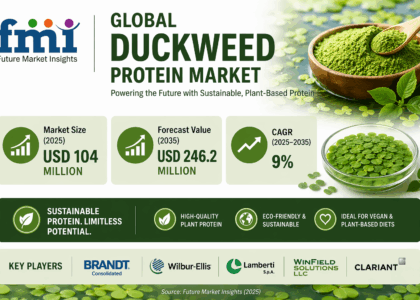
Major companies in the agricultural adjuvant market include : Brandt Consolidated, Wilbur-Ellis Holdings, Lamberti S.p.A., WINFIELD Solutions LLC, and Clariant AG.
The future outlook for the agricultural adjuvant market remains positive as sustainable farming, precision spraying, and biological crop protection continue to gain importance. Suppliers that can offer environmentally compliant, performance-driven, and crop-specific solutions are expected to capture the strongest growth opportunities through 2036.
About FMI
Future Market Insights (FMI) is a globally recognized provider of market intelligence, delivering actionable insights across industries including food and beverage, healthcare, chemicals, and advanced manufacturing. Through a combination of primary research, proprietary data models, and in-depth analysis, FMI empowers business leaders, investors, and policymakers to make informed strategic decisions in an increasingly complex global marketplace.
Contact Us
Future Market Insights Inc.
Christiana Corporate, 200 Continental Drive,
Suite 401, Newark, Delaware – 19713, USA
T: +1-347-918-3531
For Sales Enquiries: sales@futuremarketinsights.com
Website: https://www.futuremarketinsights.com
LinkedIn| Twitter| Blogs | YouTube