Tags Market Outlook 2025 to 2035
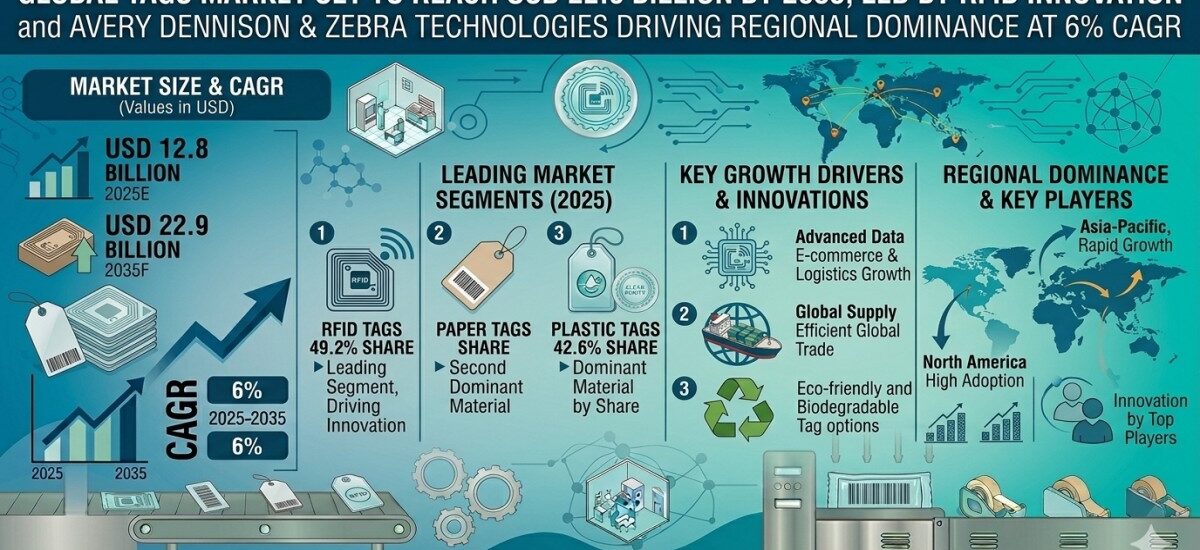
The global tags market is poised for steady expansion, driven by the convergence of IoT-enabled tracking, digital printing advancements, and increasing automation across supply chains. According to FMI analysis, the market is projected to grow from USD 12,809.7 million in 2025 to USD 22,940.3 million by 2035, registering a CAGR of 6% over the forecast period.
The evolution of intelligent labeling solutions including RFID, NFC, and QR-enabled tags is transforming how industries track, authenticate, and manage goods, positioning tags as a critical enabler of digital supply chains.
Market Overview & Key Metrics
- Market Size (2025E): USD 12.8 Billion
- Market Forecast (2035F): USD 22.9 Billion
- CAGR (2025–2035): 6%
- Leading Segment: RFID Tags (49.2% share in 2025)
- Dominant Material: Plastic Tags (42.6% share in 2025)
Discover Growth Opportunities in the Market – Get Your Sample Report Now
https://www.futuremarketinsights.com/reports/sample/rep-gb-14347
Key Demand Drivers
- Rapid Adoption of Smart Tracking Technologies
RFID and NFC tags are witnessing accelerated adoption due to their ability to provide real-time tracking, automation, and enhanced inventory visibility. Industries such as retail, logistics, and healthcare are leveraging these technologies to improve operational efficiency and reduce losses.
- E-commerce and Omnichannel Retail Boom
The global surge in e-commerce has intensified demand for accurate inventory management and last-mile tracking, fueling tag consumption across warehouses, fulfillment centers, and retail stores.
- Regulatory Compliance and Anti-Counterfeiting Needs
Stringent regulations around product traceability, safety, and authentication particularly in pharmaceuticals and food are driving the adoption of secure tagging solutions integrated with blockchain and serialization technologies.
- Sustainability and Eco-friendly Innovations
Growing environmental concerns are pushing manufacturers toward biodegradable, recyclable, and reusable tag materials, reshaping product development and procurement strategies.
Supply Chain Analysis: Who Supplies Whom
The tags market operates within a multi-tiered supply chain ecosystem:
- Raw Material Suppliers: Petrochemical companies (plastics), pulp & paper manufacturers, specialty chemical providers (adhesives, inks)
- Component Manufacturers: RFID chip producers, antenna manufacturers, NFC module developers
- Tag & Label Converters: Companies such as Avery Dennison, UPM Raflatac, and CCL Industries convert raw materials into finished tags
- Technology Providers: Firms like Zebra Technologies and Impinj supply printing, scanning, and IoT integration solutions
- End Users: Retailers, logistics firms, healthcare providers, manufacturers, and FMCG companies
Value Chain Insight: Increasing vertical integration especially among RFID manufacturers is improving margins and reducing dependency on third-party chip suppliers.
Pricing Trends & Cost Dynamics
- RFID Tag Costs: Gradually declining due to economies of scale and chip miniaturization, encouraging wider adoption
- Plastic Tags: Remain cost-effective but face pricing pressure from sustainability regulations
- Eco-friendly Tags: Currently priced at a premium (10–20% higher), but expected to normalize with scaling production
- Digital Printing: Reducing per-unit costs for customized and short-run tag production
Outlook: Price competitiveness will improve significantly as mass production and material innovation reduce costs across smart tag categories.
Segmentation Insights
By Material Type
- Plastic tags dominate due to durability and moisture resistance
- Paper and fiber tags gaining traction with sustainability mandates
- Emerging materials include bio-polymers and recyclable composites
By Tag Type
- RFID Tags (49.2%) lead due to automation and data capabilities
- Hang/swing tags remain prevalent in apparel and retail branding
- Loop tags widely used in logistics and asset tracking
By End Use
- Retail & Apparel: Largest consumer due to branding and inventory needs
- Logistics & Transportation: Fastest-growing segment
- Healthcare: Rising demand for traceability and compliance
- Food & Beverage: Increasing adoption for safety and tracking
Regional Analysis
North America – Market Leader
North America dominates due to advanced retail infrastructure and early RFID adoption. The U.S. leads with strong investments in cloud-based inventory systems and smart logistics.
Europe – Sustainability-Driven Growth
Countries such as Germany, the UK, and France are driving demand for eco-friendly and compliant tagging solutions, supported by stringent EU regulations on traceability and recyclability.
Asia-Pacific – Fastest Growing Region
Asia-Pacific is projected to register the highest growth, led by:
- China’s manufacturing dominance
- India’s e-commerce expansion
- Japan & South Korea’s technological advancements in smart logistics
Government initiatives supporting digital transformation and automation are accelerating adoption.
Competitive Landscape
The tags market is moderately consolidated, with key players focusing on innovation, sustainability, and digital integration.
Leading Players & Market Share
- Avery Dennison Corporation: 20–24%
- Zebra Technologies Corporation: 15–19%
- Brady Corporation: 12–16%
- Sato Holdings Corporation: 10–14%
- Smartrac Technology Group: 6–10%
Strategic Developments (2024–2025)
- Launch of biodegradable RFID tags
- Development of high-performance barcode labels
- Expansion into AI-enabled tracking solutions
- Advancements in anti-counterfeiting RFID chips
Key Trends Shaping the Future
- Integration of AI and predictive analytics in tagging systems
- Adoption of blockchain for product authentication
- Growth of contactless technologies (NFC, QR codes)
- Shift toward localized and sustainable production models
- Emergence of chipless RFID and ultra-thin smart tags
Challenges & Risk Factors
- High initial investment for RFID infrastructure
- Data privacy and cybersecurity concerns
- Compatibility issues with legacy systems
- Environmental concerns around plastic usage
Opportunities & Investment Outlook
The tags market presents strong investment opportunities in:
- Smart and IoT-enabled tagging solutions
- Sustainable and biodegradable materials
- AI-driven supply chain analytics platforms
- Sector-specific customization (healthcare, automotive, food safety)
Analyst Insight: Companies investing in end-to-end smart labeling ecosystems combining hardware, software, and analytics are expected to gain a competitive edge.
Future Outlook (2025–2035)
The tags market is transitioning from traditional labeling to intelligent, connected ecosystems. As industries prioritize traceability, automation, and sustainability, tags will evolve into data carriers and decision-making tools within digital supply chains.
By 2035, the market will be defined by:
- Fully integrated IoT tagging networks
- Widespread adoption of eco-friendly materials
- Advanced analytics-driven inventory systems
Why FMI: https://www.futuremarketinsights.com/why-fmi
About Future Market Insights (FMI)
Future Market Insights, Inc. (FMI) is an ESOMAR-certified, ISO 9001:2015 market research and consulting organization, trusted by Fortune 500 clients and global enterprises. With operations in the U.S., UK, India, and Dubai, FMI provides data-backed insights and strategic intelligence across 30+ industries and 1200 markets worldwide.
Contact Us:
Future Market Insights Inc., Christiana Corporate, 200 Continental Drive, Suite 401, Newark, Delaware – 19713, USA
T: +1-347-918-3531
For Sales Enquiries: sales@futuremarketinsights.com
Website: https://www.futuremarketinsights.com
LinkedIn| Twitter| Blogs | YouTube