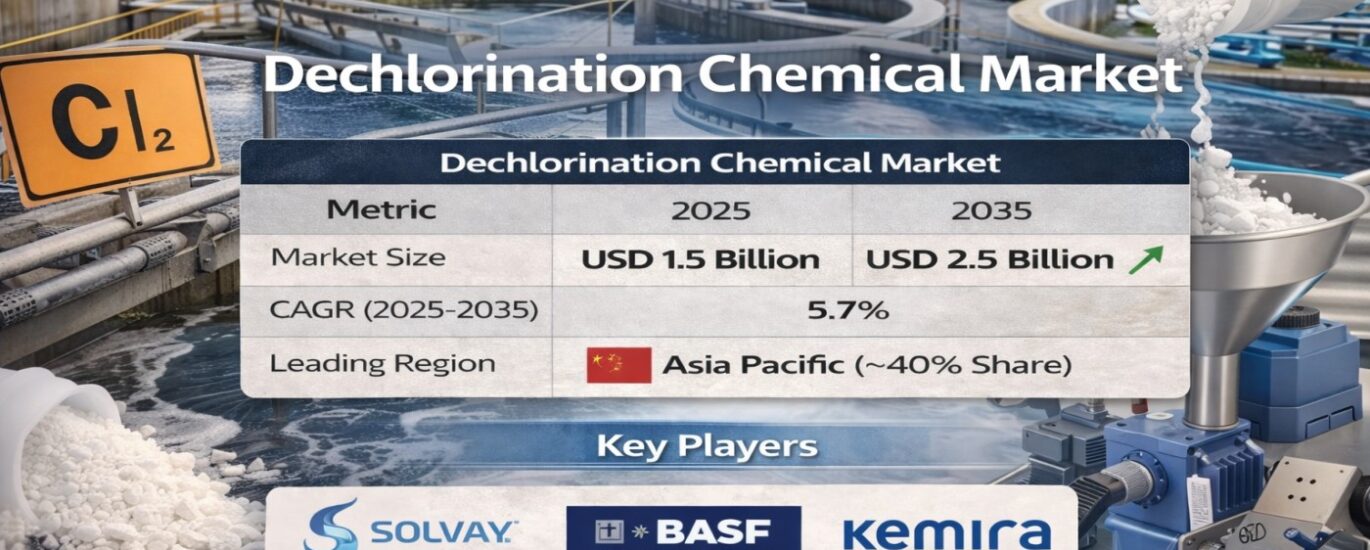
The global dechlorination chemical market is witnessing steady expansion, projected to grow from USD 1.5 billion in 2025 to USD 2.5 billion by 2035, registering a CAGR of 5.7%. The market is set to generate an absolute dollar opportunity of USD 1.0 billion, driven by increasing wastewater treatment requirements, stricter environmental discharge regulations, and rising adoption of water reuse practices across municipal and industrial sectors.
As global water stress intensifies and regulatory scrutiny tightens, demand for efficient chlorine neutralization solutions is accelerating across utilities, power plants, food processing, and industrial manufacturing facilities.
Market Momentum Driven by Water Treatment, Regulation, and Industrial Expansion
Dechlorination chemicals are becoming essential in modern water treatment systems, ensuring safe discharge and reuse of treated water. Key growth drivers include:
- Stringent environmental regulations: Increasingly strict limits on chlorine discharge are driving mandatory adoption of dechlorination solutions globally.
• Rising wastewater treatment volumes: Urbanization and industrialization are expanding the need for large-scale water treatment infrastructure.
• Industrial water reuse initiatives: Zero liquid discharge (ZLD) and closed-loop systems are increasing demand for precise chlorine removal solutions.
Between 2025 and 2030, the market is expected to reach approximately USD 1.94 billion, contributing 45% of total growth. The remaining 55% will come from 2030 to 2035, driven by advanced treatment technologies and sustainability initiatives.
Request For Sample Report | Customize Report |purchase Full Report – https://www.futuremarketinsights.com/reports/sample/rep-gb-18046
Sulfur-Based Chemicals Dominate with Cost and Efficiency Advantage
Sulfur-based chemicals, including sodium bisulfite and sodium metabisulfite, dominate the market due to their:
- High efficiency in rapid chlorine neutralization
• Cost-effectiveness for large-scale applications
• Compatibility with automated dosing systems
These chemicals remain the preferred choice for municipal and industrial operators requiring reliable and scalable treatment solutions.
Water Treatment Applications Lead Market Demand
Water treatment accounts for approximately 60% of the total market, reflecting its critical role in:
- Municipal wastewater treatment plants
• Drinking water purification systems
• Industrial effluent management
With increasing investments in infrastructure and stricter compliance requirements, utilities are prioritizing advanced dechlorination systems to ensure environmental safety and operational efficiency.
Asia Pacific Leads Global Expansion
Asia Pacific dominates the dechlorination chemical market, driven by rapid industrialization, urban water demand, and infrastructure investments.
- India (6.4% CAGR): Leads growth with ZLD mandates, municipal water reuse, and industrial expansion
• China (6.1% CAGR): Driven by strict environmental regulations and large-scale wastewater treatment capacity
• South Korea (5.9% CAGR): Strong demand from semiconductor and ultrapure water applications
Meanwhile, developed markets such as the United States (4.8%) and Germany (4.4%) show steady growth supported by infrastructure upgrades and stringent regulatory frameworks.
Competitive Landscape Focused on Reliability and Technical Support
The dechlorination chemical market is moderately consolidated, with key players focusing on supply reliability, formulation quality, and technical service capabilities.
Key companies operating in the market include:
Solvay SA, BASF SE, Kemira Oyj, Chemtrade Logistics, INEOS Calabrian, Esseco USA LLC, Hawkins Inc., Hydrite Chemical, Jay Dinesh Chemicals, Guangdong Hanyan Activated Carbon Technology Co., Ltd.
These players are investing in:
- High-purity and application-specific formulations
• Automated dosing and monitoring systems
• Sustainable and low-impact chemical production
• Strong distribution and technical support networks
Analyst Perspective: From Compliance Tool to Critical Water Management Solution
Industry analysts emphasize that dechlorination chemicals are evolving beyond basic treatment agents into essential components of sustainable water management.
“With tightening environmental regulations and growing water reuse requirements, dechlorination chemicals are becoming indispensable for ensuring safe and compliant water discharge,” noted a senior analyst. “Future growth will be shaped by automation, formulation innovation, and integration with advanced treatment systems.”
Future Outlook: Stable Growth Driven by Global Water Sustainability Needs
Looking ahead, the market is positioned for consistent expansion as industries and governments prioritize water quality and environmental protection.
Key opportunity areas include:
- Municipal wastewater infrastructure upgrades
• Industrial water recycling and ZLD systems
• Food-grade and pharmaceutical water treatment
• Advanced automated dosing and monitoring solutions
As global demand for clean and reusable water rises, dechlorination chemicals will remain a critical enabler of sustainable water treatment and environmental compliance.
About Future Market Insights (FMI)
Future Market Insights, Inc. (ESOMAR certified, recipient of the Stevie Award, and a member of the Greater New York Chamber of Commerce) offers profound insights into the driving factors that are boosting demand in the market. FMI stands as the leading global provider of market intelligence, advisory services, consulting, and events for the Packaging, Food and Beverage, Consumer Technology, Healthcare, Industrial, and Chemicals markets. With a vast team of over 400 analysts worldwide, FMI provides global, regional, and local expertise on diverse domains and industry trends across more than 110 countries.
Contact Us:
Future Market Insights Inc.
Christiana Corporate, 200 Continental Drive,
Suite 401, Newark, Delaware – 19713, USA
T: +1-347-918-3531
For Sales Enquiries: sales@futuremarketinsights.com
Website: https://www.futuremarketinsights.com
LinkedIn| Twitter| Blogs | YouTube