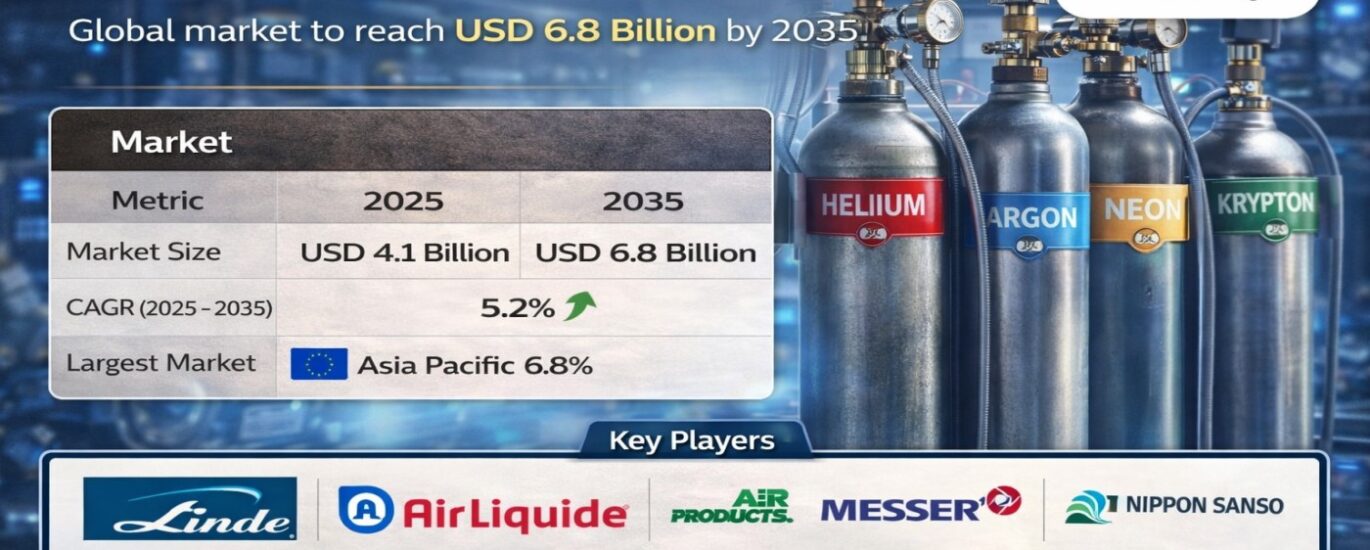
The global rare gas market is projected to expand from USD 4.1 billion in 2025 to USD 6.8 billion by 2035, registering a CAGR of 5.2% over the forecast period. Growth is driven by increasing demand for high-purity specialty gases across manufacturing, electronics, and healthcare sectors, where reliability, precision, and performance are critical.
Rising adoption of rare gases such as argon, helium, and neon in semiconductor fabrication, metal processing, and medical imaging is supporting steady market expansion globally.
Market Overview
Rare gases, also known as noble gases, are inert gases used across a wide range of industrial and scientific applications due to their chemical stability and unique physical properties. These gases play a crucial role in welding, semiconductor manufacturing, cryogenic cooling, and advanced medical diagnostics.
The market includes revenue generated from argon, helium, neon, krypton, and xenon across applications such as metal fabrication, electronics production, healthcare imaging, laser systems, and lighting. Growth is supported by industrial expansion, technological advancements, and increasing demand for ultra-high purity gases.
Key Market Drivers
A primary driver of the market is the growing demand from the electronics industry, particularly semiconductor and display manufacturing, which requires ultra-high purity gases for contamination-free processing.
Industrial manufacturing growth is another key factor, with argon widely used in welding and metal fabrication across automotive, aerospace, and heavy industries.
Additionally, the expansion of healthcare infrastructure is driving demand for helium, which is essential for MRI systems and cryogenic cooling applications.
Request For Sample Report | Customize Report |purchase Full Report – https://www.futuremarketinsights.com/reports/sample/rep-gb-14654
Market Trends and Opportunities
A key trend shaping the market is the shift toward ultra-high purity gas systems, particularly in semiconductor manufacturing, where purity levels of up to 99.9999% are increasingly required.
Another major trend is the transition from traditional cylinder supply to on-site generation and integrated gas delivery systems, improving efficiency and reducing logistics costs.
Opportunities are also emerging from new applications in quantum computing, renewable energy, and space exploration, where rare gases play a critical role in advanced technologies.
Segment Analysis
By gas type, argon dominates the market, accounting for approximately 44.0% share, driven by its widespread use in welding and industrial applications.
By end-use, the manufacturing sector leads with around 38.0% share, supported by strong demand from automotive production, metal fabrication, and industrial processing.
By supply mode, cylinders remain the dominant segment due to established distribution networks and flexibility in delivery.
Regional Outlook
Asia Pacific is expected to lead market growth, driven by rapid expansion in electronics manufacturing, semiconductor production, and industrial activities in countries such as China and India.
North America remains a significant market due to advanced healthcare infrastructure and semiconductor investments.
Europe shows steady growth, supported by strong automotive manufacturing, precision engineering, and increasing adoption of specialty gases in industrial applications.
Country-Level Insights
India is projected to witness strong growth, registering a CAGR of 7.6%, driven by expanding electronics manufacturing, automotive production, and healthcare infrastructure.
China follows with a 5.7% CAGR, supported by large-scale semiconductor fabrication and industrial manufacturing capabilities.
Germany and the United States demonstrate steady growth due to established semiconductor industries, advanced manufacturing, and healthcare demand.
Competitive Landscape
The rare gas market is highly consolidated, with leading players focusing on expanding production capacity, improving purification technologies, and strengthening distribution networks.
Companies are investing in ultra-high purity gas systems, helium recovery solutions, and integrated supply models to maintain competitive advantage.
Strategic partnerships, long-term supply contracts, and regional expansion remain key strategies among major players.
Key Players
Key companies operating in the market include Linde plc, Air Liquide, Air Products and Chemicals, Inc., Messer Group GmbH, Matheson Tri-Gas (Nippon Sanso Holdings), Iwatani Corporation, Air Water Inc., American Gas Products, Axcel Gases, and Nova Gas Technologies Inc.
Market Outlook
The rare gas market is expected to maintain steady growth through 2035, driven by increasing demand from electronics, manufacturing, and healthcare sectors.
As industries continue to prioritize precision, efficiency, and reliability, rare gases will remain essential for advanced industrial and technological applications, offering sustained growth opportunities for market participants.
About Future Market Insights (FMI)
Future Market Insights, Inc. (ESOMAR certified, recipient of the Stevie Award, and a member of the Greater New York Chamber of Commerce) offers profound insights into the driving factors that are boosting demand in the market. FMI stands as the leading global provider of market intelligence, advisory services, consulting, and events for the Packaging, Food and Beverage, Consumer Technology, Healthcare, Industrial, and Chemicals markets. With a vast team of over 400 analysts worldwide, FMI provides global, regional, and local expertise on diverse domains and industry trends across more than 110 countries.
Contact Us:
Future Market Insights Inc.
Christiana Corporate, 200 Continental Drive,
Suite 401, Newark, Delaware – 19713, USA
T: +1-347-918-3531
For Sales Enquiries: sales@futuremarketinsights.com
Website: https://www.futuremarketinsights.com
LinkedIn| Twitter| Blogs | YouTube