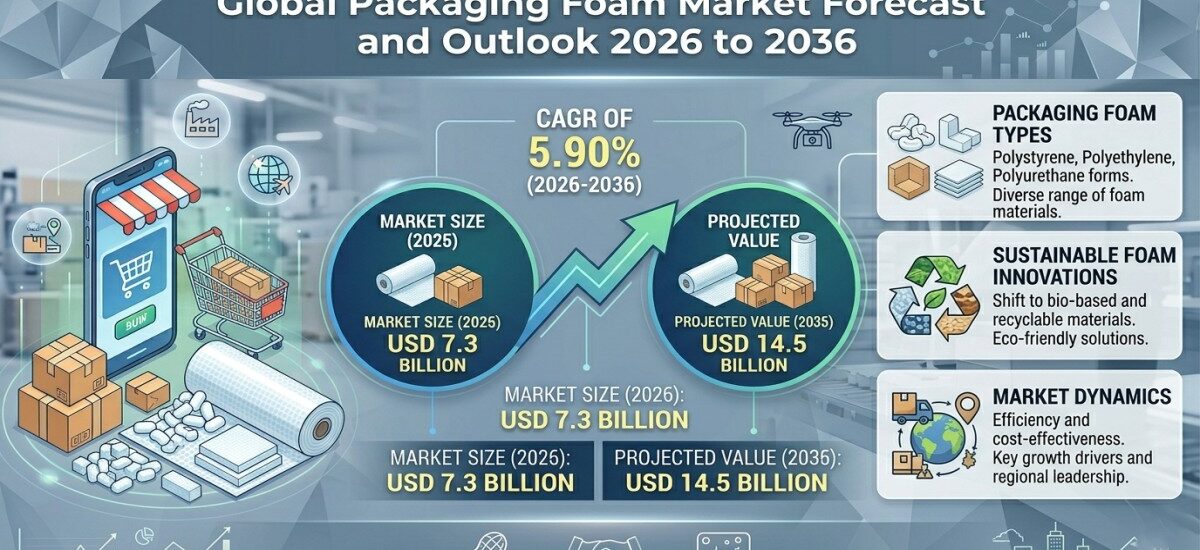
The global Packaging Foam Market is undergoing a structural transformation, shifting from volume-driven growth to efficiency-led value creation. The industry is projected to reach USD 7.3 billion in 2026 and expand to USD 14.5 billion by 2036, registering a CAGR of 5.90% during the forecast period.
Growth is increasingly shaped by a dual-speed economy—on one side, sluggish industrial manufacturing demand, and on the other, rapidly expanding e-commerce fulfillment ecosystems. This divergence is forcing packaging manufacturers to rethink traditional operating models and pivot toward automation and sustainability.
Market Dynamics: Operational Recalibration & Strategic Shift
The packaging foam industry is experiencing a phase of operational recalibration, where efficiency and profitability are becoming more critical than volume growth.
- Sealed Air Corporation reported Q3 2025 revenues of USD 1.35 billion with minimal growth, while its protective packaging segment declined due to weak industrial demand.
- In contrast, Ranpak Holdings Corp. derived 37% of its 2024 revenue from e-commerce channels, highlighting a structural shift toward fulfillment-driven packaging demand.
Discover Growth Opportunities in the Market – Get Your Sample Report Now
https://www.futuremarketinsights.com/reports/sample/rep-gb-4771
Strategic Industry Response:
- Implementation of cost optimization programs (e.g., CTO2Grow initiative)
- Increased investment in automation and digital packaging solutions
- Supply chain rationalization and productivity enhancements
This shift confirms that future competitiveness will rely on operational efficiency, automation, and material optimization.
FMI Analyst Perspective
FMI analysts observe a transition toward a “Bio-Based Substitution Economy,” where value is increasingly generated through sustainable materials and intelligent packaging systems.
Key Observations:
- Petrochemical-based foams are gradually being replaced by compostable and recyclable alternatives
- Automation is enabling on-demand packaging with reduced waste
- Companies are leveraging data-driven packaging optimization strategies
The future of the market will be defined by companies that can integrate material innovation with automation infrastructure.
Key Market Insights
- The market is expected to grow from USD 7.3 billion in 2026 to USD 14.5 billion by 2036
- A steady CAGR of 5.90% reflects resilience despite regulatory pressure
- Polystyrene continues to lead with around 36% share, driven by cold chain demand
- Flexible foam dominates with over 66% share, supported by e-commerce packaging needs
- North America remains the leading region, driven by automation and regulatory frameworks
Key Demand Drivers & Regulatory Pressure
Regulatory “Extinction Events”
Global regulations are fundamentally reshaping the packaging foam landscape, particularly targeting expanded polystyrene (EPS):
- Washington State and Colorado have implemented foam bans
- California’s SB 54 introduces extended producer responsibility with significant financial implications
These developments are forcing manufacturers to transition toward compliant and sustainable alternatives or risk losing market access.
Cost Pressures Driving Innovation
The increasing cost of compliance is:
- Accelerating investment in bio-based materials
- Driving adoption of recyclable and circular solutions
- Reshaping pricing and margin structures
Cold Chain Expansion
Despite regulatory pressure, EPS remains essential in:
- Pharmaceutical logistics
- Vaccine transportation
- Temperature-sensitive food supply chains
This ensures continued demand in high-performance insulation applications.
Product, Material & Technology Innovation
Material Evolution
The market is evolving from traditional materials toward sustainable alternatives:
- Polystyrene (EPS/XPS) remains dominant due to thermal efficiency
- Polyurethane (PU) offers superior cushioning performance
- Polyolefin foams (EPE/EPP) provide lightweight flexibility
- Bio-based foams are emerging as high-growth alternatives
Innovation Trends
- Development of compostable starch-based foams
- Emergence of wool-based and cellulose-based materials
- Introduction of anti-static foams for electronics
- Increased focus on recyclability and circular material systems
Performance Enhancements
- Improved thermal insulation for cold chain logistics
- Enhanced shock absorption for fragile goods
- Greater durability and reusability
Product Type Analysis
Flexible foam continues to dominate the market, accounting for over 66% of total demand. Its adaptability makes it ideal for modern packaging environments, especially in e-commerce where product variability is high.
Unlike rigid foam, flexible foam:
- Requires minimal tooling
- Supports on-demand packaging systems
- Enables faster packing and reduced material waste
Its compatibility with automated packaging systems further strengthens its market position.
Application & End-Use Insights
Packaging foam plays a critical role across multiple industries.
Key Applications:
- Protective inserts
- Edge and corner protectors
- Liners and cushioning layers
- Loose-fill packaging
Major End-Use Industries:
- Consumer electronics, driven by fragile shipments
- Food and beverage, requiring thermal insulation
- Pharmaceuticals, especially cold chain logistics
- Automotive, for export packaging
The rise of e-commerce continues to amplify demand across all these segments.
Regional Outlook
North America
North America leads the global market with a CAGR of approximately 5.20%, driven by:
- Advanced automation in fulfillment centers
- Strong regulatory push toward sustainability
- High adoption of circular packaging systems
Asia-Pacific
Asia-Pacific is characterized by industrial growth and export-driven demand:
- South Korea (4.90% CAGR) benefits from electronics manufacturing
- Japan (4.50% CAGR) focuses on high-quality export packaging
Manufacturers in the region are increasingly adopting compliant materials to meet global regulations.
Europe
Europe’s growth, particularly in the United Kingdom (4.70% CAGR), is shaped by:
- Plastic taxation policies
- Strong sustainability mandates
- Innovation in recycled and high-performance materials
Competitive Landscape
The packaging foam market is evolving into a dual-structure competitive environment.
Strategic Retreat by Large Players
Major conglomerates are exiting low-margin foam segments to focus on more profitable areas.
Specialist Expansion
Companies like Altor Solutions are consolidating niche markets such as cold chain packaging through acquisitions.
Rise of Disruptors
Startups and material innovators are introducing:
- Bio-based alternatives
- Compostable packaging solutions
- Circular material technologies
This is creating a competitive landscape defined by specialization and innovation.
Analyst Perspective: Efficiency as Competitive Advantage
The industry is shifting toward a model where efficiency, automation, and sustainability define success.
Strategic Priorities:
- Reducing material consumption
- Implementing circular economy models
- Integrating automation into packaging workflows
- Enhancing supply chain visibility
Companies that successfully align these elements will gain a long-term competitive advantage.
Future Outlook & Emerging Trends
The next decade will see the packaging foam market shaped by:
- Automation-driven packaging systems replacing manual processes
- Bio-based material innovation reducing reliance on plastics
- Expansion of closed-loop recycling systems
- Growth in temperature-controlled logistics
- Continued strategic divestitures and consolidation
Market Definition
The packaging foam market includes the production and conversion of cellular materials used for:
- Protection
- Cushioning
- Thermal insulation
It encompasses both petrochemical-based foams and bio-based alternatives, across applications ranging from industrial packaging to pharmaceutical logistics.
The scope excludes:
- Raw chemical feedstocks
- Non-foam packaging materials
- Construction insulation products not used in packaging
Why FMI: https://www.futuremarketinsights.com/why-fmi
About Future Market Insights (FMI)
Future Market Insights, Inc. (FMI) is an ESOMAR-certified, ISO 9001:2015 market research and consulting organization, trusted by Fortune 500 clients and global enterprises. With operations in the U.S., UK, India, and Dubai, FMI provides data-backed insights and strategic intelligence across 30+ industries and 1200 markets worldwide.
Contact Us:
Future Market Insights Inc., Christiana Corporate, 200 Continental Drive, Suite 401, Newark, Delaware – 19713, USA
T: +1-347-918-3531
For Sales Enquiries: sales@futuremarketinsights.com
Website: https://www.futuremarketinsights.com
LinkedIn| Twitter| Blogs | YouTube