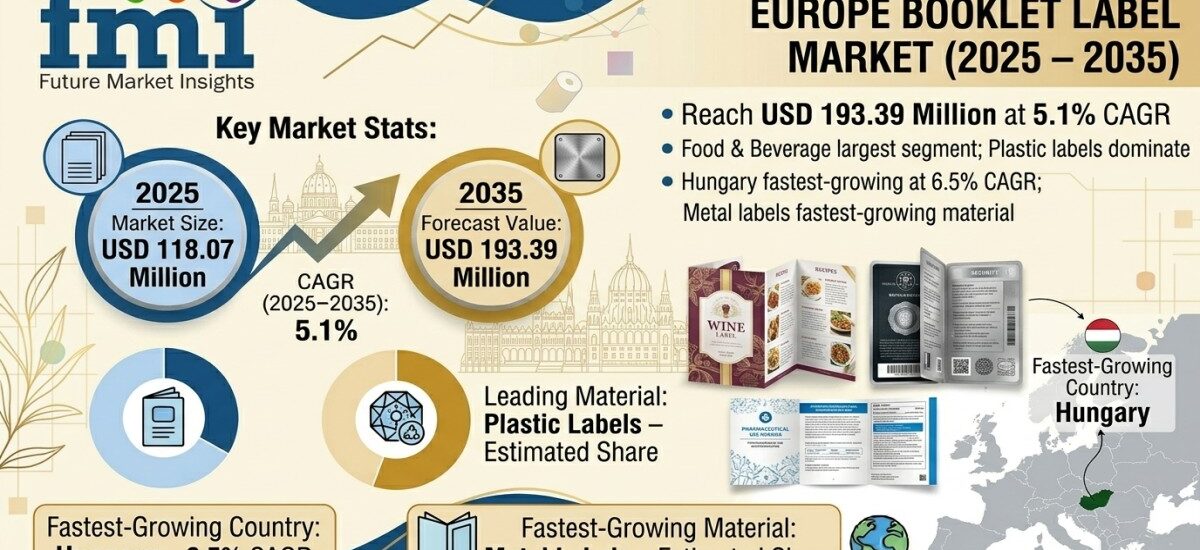
The European booklet label market is witnessing steady growth as industries increasingly adopt advanced labeling solutions to meet evolving regulatory, consumer, and branding demands. In 2025, the market is estimated to be valued at USD 118.07 million and is projected to reach USD 193.39 million by 2035, registering a compound annual growth rate (CAGR) of 5.1% during the forecast period.
Booklet labels, offering multi-layered, space-efficient information delivery, are gaining traction across food and beverages, pharmaceuticals, cosmetics, and logistics sectors. Their ability to combine compliance, marketing, and consumer engagement into a single format positions them as a strategic packaging solution in Europe.
The key growth drivers include rising demand for detailed product information and regulatory compliance, growth in sustainable and eco-friendly labeling solutions, increasing adoption of digital and smart labeling technologies, and the expansion of e-commerce and premium product branding.
Discover Growth Opportunities in the Market – Get Your Sample Report Now
https://www.futuremarketinsights.com/reports/sample/rep-gb-18347
Sales Trend Analysis: 2020–2024 vs. 2025–2035 Outlook
Between 2020 and 2024, the European booklet label market experienced strong momentum driven by the rapid adoption of digital printing technologies, integration of smart features such as QR codes, NFC, and RFID, increased focus on sustainability and recyclable materials, and stringent regulatory frameworks in the food and pharmaceutical sectors.
Looking ahead to 2025–2035, the market is expected to evolve further with growth in interactive labels, including augmented reality-enabled solutions, expansion of AI-driven and automated printing, continued emphasis on green materials and circular packaging, and higher demand for personalized and short-run production. Companies adopting digital-first and sustainable strategies are likely to gain competitive advantage, while traditional players may face cost and innovation pressures.
Key Drivers and Restraints
Technological advancements in digital printing, growing demand for sustainable solutions, and regulatory compliance are high-impact drivers shaping market growth. These drivers enable faster production, high customization, eco-friendly options, and compliance with strict food, pharmaceutical, and cosmetic labeling standards. Consumer preference for interactive labels, smart labeling technologies, branding and personalization, and e-commerce growth represent medium-impact drivers that further accelerate adoption.
On the other hand, high production costs remain the most significant restraint, limiting small-scale players from adopting advanced technologies. Material sourcing challenges, navigating a complex regulatory landscape across multiple countries, limited consumer awareness of smart labels, competition from alternative packaging solutions, environmental impact of printing, space limitations in labels, and limited retail shelf space pose additional medium to low-impact challenges.
Technology, Material, and Innovation Trends
Plastic labels are the dominant material in the European booklet label market, growing at a CAGR of 6.0% due to their durability and versatility. Paper labels are gaining traction for their eco-friendly benefits, growing at a CAGR of 4.5%. Metal labels, favored in premium and luxury segments, are expected to grow fastest at 7.6% CAGR.
In terms of printing technologies, digital printing will be a major driver over the forecast period due to its ability to produce customized, short-run, and on-demand labels. Flexographic printing remains widely used for high-volume production, while lithographic printing is preferred for premium-quality finishes.
Innovation in smart labeling technologies, including RFID, NFC, and QR codes, is enabling enhanced traceability, anti-counterfeiting, and consumer engagement. Augmented reality-enabled labeling, eco-friendly inks, biodegradable substrates, and automation in production are further shaping market trends.
Leading Applications and End-Use Insights
The food and beverage sector dominates the European booklet label market, driven by regulatory requirements for nutrition facts, ingredient transparency, and traceability. Pharmaceuticals follow closely due to stringent safety and compliance standards. Personal care and cosmetics industries are increasingly adopting premium, high-quality labels to reflect brand identity. The chemical and paint industries require durable and resistant labeling solutions, while the automotive sector demands specialized labels for branding and product information. Other industries are also embracing booklet labels to meet specific functional and branding needs.
Regional and Country-Level Insights
Germany leads the European market due to its strong industrial base and strict regulatory standards, growing at a CAGR of 4.2% over the forecast period. Italy, with its prominence in luxury goods, cosmetics, and food, is expected to grow steadily at a CAGR of 4.7%. France remains significant for the food and pharmaceutical sectors, with a CAGR of 4.4%. The United Kingdom shows consistent growth with opportunities for post-Brexit compliance-driven labeling, expected to grow at a CAGR of 5.2%.
Spain’s booklet label industry is projected to grow at a CAGR of 4.8%, fueled by its food, retail, and tourism sectors. Russia is experiencing adoption of smart labeling technologies, growing at a CAGR of 6.0%. Hungary is emerging as a manufacturing hub with an expected CAGR of 6.5%, while Poland’s expanding food, beverage, retail, and e-commerce industries are driving growth at a CAGR of 5.2%.
Competitive Landscape
The European booklet label market is fragmented, combining global leaders with regional innovators. Major players include Avery Dennison, holding an estimated 20–25% market share, UPM Raflatac at 15–20%, Michelman at 10–15%, Sappi at 8–10%, and Henkel at 5–8%. Smaller regional players collectively account for around 25–30% of the market. Other notable companies include Multi-Color Corporation (MCC), CCL Industries, Brady Corporation, Cenveo, MM Packaging, Schreiner Medipharm, Weber Packaging Solutions, and Denny Bros Ltd.
Competitive strategies focus on investing in sustainable materials, expanding digital printing capabilities, developing smart and interactive labels, and forming strategic partnerships or acquisitions.
Analyst Perspective: Strategic Value and Efficiency
Booklet labels are evolving into multi-functional communication tools that blend regulatory compliance, brand storytelling, and consumer engagement. Companies optimizing production efficiency through automation and adopting sustainable practices gain reduced operational costs and stronger positioning. Labels are no longer just packaging; they are strategic assets in the supply chain and marketing mix.
Future Outlook and Emerging Trends
The European booklet label market is set to transform with smart packaging integration, augmented reality experiences, sustainable labeling materials, mass customization through digital printing, and AI-driven production optimization. Over the next decade, booklet labels will become central to intelligent, sustainable, and consumer-focused packaging solutions.
Key Market Insights
The European booklet label market is valued at USD 118.07 million in 2025 and projected to reach USD 193.39 million by 2035, growing at a CAGR of 5.1%. Plastic labels dominate due to their durability, while metal labels are the fastest-growing material. The food and beverage sector remains the largest end-use segment, and Hungary is forecasted as the fastest-growing country in Europe at a CAGR of 6.5%.
Why FMI: https://www.futuremarketinsights.com/why-fmi
About Future Market Insights (FMI)
Future Market Insights, Inc. (FMI) is an ESOMAR-certified, ISO 9001:2015 market research and consulting organization, trusted by Fortune 500 clients and global enterprises. With operations in the U.S., UK, India, and Dubai, FMI provides data-backed insights and strategic intelligence across 30+ industries and 1200 markets worldwide.
Contact Us:
Future Market Insights Inc., Christiana Corporate, 200 Continental Drive, Suite 401, Newark, Delaware – 19713, USA
T: +1-347-918-3531
For Sales Enquiries: sales@futuremarketinsights.com
Website: https://www.futuremarketinsights.com
LinkedIn| Twitter| Blogs | YouTube