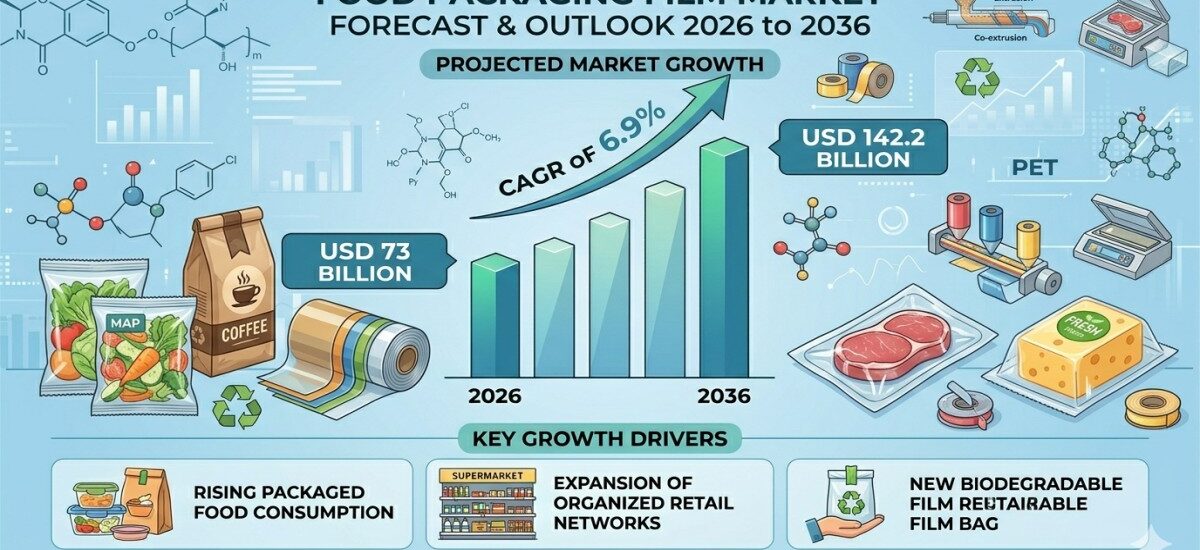
The global food packaging film market is projected to grow significantly, expanding from USD 73 billion in 2026 to USD 142.2 billion by 2036, at a CAGR of 6.9%. This growth is fueled by the increasing demand for convenient, durable, and sustainable packaging solutions across the global food and beverage industry.
Food packaging films comprising materials such as polyethylene (PE), polypropylene (PP), polyethylene terephthalate (PET), and polyamide (PA) play a critical role in preserving freshness, extending shelf life, and ensuring food safety. The shift toward eco-friendly, recyclable, and biodegradable materials, along with advancements in packaging technologies such as modified atmosphere packaging (MAP) and vacuum sealing, is further accelerating market expansion.
Key Growth Drivers
- Rising consumption of packaged and processed foods globally
- Increasing demand for extended shelf life and food safety
- Growing preference for sustainable and recyclable packaging
- Rapid expansion of e-commerce and food delivery ecosystems
Discover Growth Opportunities in the Market – Get Your Sample Report Now
https://www.futuremarketinsights.com/reports/sample/rep-gb-18937
Quick Market Stats
- Market Value (2026): USD 73 Billion
- Forecast Value (2036): USD 142.2 Billion
- CAGR (2026–2036): 6.9%
- Leading Film Type: Flexible Films (58% share)
- Top End-Use Segment: Fresh Produce (43% share)
- Key Growth Regions: Asia Pacific and North America
How is the Global Food Packaging Film Market Advancing?
The market is experiencing strong momentum as food manufacturers increasingly rely on high-performance packaging films to maintain product quality and reduce food waste. These films provide essential barrier protection against moisture, oxygen, and contaminants, making them indispensable across food categories.
A key transformation driver is the global push toward sustainability. Manufacturers are focusing on developing:
- Bio-based and compostable films
- Recyclable mono-material packaging
- Lightweight solutions to reduce material usage
Additionally, the growth of online grocery platforms and ready-to-eat food consumption is increasing demand for packaging films that ensure durability, safety, and extended shelf life.
Segment-Wise Analysis
By Film Type
Flexible films dominate the market with a 58% share, driven by their lightweight structure, versatility, and superior barrier properties. These films can easily conform to different product shapes, making them ideal for packaging a wide variety of food products including snacks, fresh produce, and frozen items.
Other film types such as rigid, shrink, and stretch films also contribute to the market, particularly in applications requiring structural strength and load stability.
By End-Use Application
Fresh produce leads the application segment with a 43% share, as packaging plays a crucial role in maintaining freshness and minimizing spoilage.
Other key applications include bakery and confectionery, meat and poultry, dairy products, and frozen foods. The increasing demand for packaged and perishable food items continues to drive growth across all segments.
Key Demand Drivers and Market Dynamics
Demand for Convenience Foods
Urbanization and evolving lifestyles are driving consumption of ready-to-eat and easy-to-prepare meals, boosting demand for efficient packaging solutions.
Food Safety and Hygiene
Heightened awareness around food safety is accelerating the adoption of advanced packaging films that prevent contamination and extend product shelf life.
Sustainability and Regulations
Stringent environmental regulations are encouraging the use of recyclable and biodegradable packaging materials, prompting innovation across the value chain.
Technology and Material Innovations
Advanced Packaging Technologies
- Multi-layer high-barrier films for enhanced protection
- Modified atmosphere packaging (MAP) for shelf life extension
- Active and intelligent packaging solutions
Material Advancements
- Bio-based and compostable films
- Recyclable mono-material structures
- High-performance polymer blends
Performance Enhancements
- Improved sealing strength and durability
- Enhanced clarity and printability
- Better resistance to punctures and environmental stress
Regional Insights and Country-Level Growth
Asia Pacific
Asia Pacific remains the fastest-growing region, driven by rapid urbanization, rising disposable income, and expansion of the food processing industry.
- China leads with a CAGR of 8.9%, supported by strong demand for packaged and convenience foods
- India follows with an estimated CAGR of around 7.2%, fueled by e-commerce growth and changing consumption patterns
North America
North America continues to show stable growth, led by the United States at a CAGR of 6.4%. Demand is driven by convenience foods, technological innovation, and sustainability initiatives.
Europe
Europe demonstrates steady growth with strong regulatory support for sustainable packaging:
- Germany grows at 6.1% CAGR
- United Kingdom at 5.8% CAGR
Japan
Japan records a CAGR of 5.5%, supported by advancements in packaging technologies and demand for high-quality, convenient food packaging.
Competitive Landscape
The food packaging film market is highly competitive, with key players focusing on innovation, sustainability, and performance optimization.
Key Companies
- Amcor plc
- Sealed Air Corporation
- Berry Global Inc.
- Bemis Company Inc. (Amcor)
- Mondi Group
- Coveris Holdings SA
- Winpak Ltd.
- Uflex Limited
- Toray Plastics (America) Inc.
- Taghleef Industries
Strategic Focus Areas
- Development of recyclable and bio-based films
- Expansion of high-barrier multi-layer film technologies
- Mergers and acquisitions for market consolidation
- Investment in R&D and advanced manufacturing capabilities
Analyst Perspective: Operational Efficiency and Strategic Value
Food packaging films are increasingly viewed as strategic assets that enhance supply chain efficiency and reduce operational costs. Their lightweight design lowers transportation expenses, while advanced barrier properties help minimize food waste.
Companies are leveraging packaging innovations to align with sustainability goals, improve product differentiation, and meet regulatory requirements. As a result, packaging films are becoming central to both operational performance and brand positioning.
Future Outlook and Emerging Trends
The food packaging film market is expected to evolve rapidly, driven by technological advancements and sustainability initiatives.
Emerging Trends
- Transition toward circular economy packaging models
- Increased adoption of smart and intelligent packaging
- Growth in mono-material recyclable films
- Rising use of AI in packaging design and optimization
- Expansion of e-commerce-friendly packaging solutions
The future of the market will be shaped by the integration of sustainability, innovation, and performance, ensuring long-term growth and competitiveness.
Why FMI: https://www.futuremarketinsights.com/why-fmi
About Future Market Insights (FMI)
Future Market Insights, Inc. (FMI) is an ESOMAR-certified, ISO 9001:2015 market research and consulting organization, trusted by Fortune 500 clients and global enterprises. With operations in the U.S., UK, India, and Dubai, FMI provides data-backed insights and strategic intelligence across 30+ industries and 1200 markets worldwide.
Contact Us:
Future Market Insights Inc., Christiana Corporate, 200 Continental Drive, Suite 401, Newark, Delaware – 19713, USA
T: +1-347-918-3531
For Sales Enquiries: sales@futuremarketinsights.com
Website: https://www.futuremarketinsights.com
LinkedIn| Twitter| Blogs | YouTube