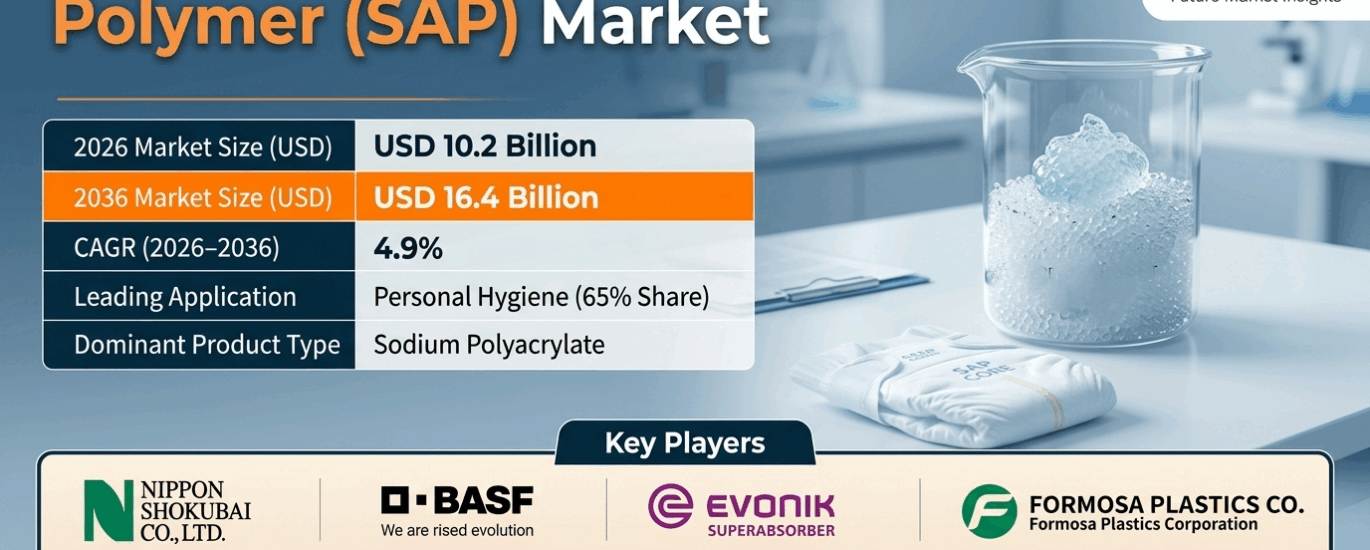
The global super absorbent polymer (SAP) market is entering a steady growth phase, projected to increase from USD 10.2 billion in 2026 to USD 16.4 billion by 2036, representing a CAGR of 4.9%, according to Future Market Insights (FMI). Growth is largely driven by rising diaper and hygiene product adoption in emerging markets, coupled with increasing demand for adult incontinence and agricultural water-retention solutions.
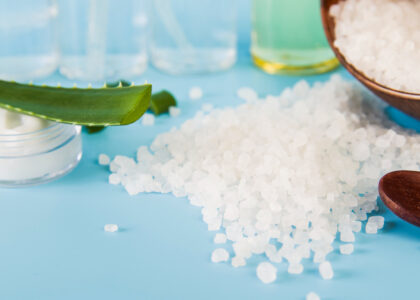
Super absorbent polymers, primarily sodium polyacrylate, are cross-linked polymer networks capable of absorbing 300–500 times their weight in liquid while maintaining structural integrity. They are critical components in personal hygiene products, medical applications, and agriculture.
Key Market Drivers
- Hygiene Penetration in Emerging Economies: India (7.2% CAGR) and China (5.8% CAGR) are leading volume growth due to increasing diaper adoption and expanding middle-class populations.
- Premiumization in Mature Markets: The United States (6.8%), Germany (5.2%), and the United Kingdom (6.3%) are showing steady replacement-driven demand for thin-core, high-performance SAP grades.
- Agricultural Applications: Rising water scarcity drives adoption of water-retention SAPs to improve crop yields and soil moisture retention.
- Sustainability Focus: Bio-based or partially bio-based SAPs and carbon-footprint-reduced products are becoming strategic differentiators, particularly in Europe.
Request For Sample Report | Customize Report |purchase Full Report – https://www.futuremarketinsights.com/reports/sample/rep-gb-429
Market Segmentation Highlights
- By Type: Sodium polyacrylate dominates with 65% market share, owing to high absorption efficiency, gel strength, and cost-to-scale advantages.
- By Feedstock: Petro-based SAP leads with 90% share, supported by established acrylic acid supply chains and large-scale production infrastructure.
- By Application: Personal hygiene remains the largest segment, followed by agriculture, medical, and industrial absorbent solutions.
- By Region: Asia-Pacific drives growth, while Europe and North America focus on premium and sustainability-led adoption.
Regional Insights
- Asia-Pacific: India and China are the primary growth engines, fueled by rising healthcare access and diaper penetration. Nippon Shokubai’s expansion in Indonesia highlights strategic capacity growth to meet regional demand.
- Europe: Germany and Poland are seeing steady growth, driven by sustainability-linked product introductions, such as BASF’s HySorb® B 6610 ZeroPCF, the first SAP marketed with a zero product carbon footprint.
- North America: Replacement demand dominates, with a focus on ultra-thin diaper-grade SAP to optimize performance under pressure.
- Latin America: Brazil and other markets are growing steadily with increased hygiene product adoption and better supply chain reliability.
Competitive Landscape
The SAP market remains concentrated among global leaders capable of large-scale production, acrylic acid integration, and technical support for converters:
- Nippon Shokubai Co., Ltd.
- BASF SE
- Evonik Superabsorber (Evonik Industries AG)
- Sumitomo Seika Chemicals Co., Ltd.
- LG Chem Ltd.
- Formosa Plastics Corporation
- Wanhua Chemical Group Co., Ltd.
These companies leverage cost efficiency, production scale, and regulatory compliance to maintain market leadership while supporting hygiene and medical OEMs with high-performance SAP grades.
Strategic Takeaways
- Premiumization Over Volume: Focus on high-performance, ultra-thin diaper SAP grades to capture incremental revenue.
- Sustainability as Necessity: Bio-based feedstock adoption and carbon-reduction initiatives are no longer optional.
- Regional Expansion: South Asia and Asia-Pacific offer high-growth opportunities, while mature markets require product upgrade strategies.
- Feedstock Risk Management: Cost volatility in acrylic acid and energy-intensive production emphasizes the need for integrated procurement strategies.
Future Outlook
FMI’s analysis indicates a balanced growth trajectory, with SAP demand increasingly tied to demographics, premiumization, and sustainability. Manufacturers are expected to invest in specialty applications, renewable feedstocks, and regional production expansions to sustain competitiveness in the next decade.
By 2036, the SAP market is poised to achieve USD 16.4 billion, with Asia-Pacific leading adoption and Europe and North America focusing on performance and low-footprint solutions, solidifying SAP’s position as a critical input across hygiene, medical, and agricultural applications.
About Future Market Insights (FMI)
Future Market Insights, Inc. (ESOMAR certified, recipient of the Stevie Award, and a member of the Greater New York Chamber of Commerce) offers profound insights into the driving factors that are boosting demand in the market. FMI stands as the leading global provider of market intelligence, advisory services, consulting, and events for the Packaging, Food and Beverage, Consumer Technology, Healthcare, Industrial, and Chemicals markets. With a vast team of over 400 analysts worldwide, FMI provides global, regional, and local expertise on diverse domains and industry trends across more than 110 countries.
Contact Us:
Future Market Insights Inc.
Christiana Corporate, 200 Continental Drive,
Suite 401, Newark, Delaware – 19713, USA
T: +1-347-918-3531
For Sales Enquiries: sales@futuremarketinsights.com
Website: https://www.futuremarketinsights.com
LinkedIn| Twitter| Blogs | YouTube