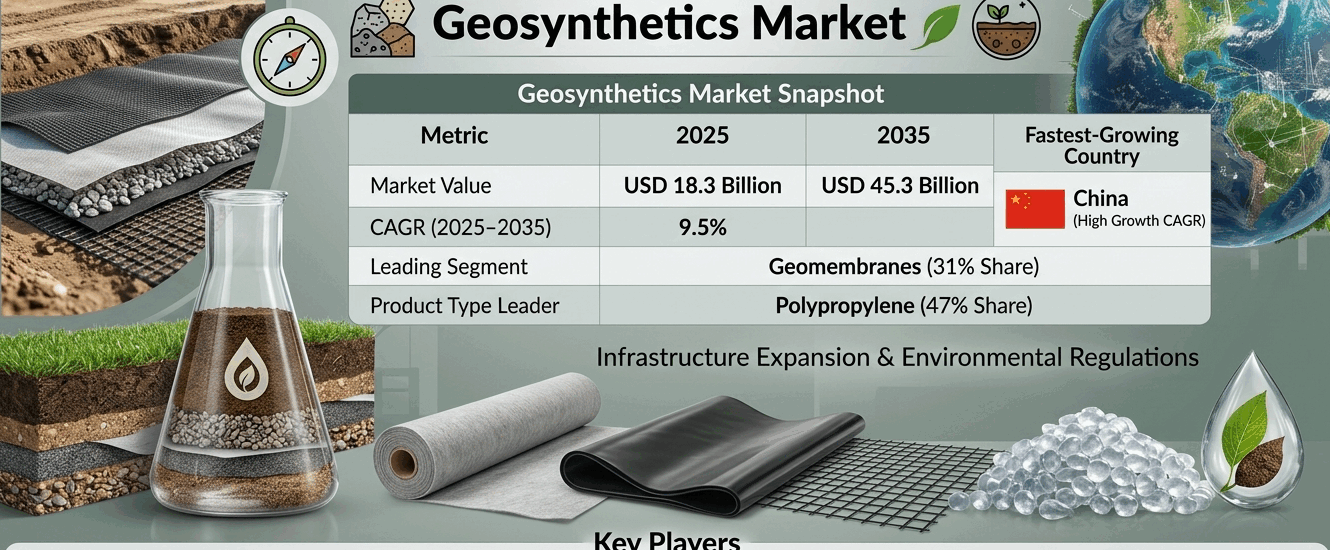
The global geosynthetics market is projected to grow from USD 18.3 billion in 2025 to USD 45.3 billion by 2035, representing a CAGR of 9.5%. Growth is primarily driven by infrastructure expansion, waste containment requirements, and increasing regulatory pressure on construction and environmental standards.
Geosynthetics include geotextiles, geomembranes, geogrids, and geonets, deployed across applications such as roadways, railways, landfills, mining, and coastal engineering. In transportation infrastructure, they improve soil stability, erosion control, and extend the service life of paved and unpaved surfaces. Regulatory support, such as the U.S. Department of Transportation (DOT) guidance on geotextiles in highway construction, has further encouraged adoption in federal and state projects.
Quick Stats for the Geosynthetics Market
- Market Value (2025): USD 18.3 billion
- Forecast Value (2035): USD 45.3 billion
- Forecast CAGR (2025–2035): 9.5%
- Leading Product Segment (2025): Geomembranes (31%)
- Key Growth Regions: China, India, European Union (infrastructure and environmental projects)
- Top Players: Solmax (TenCate), HUESKER, GSE Environmental, NAUE, Tensar
Request For Sample Report | Customize Report |purchase Full Report – https://www.futuremarketinsights.com/reports/sample/rep-gb-475
Market Growth and Forecast
- Infrastructure Projects: Geosynthetics improve soil stability, drainage, and erosion control in roads, railways, and coastal construction.
- Landfill Applications: Used in base liners and capping systems to prevent leachate contamination and comply with stricter municipal waste regulations.
- Oil & Gas Sector: Geomembranes deployed in containment ponds and secondary spill prevention systems to protect surface water.
- Product Development: Manufacturers like TenCate, NAUE, and Fibertex are introducing woven and non-woven geotextiles with improved permeability and tensile strength for high-load applications.
- Market Drivers: Continued infrastructure investment, stricter environmental regulations, and adoption across civil engineering and waste containment projects.
Regulatory Landscape
- Material Standards: ASTM International and ISO set tensile strength, permeability, and chemical resistance benchmarks for consistent product performance.
- Environmental Regulations: Guidelines minimize environmental impact during production, installation, and disposal. Critical in landfill liners and erosion control applications.
- Certification & Testing: Mandatory testing and certifications ensure safety, performance, and compliance with local and international standards.
- Installation Guidelines: Authorities mandate proper installation and maintenance protocols for long-term functionality.
Certification Requirements
- ASTM International Standards: Widely recognized testing standards for geosynthetics.
- ISO 9001: Quality management certification ensuring consistent product quality and manufacturing processes.
- Geosynthetic Institute (GSI) Certification: Validates compliance with industry-specific geosynthetics requirements.
- CE Marking: Certifies conformity with EU safety, health, and environmental requirements.
- NSF Certification: For water and wastewater applications, ensuring safe contact with potable water.
Market Insights by Product and Material
- Geomembranes: Expected to account for 31% of the market in 2025 with a CAGR of 9.6%. Used in landfill liners, mining leach pads, wastewater facilities, and water reservoirs. Driven by environmental regulations and global investment in waste management and water infrastructure.
- Polypropylene: Projected to hold 47% of the market share in 2025, CAGR of 9.7%. Chosen for high tensile strength, UV resistance, chemical inertness, and cost efficiency. Widely applied in road construction, coastal protection, and erosion control systems.
Challenges and Opportunities
Challenges:
- Fluctuating raw material prices due to dependency on polyethylene, polypropylene, and crude oil.
- Strict environmental legislation for plastic-based materials.
- Diverse and non-uniform international certifications creating compliance challenges.
- Need for bio-based geosynthetics and uniform global standards.
Opportunities:
- Increasing demand from infrastructure projects and green building initiatives.
- Use in soil stabilization, drainage, erosion control, and landfill protection.
- Investment in smart cities, transportation networks, and water management projects.
- Potential for green and biodegradable geosynthetics and digital monitoring technologies in geotechnical applications.
Regional Outlook
- USA: CAGR 10.1%; growth fueled by modernization of infrastructure, federal funding (Bipartisan Infrastructure Law), coastal protection, and landfill containment.
- United Kingdom: CAGR 9.2%; adoption in sustainable construction, flood protection, and transportation infrastructure, with increased use of recycled and biodegradable geosynthetics.
- European Union: CAGR 9.6%; driven by environmental regulations, road and rail projects, and water management initiatives. Key countries include Germany, Italy, and France.
- Japan: CAGR 9.4%; demand from disaster preparedness, urban development, and climate adaptation infrastructure.
- South Korea: CAGR 9.5%; growth supported by government infrastructure investments, mining applications, and sustainable construction projects.
Competitive Landscape
- Key players focus on quality control, local inventories, and technical support.
- Specialized product lines include geotextiles, geogrids, geomembranes, and erosion control systems.
- Manufacturers target applications in soil stabilization, separation, filtration, and reinforcement for road, rail, and coastal infrastructure.
- Notable Launches: In 2024, Wrekin Products launched GeoWorks, offering a comprehensive range of geosynthetics for civil engineering and environmental projects, emphasizing quality, inventory management, and technical support.
Market Outlook
The geosynthetics market is set for strong growth through 2035, driven by infrastructure expansion, environmental regulations, and sustainable construction initiatives. Geomembranes and polypropylene-based geosynthetics will continue to dominate due to their performance, durability, and cost efficiency, while innovations in green and high-performance materials will create new opportunities for global manufacturers.