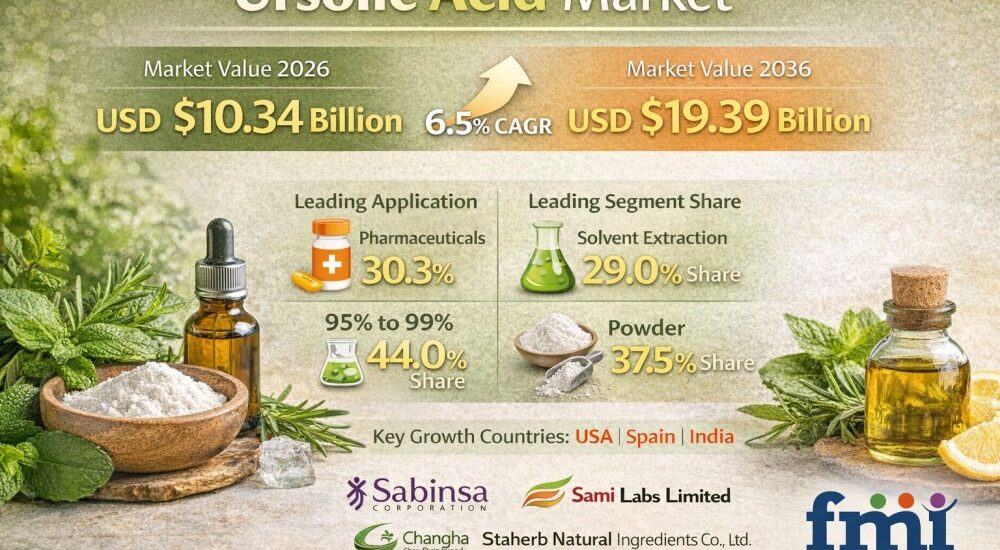
The global ursolic acid market is entering a transformative growth phase, projected to expand from USD 10.34 billion in 2026 to USD 19.39 billion by 2036, achieving a robust CAGR of 6.5%. Once a niche botanical compound, ursolic acid is now transitioning into a specification-driven active sought by pharmaceutical, cosmetic, and functional nutrition developers. This growth is fueled by the ingredient’s measurable bioactivity, standardized purity, and scalable application potential, making it a critical component of structured product pipelines.
Market Growth Drivers:
- Specification-led procurement: Buyers increasingly prioritize assay range, batch reproducibility, and solvent compliance over plant origin.
- Cross-industry adoption: Pharmaceuticals (30.3% share), cosmetics, and functional foods are expanding addressable demand.
- High-purity demand: 95–99% purity accounts for 44% of market purchases, supporting predictable dosing, stability, and formulation control.
- Powdered form dominance: Powder formats (37.5% share) allow flexible downstream processing across capsules, tablets, and blends.
Request For Sample Report | Customize Report |purchase Full Report – https://www.futuremarketinsights.com/reports/sample/rep-gb-2675
Emerging Trends:
- Solvent extraction remains the leading method (29% share) due to industrial-scale efficiency and process reliability.
- Multi-application usability drives standardized grades, enabling suppliers to serve diverse customer segments with the same purity and quality benchmarks.
- Increasing attention to documentation, compliance, and audit readiness reduces supplier churn and strengthens long-term relationships.
Regional Insights:
- USA: Fastest growth at 7.1% CAGR, fueled by a mature nutraceutical ecosystem, structured supplementation habits, and innovation pipelines in pharmaceuticals and wellness products.
- India: Growth at 6.1% CAGR driven by manufacturing expansion, export relevance, and domestic demand across functional foods and cosmetics.
- Spain: Moderate growth at 5.6% CAGR, with adoption guided by regulatory quality expectations and structured botanical sourcing.
Competitive Landscape:
The market is moderately consolidated, with competition shaped by manufacturing control, purification capability, and specification transparency. Leading players include:
Sabinsa Corporation, Sami Labs Limited, Changsha Staherb Natural Ingredients Co., Ltd., Changsha Luyuan Bio-Tech Co., Ltd., Shaanxi Hopeland Chem-Tech Co., Ltd., Xuancheng Baicao Pharmaceutical Co., Ltd., Shaanxi Huike Botanical Development Co., Ltd., Changsha E.K Herb Co., Ltd., Hunan NutraMax Inc., Shaanxi Jintai Biological Engineering Co., Ltd., Zhangjiajie Hengxing Biological Technology Co., Ltd., Xi’an TonKing Biotech Co., Ltd.
Suppliers differentiate through:
- Consistent assay ranges and batch reproducibility
- Application guidance for powder, capsule, and liquid extract formats
- Supply reliability and structured procurement support
Analyst Insights / Strategic Outlook:
“Ursolic acid is no longer a botanical curiosity—it’s evolving into a highly standardized, specification-driven ingredient critical for premium pharmaceuticals, cosmetics, and functional foods,” notes a senior industry analyst. “Companies that integrate quality assurance, purity consistency, and multi-format usability will define market leadership and secure repeat B2B partnerships.”