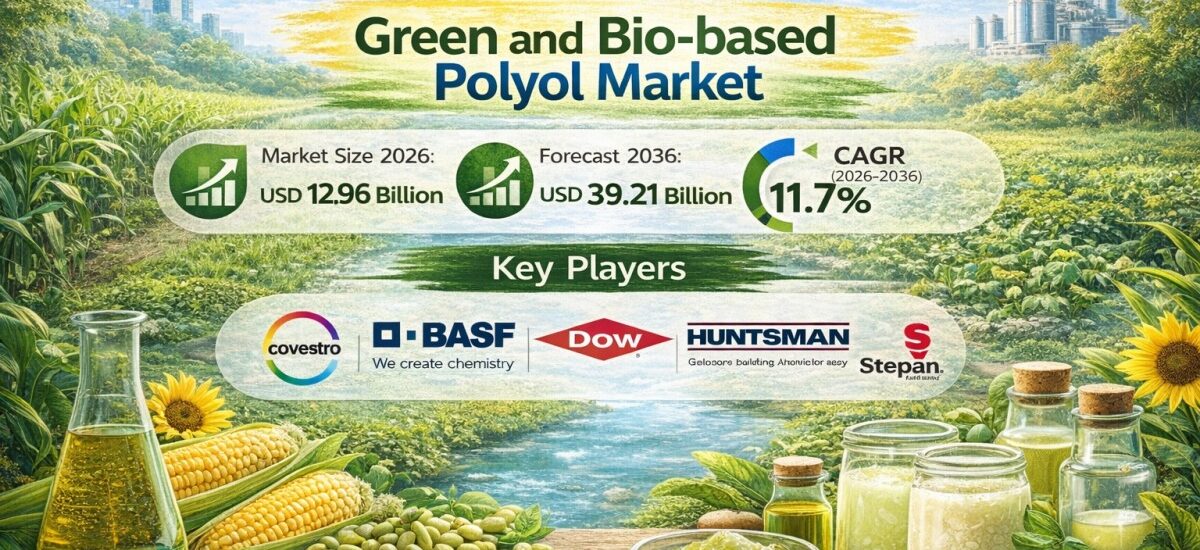
The global green and bio-based polyol market is entering a decisive growth phase, with valuation projected to rise from USD 11.60 billion in 2025 to USD 39.21 billion by 2036, expanding at a robust CAGR of 11.7%, according to new analysis by Future Market Insights (FMI). Estimated to reach USD 12.96 billion in 2026, the market is expected to generate an incremental opportunity of USD 27.61 billion over the forecast period—signaling a structural transformation rather than incremental growth.
At the core of this expansion is a fundamental reconfiguration of polyurethane supply chains, where renewable and recycled feedstocks are steadily replacing petroleum-based polyols across high-volume applications such as insulation, automotive interiors, and furniture foams.
Sustainability Mandates and Construction Demand Drive Market Expansion
The surge in demand for green and bio-based polyols is being shaped by regulatory pressure, corporate decarbonization goals, and the growing influence of green building certifications.
Key growth drivers include:
- Construction sector dominance: Accounting for 44% of total demand in 2026, driven by insulation requirements aligned with energy efficiency codes
- Automotive transition: OEMs and Tier-1 suppliers increasingly adopting bio-based foam systems to meet Scope 3 emission targets
- Furniture and bedding demand: Brands integrating sustainable materials to meet retailer procurement standards
- Carbon transparency requirements: Increasing need for auditable, low-carbon material inputs across global supply chains
The shift is particularly pronounced in insulation applications, which are expected to hold a 34% market share in 2026, reflecting their critical role in reducing building energy consumption.
Request For Sample Report | Customize Report |purchase Full Report – https://www.futuremarketinsights.com/reports/sample/rep-gb-273
Digital Tools and Mass-Balance Certification Reshape Procurement
A defining trend in the market is the emergence of digital transparency platforms and certification-backed supply chains. Companies like Covestro AG are leading innovation with tools such as the CQ-Configurator, enabling real-time calculation of CO₂ footprints in polyurethane formulations.
Simultaneously, mass-balance certification systems such as ISCC PLUS are gaining traction, allowing manufacturers to verify renewable or circular content across complex supply chains without disrupting existing production processes.
Other notable developments include:
- Biomass-balanced product launches by BASF SE
- ISCC PLUS-certified polyol production by Dow Inc.
- Circular feedstock innovations from Wanhua Chemical Group Co., Ltd.
These advancements are reducing procurement friction while strengthening the credibility of sustainability claims.
Asia Leads Growth, While Western Markets Focus on Compliance
Regionally, East Asia is emerging as the epicenter of growth, accounting for 27% of global demand, supported by large-scale polyurethane production and strong regulatory push toward low-carbon materials.
- China is forecast to expand at a CAGR of 13.4%, driven by green building standards and industrial decarbonization policies
- India follows closely at 12.8%, fueled by housing programs and automotive manufacturing growth
- Brazil (12.1%) benefits from abundant bio-feedstocks such as soy-based inputs
- United States (10.5%) growth is driven by ESG-aligned procurement and retrofit demand
- Europe remains compliance-driven, with moderate growth (8.6%–9.2%) led by regulatory enforcement
This divergence highlights a dual-speed market: volume-driven expansion in Asia versus policy-driven adoption in Western economies.
Competitive Landscape: Sustainability Verification Becomes a Differentiator
The competitive environment remains moderately fragmented, with leading players focusing on integrating sustainability with performance.
Key companies operating in the market include:
Covestro AG, BASF SE, Dow Inc., Huntsman Corporation, Stepan Company, Mitsui Chemicals, Inc., Tosoh Corporation, Manali Petrochemicals Limited, Wanhua Chemical Group Co., Ltd., Monument Chemical LLC, Econic Technologies, Carlisle Construction Materials.
Strategic priorities for market participants include:
- Developing drop-in bio-based polyols to minimize requalification cycles
- Expanding certified product portfolios aligned with ESG requirements
- Strengthening application-specific formulation support
- Building long-term supply agreements with OEMs and construction firms
Notably, companies that can combine verified sustainability attributes with consistent performance and supply reliability are gaining pricing power in a specification-driven market.
Analyst Perspective: From Niche Substitution to Structural Transition
According to FMI, the green and bio-based polyol market has moved beyond early-stage adoption into a structural transition phase within the broader chemicals industry.
“Stakeholders are no longer asking whether to adopt sustainable polyols, but where and how fast they can scale them,” notes an FMI analyst. “The competitive edge now lies in traceability, certification readiness, and the ability to align with customer ESG frameworks.”
Future Outlook: High-Value Growth Anchored in Verified Sustainability
Looking ahead, the market’s trajectory will be shaped by the balance between cost competitiveness and sustainability verification. While conventional polyols will retain share in price-sensitive segments, bio-based and circular alternatives are expected to dominate specification-led applications.
Opportunities are particularly strong in:
- Energy-efficient construction materials
- Automotive lightweighting and interiors
- Circular economy initiatives in polyurethane recycling
As sustainability transitions from a branding exercise to a compliance requirement, green and bio-based polyols are poised to become a cornerstone of next-generation material strategies.
About Future Market Insights (FMI)
Future Market Insights, Inc. (ESOMAR certified, recipient of the Stevie Award, and a member of the Greater New York Chamber of Commerce) offers profound insights into the driving factors that are boosting demand in the market. FMI stands as the leading global provider of market intelligence, advisory services, consulting, and events for the Packaging, Food and Beverage, Consumer Technology, Healthcare, Industrial, and Chemicals markets. With a vast team of over 400 analysts worldwide, FMI provides global, regional, and local expertise on diverse domains and industry trends across more than 110 countries.
Contact Us:
Future Market Insights Inc.
Christiana Corporate, 200 Continental Drive,
Suite 401, Newark, Delaware – 19713, USA
T: +1-347-918-3531
For Sales Enquiries:
Website: https://www.futuremarketinsights.com
LinkedIn| Twitter| Blogs | YouTube