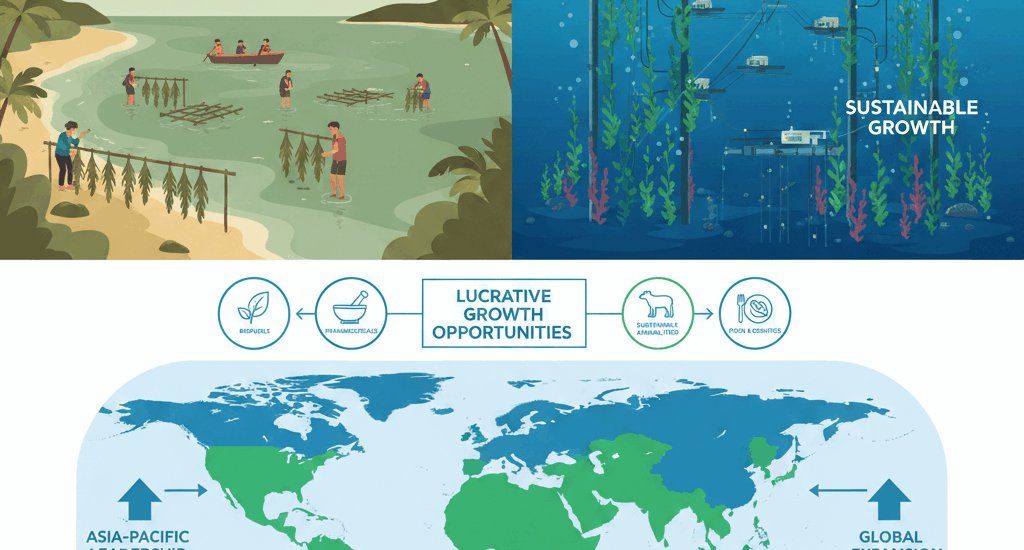
Commercial seaweed aquaculture has transformed remarkably over the past few decades. Valued as a multi-billion-dollar industry, the sector is witnessing lucrative growth opportunities driven by innovative harvesting techniques and sustainable cultivation practices. With mounting environmental concerns and climate change affecting marine ecosystems, commercial seaweed farmers are shifting focus from wild harvesting to controlled, high-yield cultivation.
This transition is not only improving production efficiency but also addressing environmental sustainability, allowing stakeholders to balance profitability with ecological responsibility.
Asia Pacific Dominates Global Seaweed Production
The Asia Pacific region has traditionally led global seaweed cultivation, with countries like Indonesia, China, the Philippines, and South Korea at the forefront. These nations have implemented large-scale enhancement projects that promote the commercial production of red seaweeds.
- Red seaweed applications: Primarily used as a thickening agent in cosmetic and industrial food products.
- Emerging opportunities: Biofuels, nutraceuticals, pharmaceuticals, and sustainable animal feeds.
For example, The Nature Conservancy (TNC) has invested in seaweed aquaculture projects in Indonesia over the past four years, fostering local production while boosting economic benefits for coastal communities. According to the World Bank, commercial seaweed farming in tropical Asia has the potential to improve environmental health, enhance food security, and generate significant local income.
Growth Expands Across Europe and North America
While Asia Pacific continues to dominate, Europe and North America are showing notable progress. Small-scale commercial and pilot projects are emerging across these regions, providing insight into scalable production models. Operators are experimenting with cost-effective and robust farming systems designed to withstand offshore conditions, reduce fouling organisms, and optimize growth of disease-resistant, thermally tolerant seaweed strains.
Innovations in Seaweed Cultivation Technology
The industry is witnessing the integration of advanced cultivation and harvesting technologies, including:
- Automated seeding and harvesting systems
- Floating offshore farming structures
- Disease and pest-resistant strain development
These innovations are enabling higher yield per hectare while minimizing labor costs and environmental footprint. Companies in the commercial seaweed value chain are increasingly investing in research to produce resilient strains with rapid growth, high thermo tolerance, and minimal fouling.
Underwater Seaweed Farming Emerges as Climate Solution
Environmental concerns are driving research into the potential of underwater seaweed forests as a tool to combat climate change. Scientists across Asia Pacific are exploring how submerged seaweed cultivation can absorb carbon, support biodiversity, and maintain marine ecosystem balance.
- Pacific island governments, such as New Zealand, are allocating funds to streamline seaweed aquaculture projects.
- Researchers believe underwater seaweed farming could be the next major breakthrough in sustainable marine agriculture.
These developments reflect a growing recognition of the dual role of seaweed as both an economic commodity and an environmental ally.
Future Outlook: Global Expansion and Diversification
The commercial seaweed market is poised for substantial growth as it extends beyond its traditional East Asian stronghold. North America and Europe are anticipated to become significant players, adopting sustainable, technologically advanced farming practices.
Key growth drivers include:
- Rising demand for seaweed-based nutraceuticals and functional foods
- Increasing investment in climate-resilient aquaculture systems
- Expanding industrial applications of seaweed-derived products
Unlock the Full Potential of Commercial Seaweed Farming
With global demand for commercial seaweed on the rise, stakeholders are presented with opportunities to enhance profitability, sustainability, and societal impact. From food security to renewable energy solutions, seaweed aquaculture continues to evolve into a cornerstone of sustainable marine industry practices.
Uncover all the data—grab the full report today. https://www.futuremarketinsights.com/articles/sustainable-commercial-seaweed-farming-techniques-intensify