The Hidden Economics of Downstream Processing: Why Resin Performance Trumps Price
In the world of monoclonal antibody (mAb) production, a persistent paradox exists: while upstream titers have skyrocketed over the last decade, the cost of goods (COGS) hasn’t dropped proportionally. Instead, the bottleneck has shifted. Downstream processing (DSP) now frequently accounts for 50% to 80% of total manufacturing costs.
At the heart of this economic challenge sits chromatography. Specifically, the “Capture” step—typically utilizing Protein A resin—is the single most significant consumable expense in the entire process. To optimize biologics production, manufacturers must look past the sticker price of resins and evaluate the structural economic levers of capacity, stability, and lifetime.
The Chromatography Cost Burden
While polishing resins like ion-exchange (IEX) or hydrophobic interaction (HIC) are essential, Protein A is in a price bracket of its own. It can cost ten times more than standard resins, making its utilization per liter far more critical than its unit price.
As titers rise, the mass of the protein increases, but so does the downstream load. If a resin has a low Dynamic Binding Capacity (DBC), manufacturers are forced to use larger columns or more cycles, which increases the demand for buffers and Water-for-Injection (WFI), as well as the overall facility footprint.
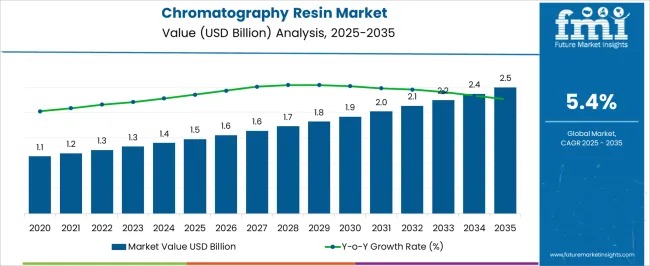
Exhaustive Market Report: A Complete Study
https://www.futuremarketinsights.com/reports/chromatography-resin-market
How Much of COGS Comes from Chromatography?
Techno-economic analyses reveal that the capture step represents a massive share of commercial-scale costs. This is because resin isn’t just a material; it’s a validated asset with a specific “cycle life.” The true cost isn’t what you pay for the bottle; it’s the cost per gram of purified protein over the resin’s entire functional lifespan.
Performance Factors: The True Drivers of ROI
To move the needle on COGS, three performance metrics matter more than any others:
- Resin Capacity (DBC): High capacity at practical residence times allows for smaller columns and shorter campaign times. This reduces labor and the physical space required for production.
- Alkaline Stability: To prevent cross-contamination, resins must undergo rigorous Clean-in-Place (CIP) cycles using sodium hydroxide ($NaOH$). A resin that degrades after 50 cycles is exponentially more expensive than one that remains stable for 200 cycles.
- Cycle Lifetime: Spreading the initial capital outlay over hundreds of cycles is the most effective way to lower the “per-gram” cost.
Key Insight: A “cheap” resin with limited alkaline stability often leads to higher total costs due to early replacement risks and increased wastewater management needs.
Intensification: A Double-Edged Sword
To combat high costs, many manufacturers are moving toward Continuous Multicolumn Chromatography (MCC). By cycling smaller columns more frequently, resin utilization stays near 100%.
While intensification can significantly reduce total resin volume and buffer consumption, it places immense mechanical and chemical stress on the media. If the resin cannot withstand high cycle numbers and aggressive cleaning, the economic benefits of an intensified process evaporate. Robust resin chemistry is the foundation upon which process intensification is built.
The Indirect Costs: Water and Footprint
Resin selection also dictates the “hidden” costs of a facility. Chromatography requires massive volumes of buffer for equilibration, washing, and elution.
- Buffer Demand: Higher capacity resins require fewer column volumes (CVs) relative to the product mass.
- WFI Usage: Generating Water-for-Injection is energy-intensive. Reducing wash volumes directly lowers utility bills.
- Waste Management: Every liter of buffer used eventually becomes a liter of wastewater that must be treated.
By choosing a resin that optimizes flow rates and loading strategies, manufacturers can shrink their environmental footprint and operational expenditure (OPEX) simultaneously.
Conclusion: A Structural Economic Lever
In modern bioprocessing, chromatography resin should be viewed as a structural economic lever rather than a routine consumable. Early-stage process design must incorporate realistic cost modeling—factoring in resin lifetime, cleaning compatibility, and mass-per-cycle. For suppliers and manufacturers alike, the goal is clear: maximize the grams processed per liter of resin to ensure long-term commercial competitiveness.
Why Choose FMI: Empowering Decisions that Drive Real-World Outcomes: https://www.futuremarketinsights.com/why-fmi
About Future Market Insights (FMI)
Future Market Insights, Inc. (FMI) is an ESOMAR-certified, ISO 9001:2015 market research and consulting organization, trusted by Fortune 500 clients and global enterprises. With operations in the U.S., UK, India, and Dubai, FMI provides data-backed insights and strategic intelligence across 30+ industries and 1200 markets worldwide.