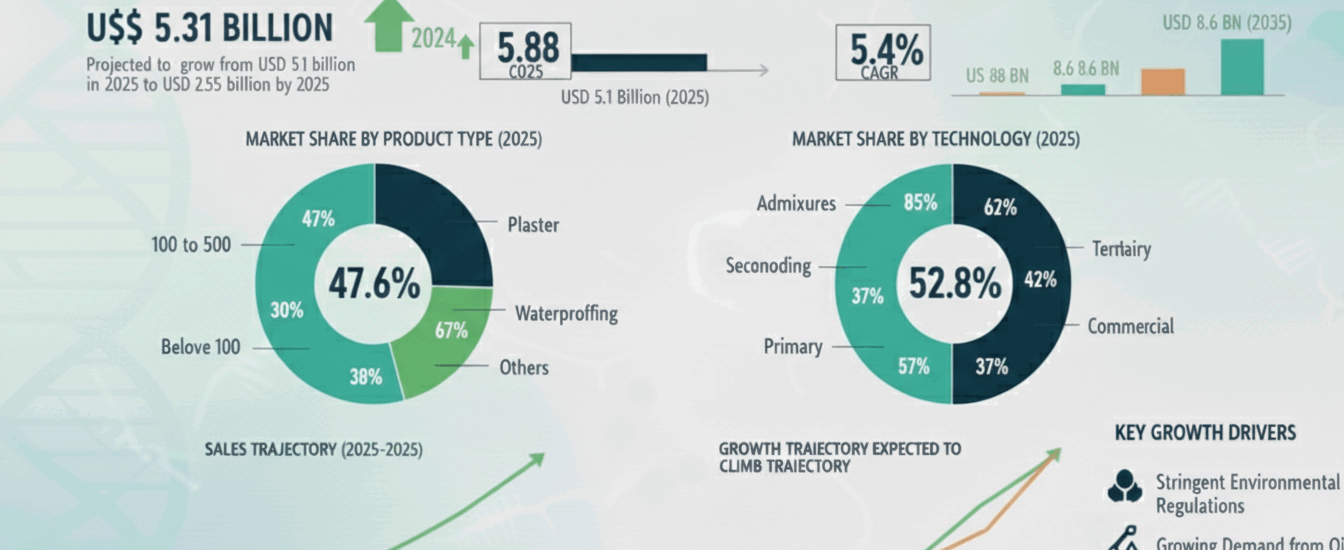
The global produced water treatment market is set for sustained expansion over the next decade, driven by rising oil and gas production, increasing environmental regulations, and a growing global focus on water reuse and sustainability. According to Future Market Insights (FMI), the produced water treatment system market is valued at approximately USD 5.1 billion in 2025 and is projected to reach USD 8.6 billion by 2035, expanding at a compound annual growth rate (CAGR) of 5.4% during the forecast period.
Produced water, a byproduct of oil and gas extraction, represents the largest waste stream generated by the energy sector. As upstream and midstream activities continue to expand across key regions, the volume of produced water requiring treatment is increasing steadily. This has intensified the need for advanced treatment technologies that ensure regulatory compliance, reduce environmental risks, and enable cost-effective water reuse.
Regulatory Pressure and Water Scarcity Accelerate Adoption
Stricter environmental policies across North America, Europe, and Asia-Pacific are compelling oil and gas operators to invest in robust produced water treatment systems. Governments and regulatory agencies are placing greater emphasis on discharge standards, pollution prevention, and sustainable water management practices. At the same time, rising freshwater scarcity in many industrial regions is encouraging companies to treat and reuse produced water, reducing reliance on freshwater sources and lowering overall water procurement costs.
These combined pressures are reshaping water management strategies in the energy sector. Produced water is increasingly being viewed not just as waste, but as a valuable resource that can be recycled for drilling, hydraulic fracturing, enhanced oil recovery, and in some cases, agricultural and industrial applications after advanced treatment.
Technology Advancements Transform Market Landscape
Technological innovation remains a core growth driver in the produced water treatment market. Advancements in filtration, membrane separation, flotation, oxidation, and electrocoagulation technologies are significantly improving treatment efficiency while reducing operating costs and environmental impact.
FMI highlights a growing shift toward modular and scalable treatment systems, allowing operators to adapt capacity based on fluctuating production levels. These modular solutions enhance operational flexibility, minimize downtime, and lower capital expenditure—making them particularly attractive for mid-sized and remote operations.
In addition, digital integration, real-time monitoring, and data-driven optimization tools are gaining traction. These solutions enable predictive maintenance, improved system performance, and better regulatory compliance, helping operators achieve both operational and sustainability objectives.
Medium-Capacity Systems Lead Market Demand
By capacity, the 100 to 500 thousand barrels per day segment dominates the market, accounting for a significant share of installations. This segment is favored for its balance between cost efficiency and operational capability, making it well-suited for medium-scale oil and gas operations.
These systems offer scalability and flexibility, allowing operators to expand or modify treatment capacity in response to changing production volumes. As a result, this segment is expected to continue leading demand throughout the forecast period, supported by steady upstream investments and infrastructure development.
Secondary Treatment Technologies Gain Momentum
From a technology perspective, secondary treatment systems are projected to see strong adoption, capturing a growing share of the market. Secondary treatment plays a critical role in removing residual contaminants following primary treatment, helping operators meet increasingly stringent discharge and reuse standards.
With environmental regulations tightening worldwide, demand for comprehensive, multi-stage treatment solutions is rising. Secondary technologies provide an added layer of purification, enhancing water quality and enabling broader reuse applications across industrial and energy sectors.
Regional Growth Highlights
North America remains a key growth region, supported by large-scale shale operations, mature oilfield infrastructure, and strong regulatory enforcement. Asia-Pacific is also emerging as a high-growth region, driven by expanding energy demand, industrialization, and heightened awareness of water resource management.
Countries such as China, Japan, and Australia are investing heavily in advanced water treatment technologies to address water scarcity, environmental sustainability goals, and infrastructure resilience. These regional dynamics are expected to contribute significantly to global market expansion over the next decade.
Subscribe for Year-Round Insights → Stay ahead with quarterly and annual data updates: https://www.futuremarketinsights.com/reports/brochure/rep-gb–86
Request For Sample Report | Customize Report |purchase Full Report –https://www.futuremarketinsights.com/reports/sample/rep-gb–86
Competitive Landscape and Strategic Investments
The global produced water treatment market is highly competitive, with leading players including Veolia, Siemens Water Technologies, Aker Solutions, Aquatech, Schlumberger, FMC Technologies, and Ecosphere. Market participants are focusing on strategic partnerships, technology innovation, and geographic expansion to strengthen their market position.
Investments in treatment infrastructure, along with policy-driven initiatives promoting water reuse, are further supporting long-term market growth. As energy companies prioritize environmental, social, and governance (ESG) objectives, produced water treatment is becoming a critical component of sustainable operations.
Outlook
With rising energy production, stricter environmental regulations, and growing emphasis on water reuse, the produced water treatment market is positioned for steady and resilient growth. The next decade will see increased adoption of advanced, modular, and digitally enabled treatment systems, transforming produced water from a waste challenge into a strategic water management opportunity.
Explore More Related Studies Published by FMI Research:
Phage MuA Transposase Market- https://www.futuremarketinsights.com/reports/phage-mua-transposase-market
Otoacoustic Emissions Hearing Screener Market- https://www.futuremarketinsights.com/reports/otoacoustic-emissions-hearing-screener-market
Mobile Animal Inhalation Anesthesia Machine Market- https://www.futuremarketinsights.com/reports/mobile-animal-inhalation-anesthesia-machine-market
Cardiac Monitoring And Cardiac Rhythm Management Devices Market- https://www.futuremarketinsights.com/reports/cardiac-monitoring-and-cardiac-rhythm-management-devices-market
About Future Market Insights (FMI)
Future Market Insights, Inc. (FMI) is an ESOMAR-certified, ISO 9001:2015 market research and consulting organization, trusted by Fortune 500 clients and global enterprises. With operations in the U.S., UK, India, and Dubai, FMI provides data-backed insights and strategic intelligence across 30+ industries and 1200 markets worldwide.
Why FMI: Decisions that Change Outcomes- https://www.futuremarketinsights.com/why-fmi
Contact Us:
Future Market Insights Inc.
Christiana Corporate, 200 Continental Drive,
Suite 401, Newark, Delaware – 19713, USA
T: +1-347-918-3531
Website: https://www.futuremarketinsights.com
LinkedIn| Twitter| Blogs | YouTube
Have a specific Requirements and Need Assistant on Report Pricing or Limited Budget please contact us – sales@futuremarketinsights.com