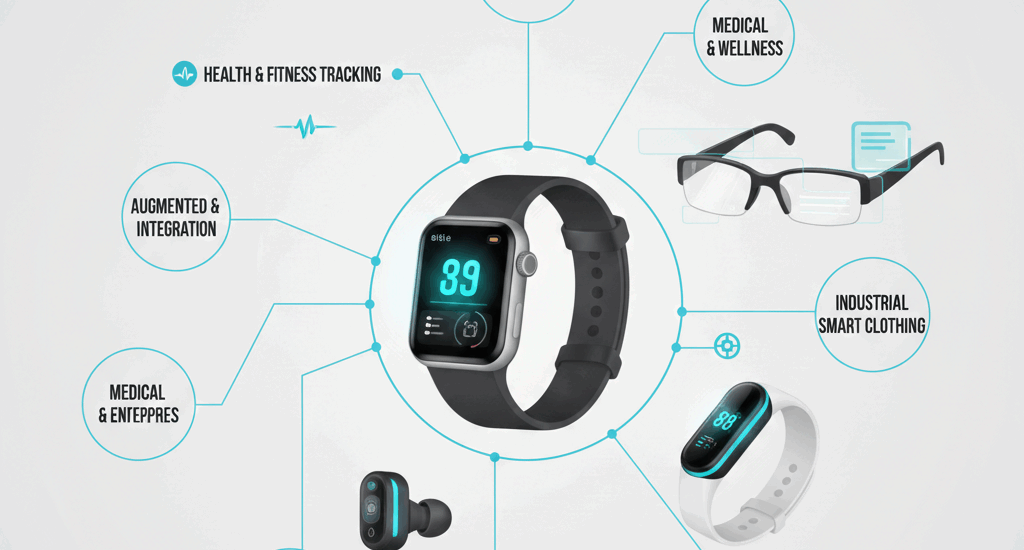
The era of “specification wars” in the wearable market is officially over. In 2026, the industry is no longer defined by how many sensors can fit onto a wrist or finger, but by who can own the daily behavior loop.
We have moved from a market of gadget sales to a market of predictable revenue streams. The brands winning today are those that have successfully transitioned from selling a product to providing a persistent interface between the human body and digital systems.
- The Platform Giants: Ecosystem Over Hardware
For giants like Apple, Samsung, and Google, the wearable is a strategic “lock-in” tool. They aren’t just selling watches; they are selling a front-end to a massive infrastructure of payments, media, identity, and cloud services.
- Apple’s Moat: The Apple Watch is the ultimate “wrist interface” for the iPhone stack. By integrating health features like ECG and irregular rhythm notifications—validated by rigorous 2025 clinical studies—Apple has turned a accessory into a medical-grade gateway. This reduces iPhone churn while fueling high-margin services like Apple Fitness+ and iCloud.
- The Android Counter-Move: Samsung and Google are leveraging AI-enhanced health monitoring (like Samsung’s 2026 heart screening tools) to deepen their own ecosystems. Their success hinges on making the watch an indispensable part of the Android cloud, from Google Wallet to predictive Assistant alerts.
- The Specialists: High-Value “Jobs to be Done”
If you don’t own the Operating System, you must own the Human Problem. Specialists like Garmin, Oura, and Whoop have thrived by targeting high-value niches where generalist watches often fall short.
Exhaustive Market Report: A Complete Study
https://www.futuremarketinsights.com/reports/wearable-computing-devices-market
Endurance & Environment: Garmin
Garmin has built an ironclad identity around endurance and the outdoors. While an Apple Watch is for “everyone,” a Garmin Fēnix is for the “athlete.”
- The Strategy: Garmin wins on battery life (measured in weeks, not days) and rugged, GNSS-heavy hardware.
- The Credibility: Algorithms for training load and $VO_2$ max are now backed by 2025 validation studies, making them the gold standard for runners and triathletes who need data they can trust for performance, not just steps.
Sleep & Longevity: Oura
Oura redefined the category by focusing on recovery. By opting for a discreet ring form factor, they own the night—a period many users find too uncomfortable for a bulky smartwatch.
- The Shift: In 2026, Oura is positioning itself as a “Longevity Platform.” Features like Symptom Radar and daytime stress monitoring move beyond simple sleep tracking into proactive health forecasting.
Behavior as a Service: Whoop
Whoop is perhaps the most radical example of the “economics of behavior.” By decoupling hardware from the business model (offering the device “free” with a subscription), Whoop isn’t selling a gadget; it’s selling an ongoing conversation with your body.
- The Moat: Their focus on the strain/recovery loop targets high-performers who are willing to pay for continuous, actionable coaching rather than a static piece of hardware.
- Why Brands Fail: Data Without Decisions
The “quiet deaths” in the wearable space are rarely due to a lack of consumer interest. Instead, they fail because they produce more data than decisions.
A wearable that tells you your heart rate was 140 BPM is a gadget. A wearable that tells you to rest because your HRV indicates a brewing illness is a service. Companies that fail usually:
- Mis-price Hardware: They fail to realize that hardware is just a delivery mechanism for high-margin services.
- Ignore Regulation: As wearables move into the “quasi-clinical” space, the lack of medical-grade validation (FDA/CE Mark) becomes a fatal flaw.
- Produce Noise, Not Signal: They overwhelm the user with metrics that don’t lead to a change in daily behavior.
Why Choose FMI: Empowering Decisions that Drive Real-World Outcomes: https://www.futuremarketinsights.com/why-fmi
About Future Market Insights (FMI)
Future Market Insights, Inc. (FMI) is an ESOMAR-certified, ISO 9001:2015 market research and consulting organization, trusted by Fortune 500 clients and global enterprises. With operations in the U.S., UK, India, and Dubai, FMI provides data-backed insights and strategic intelligence across 30+ industries and 1200 markets worldwide.