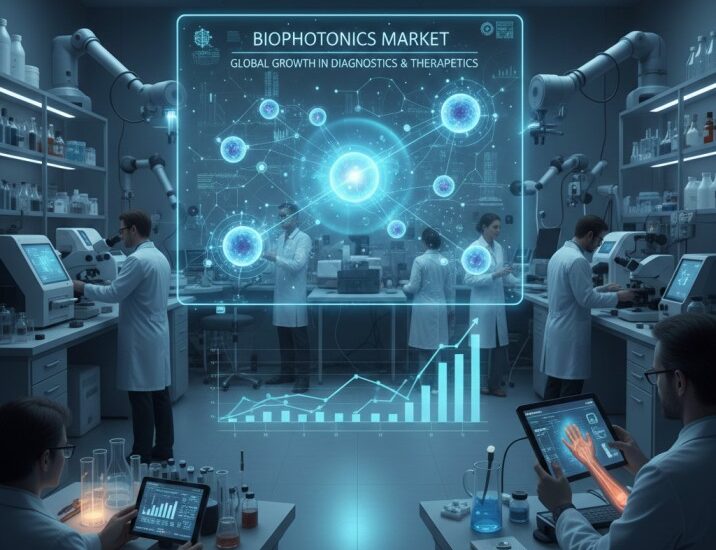
In the world of MedTech, “Biophotonics” is often used as a catch-all buzzword for anything involving lasers and tissue. However, for the product managers (PMs) tasked with bringing these systems to market, biophotonics is not a single technology—it is a complex pipeline of hardware, physics, and algorithms.
Understanding where value is created—and where risk hides—within this stack is the difference between a clinical breakthrough and a piece of expensive laboratory shelfware.
- Mapping the Biophotonics Technology Stack
Product managers must view biophotonics as a vertical stack. Every decision made at the bottom of the stack constrains the possibilities at the top.
- Illumination & Wavelength: Choosing between Near-Infrared (NIR), broadband low-coherence light (for OCT), or specific lasers (for Raman) encodes the depth of penetration and safety profile from day one.
- Tissue Interaction: This is the core “contrast mechanism.” Are you selling structure (OCT), molecular composition (Raman), or metabolic function (Fluorescence)?
- The Computational Layer: This is where the modern competitive battle is fought. Image reconstruction, noise reduction, and AI-driven analytics are what turn “noisy light” into a “clinical decision.”
PM Strategy: You must decide which layer is your differentiator and which you will commoditize. If your edge is a proprietary algorithm, don’t waste R&D budget reinventing a standard laser source.
Exhaustive Market Report: A Complete Study
https://www.futuremarketinsights.com/reports/global-biophotonics-market
- Diagnostics: The Mature Workhorses
In non-invasive imaging, the question is rarely “Does the physics work?” but rather “Where does this fit in the workflow?”
Optical Coherence Tomography (OCT)
OCT is the gold standard in ophthalmology for retinal imaging. It has moved beyond the “experimental” phase into a mature platform. For a PM in this space, innovation isn’t about the interferometer; it’s about ergonomics and automation.
- The Challenge: Integration with existing Electronic Health Records (EHR) and Picture Archiving and Communication Systems (PACS).
- The Goal: Moving from high-end consoles to handheld or intraoperative probes that can be used in cardiology or dermatology.
Molecular Diagnostics
Modalities like Raman spectroscopy or fluorescence-based cancer detection offer a powerful value proposition: detecting biochemical changes before anatomical changes appear. The trade-off? These often require contrast agents, which significantly increase the regulatory burden and complexity of the clinical trial.
- Surgery: The “Second Set of Eyes”
In the Operating Room (OR), biophotonics functions as an augmented reality layer. Fluorescence-guided surgery (FGS) using Indocyanine Green (ICG) allows surgeons to see blood perfusion or tumor margins in real-time.
However, the constraints in the OR are brutal:
- Latency: If the digital overlay lags by even a fraction of a second, it is useless for active cutting.
- Field of View: Surgeons need to see the “big picture” without constantly adjusting the hardware.
- Interpretation: The system must provide a clear “cut/don’t cut” signal rather than a vague colorful glow that requires expert interpretation.
- The “Hard” Problems are Non-Technical
The graveyard of Biophotonics is filled with technically brilliant devices that failed commercially. For PMs, the most significant risks often sit outside the R&D lab:
| Risk Category | Key Question for Product Managers |
| Regulatory | Is this a Class II or Class III device? Does it require a new contrast agent (PMA path)? |
| Reimbursement | Is there an existing CPT code, or are you fighting for a “new technology” add-on payment? |
| Workflow | Does this add 10 minutes to a 30-minute procedure? (If yes, it will likely fail). |
| Training | Can a technician use this at a community hospital, or does it require a PhD? |
The Field Guide for Biophotonics PMs
Whenever a new biophotonics proposal hits your desk, force the team to define these three pillars:
- The Clinical Decision: Exactly what choice will the doctor make differently because of this light?
- The Gold Standard: What are you replacing? (e.g., a physical biopsy, a CT scan, or “surgeon’s intuition”).
- The Trust Package: What is the minimum data set required for a hospital board to authorize the purchase?
In biophotonics, the “coolness” of the laser is irrelevant if the data doesn’t integrate into the clinician’s existing mental—and digital—workflow.
Why Choose FMI: Empowering Decisions that Drive Real-World Outcomes: https://www.futuremarketinsights.com/why-fmi
About Future Market Insights (FMI)
Future Market Insights, Inc. (FMI) is an ESOMAR-certified, ISO 9001:2015 market research and consulting organization, trusted by Fortune 500 clients and global enterprises. With operations in the U.S., UK, India, and Dubai, FMI provides data-backed insights and strategic intelligence across 30+ industries and 1200 markets worldwide.