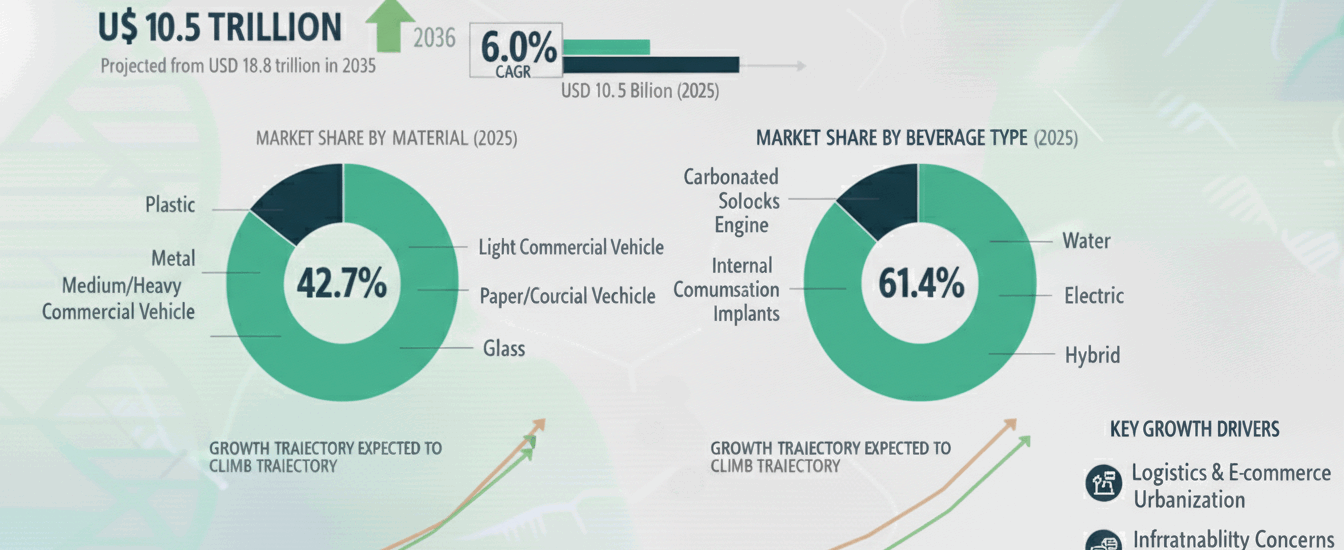
Future Market Insights (FMI), a leading provider of market intelligence and consulting services, has released a comprehensive analysis of the global commercial vehicle market. The report examines trucks, vans, buses, and coaches utilized across freight, logistics, construction, public transport, and related sectors. It projects steady expansion driven by interconnected industry demands, with the market expected to grow from USD 10.5 trillion in 2025 to USD 18.8 trillion by 2035, achieving a compound annual growth rate (CAGR) of 6.0%. This growth reflects increasing fleet sizes, higher vehicle utilization rates, and evolving replacement cycles worldwide.
The study highlights how commercial vehicles support essential economic activities, particularly in freight and logistics, which account for 40% of market demand. Construction and infrastructure contribute 20%, while public transport and municipal services add 15%. Together, these segments represent 75% of the market, underscoring the vehicles’ role in enhancing operational efficiency, load capacity, and reliability amid global urbanization and trade expansion.
Commercial Vehicle Market Drivers and Restraints
Key factors propelling the commercial vehicle market include surging needs in freight and logistics, fueled by e-commerce growth, retail distribution, and industrial shipping. These applications demand vehicles with superior payload capabilities, fuel efficiency, and durability. Infrastructure development and construction projects further drive demand for heavy-duty trucks essential to building roadways, bridges, and urban facilities.
Public transport and municipal services rely on buses, sanitation trucks, and emergency vehicles that prioritize regulatory compliance and consistent performance. Additionally, the rise in automotive rental, leasing, and specialty vehicles—such as refrigerated units—supports flexible business models for small and medium enterprises (SMEs) and seasonal operations.
Opportunities in Emerging Economies and Technology Integration
The report identifies significant opportunities in emerging markets, where urbanization, e-commerce, and last-mile delivery are accelerating vehicle demand. Fleet modernization presents another avenue, incorporating telematics, advanced safety features, and alternative fuel systems to improve efficiency and reduce operational costs.
Strategic partnerships, electrification efforts, and investments in fuel management technologies are poised to reshape the industry. Post-pandemic supply chain stabilization and expanded manufacturing capacities are also expected to sustain momentum. Regions like Asia-Pacific, with major infrastructure initiatives, and North America, focused on logistics upgrades, stand to benefit most from these trends.
Commercial Vehicle Market Segmentation Insights
Breaking down the market by vehicle type, light commercial vehicles lead with a 42.7% share in 2025, attributed to their suitability for urban transport, e-commerce logistics, and fuel economy. Heavy commercial vehicles and buses/coaches follow, catering to diverse payload and passenger needs.
By drive type, internal combustion engines hold 61.4% of the market in 2025, including diesel variants for demanding tasks. Electric vehicles, battery EVs, and hybrids are gaining traction, supported by regulatory pressures on emissions, though ICE dominance persists due to infrastructure advantages.
End-use industries show logistics and transportation commanding 36.9%, driven by global supply chains, e-commerce, and trade volumes. This segment increasingly adopts telematics and GPS for optimized operations. Construction and mining, public transportation, emergency services, agriculture, and other sectors round out the analysis, each influenced by specific infrastructure investments and technological integrations.
Regionally, the market spans North America, Latin America, Western Europe, Eastern Europe, Balkan & Baltic Countries, Russia & Belarus, Central Asia, East Asia, South Asia & Pacific, and the Middle East & Africa. High-growth areas include China (8.1% CAGR) and India (7.5% CAGR), propelled by industrialization and highway expansions. Germany (6.9%), France (6.3%), the UK (5.7%), the USA (5.1%), and Brazil (4.5%) reflect focuses on emission compliance, urban mobility, and fleet efficiency.
Competitive Landscape and Recent Developments in Commercial Vehicles
The competitive environment features prominent players such as Toyota Motor Corporation, known for its reliable and cost-effective portfolio; Ford Motor Company, emphasizing advanced trucks and telematics; AB Volvo, advancing heavy-duty and electrified solutions; General Motors, integrating connected technologies; Paccar Inc., specializing in Class 8 trucks with predictive maintenance; BYD Motors, leading in electric vehicles and battery innovations; Scania AB, offering modular trucks and connected services; and Dongfeng Motor Corporation, providing affordable options for Asian markets.
Recent industry shifts include the adoption of advanced telematics, predictive maintenance, and fuel management systems. There’s a notable move toward electrification and hybrids in response to emission standards. Original equipment manufacturers (OEMs) are forming collaborations for modular platforms, driver-assistance systems, and robust after-sales networks, enhancing fleet safety and modernization.
Subscribe for Year-Round Insights → Stay ahead with quarterly and annual data updates: https://www.futuremarketinsights.com/reports/brochure/rep-gb-25068
Request For Sample Report | Customize Report |purchase Full Report –https://www.futuremarketinsights.com/reports/sample/rep-gb-25068
Industry Trends and Data-Backed Projections
Data from the report indicates freight and logistics’ 40% dominance, amplified by e-commerce and delivery demands. Light commercial vehicles’ 42.7% share highlights their urban adaptability, while ICE’s 61.4% position signals a gradual transition to sustainable alternatives. Logistics’ 36.9% end-use share is bolstered by infrastructure and tech advancements.
Overall, the market’s resilience stems from normalized supply chains and strategic investments, forecasting sustained growth through 2035. This analysis equips stakeholders with actionable insights for navigating regulatory changes, technological shifts, and regional dynamics.
Explore More Related Studies Published by FMI Research:
Optical Fingerprint Collector Market: https://www.futuremarketinsights.com/reports/optical-fingerprint-collector-market
CRDMO Market: https://www.futuremarketinsights.com/reports/crdmo-market
Absorbable PGLA Surgical Sutures Market: https://www.futuremarketinsights.com/reports/absorbable-pgla-surgical-sutures-market
Absorbable Surgical Suture with Needle Market: https://www.futuremarketinsights.com/reports/absorbable-surgical-suture-with-needle-market
Absorbable PGA Surgical Sutures Market: https://www.futuremarketinsights.com/reports/absorbable-pga-surgical-sutures-market
3D Ready Organoid Expansion Service Market: https://www.futuremarketinsights.com/reports/3d-ready-organoid-expansion-service-market
About Future Market Insights (FMI)
Future Market Insights, Inc. (FMI) is an ESOMAR-certified, ISO 9001:2015 market research and consulting organization, trusted by Fortune 500 clients and global enterprises. With operations in the U.S., UK, India, and Dubai, FMI provides data-backed insights and strategic intelligence across 30+ industries and 1200 markets worldwide.
Why FMI: Decisions that Change Outcomes- https://www.futuremarketinsights.com/why-fmi
Contact Us:
Future Market Insights Inc.
Christiana Corporate, 200 Continental Drive,
Suite 401, Newark, Delaware – 19713, USA
T: +1-347-918-3531
Website: https://www.futuremarketinsights.com
LinkedIn| Twitter| Blogs | YouTube
Have a specific Requirements and Need Assistant on Report Pricing or Limited Budget please contact us – sales@futuremarketinsights.com