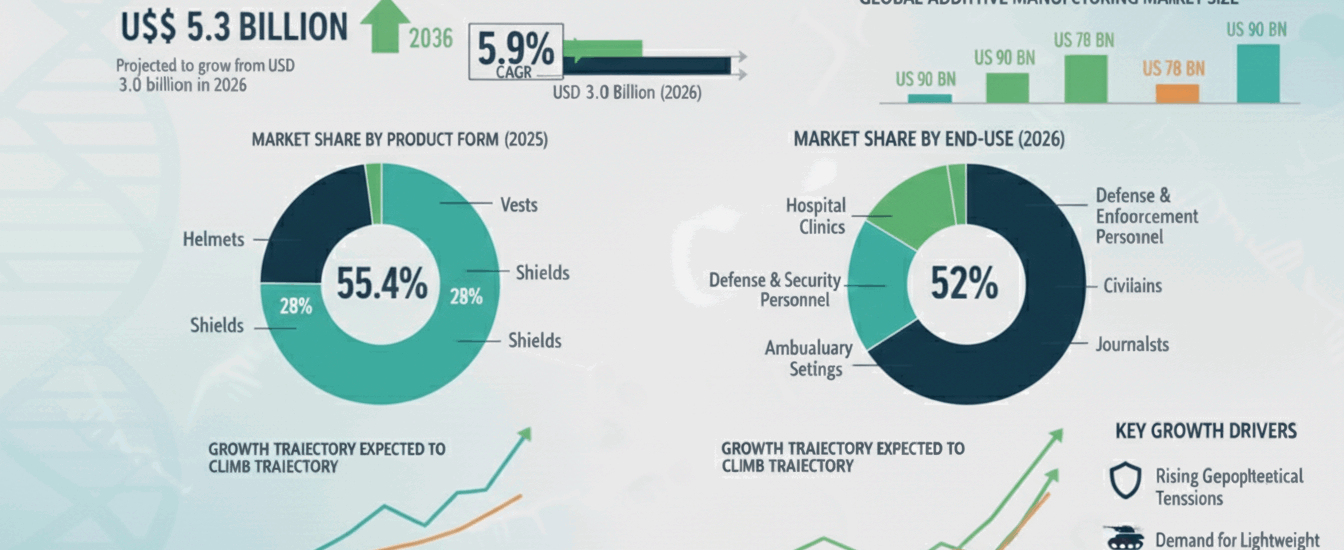
Future Market Insights (FMI), a leading market intelligence and consulting firm, today released its comprehensive report on the global body armor market. The study forecasts the market to grow from USD 3.0 billion in 2026 to USD 5.3 billion by 2036, achieving a compound annual growth rate (CAGR) of 5.9%. This projection underscores the escalating need for advanced protective gear driven by geopolitical tensions, asymmetrical warfare, and civil unrest worldwide. The report, based on extensive data analysis, provides stakeholders with critical insights into market dynamics, segmentation, and regional trends.
The analysis highlights how innovations in materials and design are addressing longstanding challenges in the industry, such as balancing protection with mobility. Key players, including Armor Express, Safariland, and BAE Systems, are responding to these demands through vertical integration and technological advancements. FMI’s report aims to equip industry leaders, analysts, and investors with actionable intelligence to navigate this evolving landscape.
Key Market Drivers: Geopolitical Conflicts and Technological Advancements Fuel Growth
The body armor market’s expansion is primarily propelled by rising geopolitical conflicts and the need for enhanced infantry gear. Governments worldwide are investing in large-scale procurement programs to equip defense and security personnel, who account for 52% of the market share in 2026. Asymmetrical warfare and increasing civil unrest have heightened demand for modular scalable vests (MSVs), which allow for adjustable protection levels without compromising ergonomics.
Breakthroughs in ballistic composites, such as ultra-high-molecular-weight polyethylene (UHMWPE) and ceramic materials, enable multi-hit protection while reducing weight— a critical factor, as systems must remain under 10 kg to meet NIJ Level IV standards. Educational initiatives on proper fit and coverage are also reducing injury risks, further supporting market growth. In regions like India, policies such as Atmanirbhar Bharat are driving domestic production and border security enhancements, contributing to a 7.0% CAGR in the country from 2026 to 2036.
However, the market faces restraints, including volatility in raw material costs for aramid and UHMWPE, which impact long-term contracts. High certification expenses, often exceeding USD 50,000 per stock-keeping unit (SKU) for NIJ and STANAG testing, pose barriers for smaller manufacturers. The commoditization of soft armor segments necessitates differentiation through comfort and design innovations.
Market Segmentation Insights: Soft Armor and Vests Lead Demand
FMI’s report segments the body armor market by product type, application, and form, revealing dominant trends. Soft armor holds a 46.21% share in 2026, favored for its flexibility in law enforcement and civilian applications. Hard armor and accessories follow, with ongoing shifts toward advanced composites like graphene and carbon nanotubes.
By application, defense and security personnel dominate at 52%, followed by law enforcement officers and civilians. The rise in civil unrest has spurred opportunities in riot gear and dual-threat vests for non-military users. In terms of product form, vests command 55.4% of the market, with helmets and other items gaining traction through integrations like quick-release mechanisms and smart textiles.
Functionality trends emphasize weight reduction, concealment, and longevity, with vacuum-sealed barriers extending storage life. Gender-specific designs and ergonomic features are addressing diverse user needs, enhancing overall market relevance.
Regional Body Armor Market Trends: Asia-Pacific and North America Drive Momentum
Geographically, the body armor market shows robust growth in key regions. Asia-Pacific leads with high CAGRs in India (7.0%) and China (6.8%), fueled by military modernization efforts. China’s People’s Liberation Army (PLA) upgrades and peacekeeping missions, alongside India’s self-reliance initiatives, are key contributors.
In North America, the United States anticipates a 6.8% CAGR, driven by law enforcement upgrades and modular vest adoptions. Europe’s growth, particularly in Germany at 6.4%, stems from increased defense spending and adherence to NATO standards. Japan, with a 6.5% CAGR, focuses on Self-Defense Forces enhancements and disaster relief applications.
Broader regional breakdowns include North America, Latin America, Western Europe, Eastern Europe, East Asia, South Asia and Pacific, and the Middle East & Africa. Emerging opportunities in naval operations, such as ballistic flotation vests, and musculoskeletal health integrations like exoskeletons, are poised to influence future regional dynamics.
Subscribe for Year-Round Insights → Stay ahead with quarterly and annual data updates: https://www.futuremarketinsights.com/reports/brochure/rep-gb-11146
Request for Sample Report | Customize Report |purchase Full Report –https://www.futuremarketinsights.com/reports/sample/rep-gb-11146
Competitive Landscape and Opportunities: Innovation and Consolidation Shape the Future
The competitive environment is marked by vertical integration, with companies acquiring textile and ceramic firms to control supply chains. Key players like Armor Express (23.0% market share), Point Blank Enterprises, and Honeywell International Inc. are building proprietary ecosystems that integrate with body-worn cameras and holsters.
Recent developments include launches of cooling-equipped ballistic gear for tropical zones and shifts to non-Chinese supply chains for NATO compliance. Collaborations with material science firms are accelerating nano-enhanced composites and shear-thickening fluids.
Opportunities abound in smart integrations, including health sensors and communications interfaces, as well as sustainability through recycling programs. Long-term indefinite delivery/indefinite quantity (IDIQ) contracts, often spanning five years, drive high customer lifetime value (CLV) and net revenue retention exceeding 100% via modular accessories.
High customer acquisition costs in business-to-government (B2G) sales—due to 18-24-month testing cycles—underscore the need for performance-based differentiators. FMI’s analysis predicts continued consolidation by defense conglomerates, fostering innovation in bio-mimetic structures and wearable technologies.
Industry Relevance: Navigating Challenges in a High-Stakes Sector
This report from Future Market Insights provides a data-driven roadmap for stakeholders amid global security uncertainties. By focusing on factual trends and projections, it supports informed decision-making for investors and analysts tracking defense and protective equipment sectors.
Explore More Related Studies Published by FMI Research:
Non-Insulin Peptide Drugs Market- https://www.futuremarketinsights.com/reports/non-insulin-peptide-drugs-market
Viral Safety Testing Market- https://www.futuremarketinsights.com/reports/viral-safety-testing-market
Intracameral Antibiotics Market- https://www.futuremarketinsights.com/reports/intracameral-antibiotics-market
MRI-based Quantitative Biomarkers Market- https://www.futuremarketinsights.com/reports/mri-based-quantitative-biomarkers-market
Unattended Fundus Camera Market- https://www.futuremarketinsights.com/reports/unattended-fundus-camera-market
About Future Market Insights (FMI)
Future Market Insights, Inc. (FMI) is an ESOMAR-certified, ISO 9001:2015 market research and consulting organization, trusted by Fortune 500 clients and global enterprises. With operations in the U.S., UK, India, and Dubai, FMI provides data-backed insights and strategic intelligence across 30+ industries and 1200 markets worldwide.
Why FMI: Decisions that Change Outcomes- https://www.futuremarketinsights.com/why-fmi
Contact Us:
Future Market Insights Inc.
Christiana Corporate, 200 Continental Drive,
Suite 401, Newark, Delaware – 19713, USA
T: +1-347-918-3531
Website: https://www.futuremarketinsights.com
LinkedIn| Twitter| Blogs | YouTube
Have a specific Requirements and Need Assistant on Report Pricing or Limited Budget please contact us – sales@futuremarketinsights.com