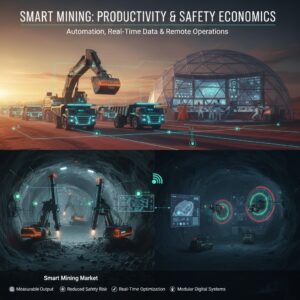
The global mining industry is undergoing a powerful transformation. What began as isolated automation pilots has evolved into a full-scale shift toward smart mining—an approach that prioritizes measurable productivity, worker safety, and long-term capital discipline over digital novelty. For established manufacturers and emerging technology providers alike, this evolution creates a rare opportunity: expand business footprints, co-develop next-generation solutions, and reshape how minerals are extracted, hauled, and processed.
At its core, smart mining is not about flashy dashboards or experimental artificial intelligence. It is about output per tonne, uptime per asset, and recovery per blast. Mines are investing in systems that deliver hard returns, reduce exposure to risk, and scale across sites and commodities.
Productivity Gains Across the Mining Value Chain
- Smart mining delivers its biggest productivity gains where human limitations previously capped performance. Autonomous drilling systems now operate with far greater consistency than manual rigs. Automated positioning and depth control allow drill rigs to work through shift changes, meal breaks, and low-visibility conditions. The result: 20–30% higher utilisation rates and blast hole accuracy improvements of up to 25%, which directly reduce ore dilution and improve downstream recovery.
- Autonomous haulage represents the single largest productivity leap in surface mining. Driverless truck fleets operate 24/7 without fatigue, shift handovers, or inconsistent driving behaviour. Mines using autonomous trucks report 15–20% higher payload utilisation and 10–15% lower fuel consumption. At scale, the economics become compelling—large fleets generate tens of millions of dollars annually in savings while lowering cost per tonne.
- Predictive maintenance further compounds these gains. Sensors monitoring vibration, temperature, and lubricant condition detect early signs of mechanical failure long before catastrophic breakdowns occur. With planned repairs replacing emergency interventions, equipment availability improves dramatically. Major OEMs report 20–35% reductions in unplanned maintenance events, unlocking higher annual production from existing asset bases without new capital expenditure.
Safety as a Strategic Investment Driver
While productivity drives returns, safety accelerates adoption. Remote operations remove workers from high-risk zones such as underground headings, unstable slopes, and heavy traffic haul roads. Operators now control loaders, jumbos, and haul trucks from surface control rooms, reducing exposure to ground failures, ventilation hazards, and equipment collisions.
Collision avoidance and proximity detection systems are becoming standard across jurisdictions. These technologies prevent fatal interactions by warning operators and automatically braking when collision risks arise. In many regions, regulatory mandates now require such systems, making safety technology not just a choice—but a compliance necessity.
Real-time environmental monitoring adds another layer of protection. Continuous gas sensing, slope stability radar, and geotechnical analytics provide early warnings that manual inspections cannot reliably deliver. Following high-profile tailings dam failures, major producers accelerated digital monitoring investments, demonstrating how safety incidents catalyze technology adoption across the sector.
Data Platforms Reshaping Recovery and Decision-Making
The true power of smart mining emerges when data flows seamlessly across drilling, blasting, excavation, and processing. Grade control sensors on excavators now provide real-time ore-body delineation, directing material to the correct processing stream instantly. This eliminates delays associated with laboratory assays and reduces ore loss and dilution. Even a 2–4% improvement in recovery translates into millions of dollars annually for large operations.
Digital twins extend this capability further. By combining geological models, equipment telemetry, and processing data, mines can simulate operational scenarios before implementing changes. Planners test extraction sequences, equipment assignments, and ventilation strategies virtually, reducing trial-and-error costs while improving productivity and energy efficiency.
Predictive analytics completes the loop. Machine learning models forecast equipment failures, throughput bottlenecks, and ore quality variations. Instead of reacting to disruptions, operations teams receive early warnings and adjust plans proactively, stabilizing production and improving recovery consistency.
Why Connectivity and Interoperability Matter Most
- No smart mine succeeds without robust connectivity. Autonomous systems depend on private LTE and 5G networks capable of millisecond response times. In remote regions, connectivity investment alone can exceed $10–50 million, creating a deployment threshold that often determines whether automation is viable.
- Edge computing addresses latency constraints by processing time-critical data locally while sending aggregated information to central platforms. This hybrid architecture enables real-time control even in regions with limited terrestrial connectivity.
- Interoperability remains a stubborn challenge. Mixed fleets from different manufacturers use proprietary control systems, making integration complex and costly. Until industry standards mature, operators must rely on middleware platforms or single-vendor strategies—an opportunity for both established OEMs and agile software providers to deliver integration-ready solutions.
Capital Discipline and Scalable Deployment
Smart mining adoption increasingly follows a phased model. Mines start with high-impact applications—autonomous haulage or predictive maintenance—then expand as returns validate investment logic. This staged approach lowers capital risk, supports workforce adaptation, and builds internal digital capability.
Return expectations vary by commodity and margin profile. Base metal producers prioritize fast payback solutions, while precious metal operations accept longer horizons for safety and recovery technologies. Greenfield projects integrate automation from day one, while legacy mines adopt retrofit solutions aligned with remaining reserve life.
A Growing Market for Innovators and Manufacturers
For established manufacturers, smart mining offers a pathway to defend market share through automation-ready equipment, service contracts, and digital ecosystems. For emerging technology firms, it creates entry points through sensors, analytics platforms, connectivity infrastructure, and integration software.
The future mine will not be built by one company alone. It will be co-created by OEMs, software developers, network providers, and analytics specialists—each contributing modular, scalable technologies that deliver measurable value per tonne.
Smart mining is no longer optional. It is the operating model for the next generation of mining—and the companies that embrace it now will define the industry’s future.
Read the Full Article : https://www.futuremarketinsights.com/articles/why-is-smart-mining-adoption-driven-by-productivity-and-safety-economics-rather-than-technology-experimentation