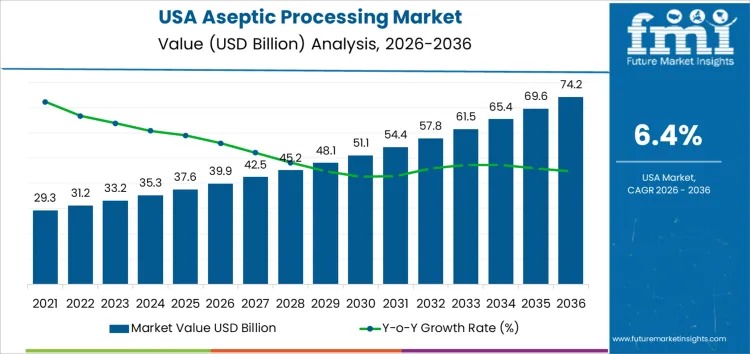
The Demand for Aseptic Processing in USA is witnessing sustained expansion as U.S. manufacturers scale sterile pharmaceutical production and shelf-stable food processing. Valued at USD 39.9 billion in 2026, the market is projected to reach USD 74.2 billion by 2036, growing at a CAGR of 6.4%. This growth underscores the rising importance of contamination control, regulatory compliance, and extended shelf life across pharmaceutical, biotechnology, and food manufacturing environments.
Aseptic processing has evolved into a strategic necessity, enabling producers to meet stringent safety requirements while maintaining efficiency and product quality at scale.
Subscribe for Year-Round Insights → Stay ahead with quarterly and annual data updates
Key Factors Driving Market Growth
Demand for aseptic processing in the United States is expanding due to several converging trends across end-use industries:
- Rising production of biologics, vaccines, and injectable drugs requiring sterile environments
- Increasing consumption of ready-to-drink beverages, dairy alternatives, soups, and liquid nutrition
- Strong regulatory focus on sterility assurance and contamination prevention
- Preference for ambient-stable products that reduce cold-chain dependence
These drivers reinforce long-term investments in advanced aseptic systems across U.S. manufacturing facilities.
Packaging Dominates Aseptic Processing Demand
Packaging remains the leading type segment in the U.S. aseptic processing market. Manufacturers prioritize aseptic filling and sealing technologies to protect product integrity after sterilization and enable nationwide distribution without refrigeration.
Key points:
- Packaging ensures final sterility and product safety
- Automated filling systems support high-throughput production
- Aseptic packaging extends shelf life while preserving quality
- Compatibility with liquid and semi-liquid formulations drives adoption
While processing systems play a critical upstream role, packaging attracts the highest share of capital investment due to its impact on final product safety.
Material Usage Reflects Cost Efficiency and Sustainability
Material trends in U.S. aseptic processing highlight a balance between performance, cost, and environmental considerations:
- Paper and paperboard dominate, especially in carton-based beverage packaging
- Plastics support flexible and rigid containers with strong barrier properties
- Metal and glass serve niche and premium applications
The prominence of paper-based materials reflects sustainability goals and large-scale beverage production needs.
Food and Beverage Sector Leads Applications
Food and beverage manufacturing accounts for the largest share of aseptic processing demand in the USA. Aseptic systems enable producers to deliver safe, preservative-free products with extended shelf life.
Application insights:
- Shelf-stable dairy, juices, sauces, and soups drive system upgrades
- Reduced refrigeration lowers logistics and energy costs
- Consumer demand for convenience and safety accelerates adoption
Industrial applications contribute a smaller but steady share, focused on sterile handling of specialty liquids.
Regional Growth Highlights
Demand growth varies by region, shaped by industry concentration and investment intensity:
- West USA leads growth, supported by biopharmaceutical manufacturing and advanced food processing
- South USA benefits from beverage production expansion and contract manufacturing activity
- Northeast USA demand is driven by pharmaceutical, clinical, and biologics manufacturing
- Midwest USA shows stable growth anchored in dairy and packaged food production
Regional performance reflects differences in regulatory focus, capital allocation, and product mix.
Competitive Landscape and Industry Leaders
The U.S. aseptic processing market is anchored by companies with strong regulatory alignment and validated technologies. Key players include STERIS Corporation, Getinge, Sartorius, MilliporeSigma (Merck KGaA), and IMA Life. These firms compete on technology reliability, service infrastructure, and compliance support tailored to FDA and USDA requirements.
Manufacturers increasingly favor suppliers offering integrated, automation-ready solutions that reduce contamination risk and improve operational efficiency.
Market Outlook Through 2036
Looking ahead, U.S. demand for aseptic processing will continue to rise as pharmaceutical pipelines expand, shelf-stable food consumption increases, and regulatory scrutiny intensifies. Automation, real-time monitoring, and flexible system design will shape purchasing decisions across industries.
Aseptic processing is expected to remain a cornerstone of U.S. manufacturing strategies focused on safety, scalability, and supply chain resilience.
Get data that aligns with your strategic priorities — ask for report customization today:
Related Reports
End-of-Pipe Air Pollution Control Equipment Market- https://www.futuremarketinsights.com/reports/end-of-pipe-air-pollution-control-equipment-market
Non-Destructive Testing Equipment Market- https://www.futuremarketinsights.com/reports/non-destructive-testing-equipment-market
Fuel Cell For Data Center Market- https://www.futuremarketinsights.com/reports/fuel-cell-for-data-center-market
Have a specific Requirements and Need Assistant on Report Pricing or Limited Budget please contact us – sales@futuremarketinsights.com
About Future Market Insights (FMI)
Future Market Insights, Inc. (FMI) is an ESOMAR-certified, ISO 9001:2015 market research and consulting organization, trusted by Fortune 500 clients and global enterprises. With operations in the U.S., UK, India, and Dubai, FMI provides data-backed insights and strategic intelligence across 30+ industries and 1200 markets worldwide.
Contact Us:
Future Market Insights Inc.
Christiana Corporate, 200 Continental Drive,
Suite 401, Newark, Delaware – 19713, USA
T: +1-347-918-3531
Why FMI: https://www.futuremarketinsights.com/why-fmi
For Sales Enquiries: sales@futuremarketinsights.com
Website: https://www.futuremarketinsights.com
LinkedIn| Twitter| Blogs | YouTube