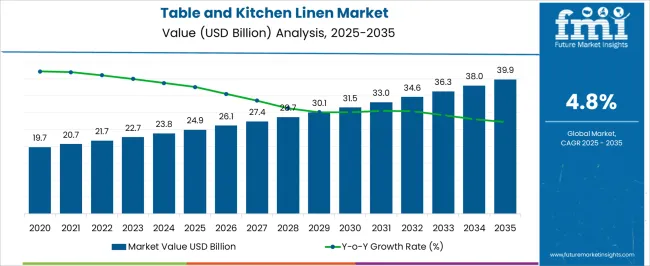
The global Table and Kitchen Linen Market is entering a new phase of steady and design-driven expansion, supported by rising consumer interest in premium home textiles and strong demand from hospitality and food service industries. According to the latest market outlook, the industry is estimated to be valued at USD 24.9 billion in 2025 and is projected to reach USD 39.9 billion by 2035, growing at a CAGR of 4.8% during the forecast period.
This growth trajectory reflects a shift in consumer behavior toward high-quality, durable, and aesthetically appealing linen products that enhance dining and kitchen experiences across households, restaurants, hotels, and institutional settings.
Gain access to detailed segment-wise analysis and forecast statistics – Request the Sample Report Today
Market Growth Drivers Shaping the Industry
The table and kitchen linen market is expanding due to a combination of lifestyle evolution, hospitality sector growth, and manufacturing innovation.
- Rising demand for premium and customized linens from hotels, restaurants, banquet halls, and luxury households
- Growing influence of home décor and interior design trends, driven by social media and lifestyle branding
- Expansion of global hospitality and food service industries, especially in emerging economies
- Technological advancements in textile manufacturing, including digital printing, stain resistance, wrinkle-free finishes, and quick-dry fabrics
- Shift toward eco-friendly and sustainable materials, with increased preference for natural fibers such as cotton
Manufacturers—both established brands and emerging players—are focusing on multifunctional products that combine visual appeal with easy maintenance, durability, and sustainability.
Quick Market Snapshot
- Market Value (2025): USD 24.9 billion
- Forecast Value (2035): USD 39.9 billion
- Forecast CAGR (2025–2035): 4.8%
- Leading Product Segment: Table linen (41.8% share in 2025)
- Dominant Material: Cotton (52.4% share in 2025)
- Top Growth Regions: North America, Asia-Pacific, Europe
Key Takeaways from the Table and Kitchen Linen Market
The market is influenced by five interconnected parent segments that collectively shape demand and innovation:
- Hospitality and Food Service (35%)
Restaurants, hotels, and catering services drive demand for premium, durable, and visually appealing linens to enhance guest experience and brand positioning. - Retail and E-commerce Distribution (25%)
Supermarkets, specialty home décor stores, and online platforms are expanding product reach, enabling wider adoption among households and small businesses. - Home Décor and Interior Design (15%)
Designers increasingly integrate coordinated and themed table and kitchen linens into modern dining spaces. - Wholesale and Institutional Supply (15%)
Bulk procurement by hotels, corporate cafeterias, and event organizers ensures steady, long-term demand. - Consumer Lifestyle and Gifting (10%)
Seasonal gifting, festive purchases, and personalized linens add incremental growth opportunities.
Together, hospitality, retail, and interior design segments account for 75% of overall market demand, highlighting the importance of design integration, service quality, and product variety.
Segmental Analysis: Key Market Leaders
By Product: Table Linen
- Accounts for 41.8% of market revenue in 2025
- Strong demand from residential dining and commercial hospitality
- Growth supported by festive occasions, themed collections, and curated dining experiences
By Material: Cotton
- Holds 52.4% market share
- Preferred for durability, softness, absorbency, and sustainability
- Compatible with stain-resistant, wrinkle-free, and blended finishes
By Price: Medium Segment
- Represents 44.6% of total revenue
- Balances affordability with quality and design
- Popular among middle-income households and cost-conscious hospitality buyers
Regional Growth Outlook
- China (CAGR 6.5%)
Driven by hospitality expansion, e-commerce penetration, and investment in advanced textile finishing technologies. - India (CAGR 6.0%)
Supported by rising disposable incomes, festive demand, modern retail growth, and hospitality infrastructure development. - France (CAGR 5.0%)
Growth fueled by premium home décor preferences, strong hospitality sector, and designer collaborations. - United Kingdom (CAGR 4.6%)
Urban households, boutique hotels, and event services drive demand for stylish, durable linens. - United States (CAGR 4.1%)
Demand supported by holiday dining trends, sustainability-conscious consumers, and omnichannel retail strategies.
Competitive Landscape: Innovation Meets Expansion
The competitive landscape of the table and kitchen linen market highlights a mix of global leaders and regional innovators focusing on quality, design, and sustainability.
- Established Players such as Welspun India, Cannon Mills, Trident Group, Standard Textile, and Sunvim Group leverage scale, advanced weaving technologies, and strong distribution networks to serve both retail and hospitality clients globally.
- Design-Driven and Lifestyle Brands including H&M Home, Ralph Lauren Home, LinenMe, and Hampton Linens emphasize premium aesthetics, seasonal collections, and eco-conscious materials to attract modern consumers.
- Emerging and Regional Manufacturers like Shree Jee International, SS Rathi Textiles, Dian Foshan Textile, Uptown Home, and Verenich Home Textiles are expanding their footprint through customization, bulk institutional supply, and collaborations with interior designers and hospitality chains.
Across the industry, manufacturers are investing in:
- Sustainable sourcing and certified fabrics
- Digital printing and innovative finishing technologies
- Omnichannel distribution and direct-to-consumer models
- Co-branded and curated collections with chefs, designers, and hotels
Future Outlook
Looking ahead to 2035, the table and kitchen linen market is expected to benefit from continued premiumization, sustainability initiatives, and evolving lifestyle preferences. Established players will strengthen global reach through supply chain optimization, while new manufacturers gain opportunities by introducing innovative designs, eco-friendly fabrics, and technology-enhanced linen solutions.
With dining spaces increasingly viewed as extensions of personal style and brand identity, the table and kitchen linen market is set to remain a vital and growing segment within the global home textile and hospitality ecosystem.
Why FMI: https://www.futuremarketinsights.com/why-fmi
About Future Market Insights (FMI)
Future Market Insights, Inc. (FMI) is an ESOMAR-certified, ISO 9001:2015 market research and consulting organization, trusted by Fortune 500 clients and global enterprises. With operations in the U.S., UK, India, and Dubai, FMI provides data-backed insights and strategic intelligence across 30+ industries and 1200 markets worldwide.
Contact Us:
Future Market Insights Inc.
Christiana Corporate, 200 Continental Drive,
Suite 401, Newark, Delaware – 19713, USA
T: +1-347-918-3531
For Sales Enquiries: sales@futuremarketinsights.com
Website: https://www.futuremarketinsights.com
LinkedIn| Twitter| Blogs | YouTube