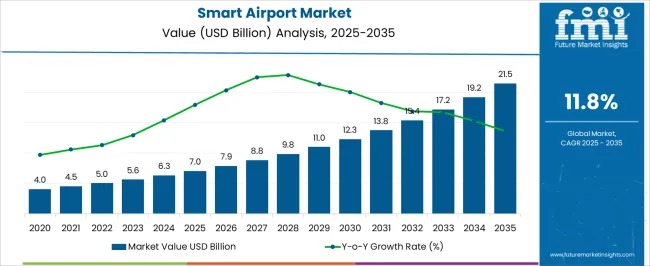
The global smart airport market is entering a decisive growth phase, projected to expand from USD 7.0 billion in 2025 to USD 21.5 billion by 2035, registering a robust compound annual growth rate (CAGR) of 11.8%. Over the ten-year period, the market is expected to generate an absolute dollar opportunity of USD 14.5 billion, underlining the strategic importance of digital, automated, and software-driven systems in the future of airport operations worldwide.
This sustained expansion reflects a fundamental shift in how airports are designed, managed, and optimized. Rising passenger traffic, growing pressure on infrastructure capacity, heightened security requirements, and the demand for seamless passenger experiences are accelerating the adoption of smart airport technologies. Solutions built on IoT, artificial intelligence, advanced analytics, cloud platforms, automation, and biometric systems are becoming central to airport modernization strategies, enabling operators to improve efficiency without proportional increases in physical infrastructure.
Long-Term Value Accumulation Driven by Phased Global Adoption
The smart airport market follows a clear long-term value accumulation curve shaped by phased adoption across regions. Between 2025 and 2028, market value increases steadily as airports in North America and Europe continue early-stage digitalization programs. During this phase, investments are largely focused on regulatory compliance, pilot deployments, and foundational upgrades such as intelligent passenger processing, connected security systems, and digital airport management platforms.
From 2029 to 2032, growth accelerates as adoption scales rapidly in Asia Pacific, the Middle East, and Latin America. These regions are responding to surging passenger volumes, new airport construction, and terminal expansion programs by embedding smart technologies at the core of airport design and operations. Large-scale deployments of automated baggage handling, AI-enabled security screening, and real-time passenger flow analytics drive a sharper increase in market value during this mid-phase.
In the 2033–2035 period, growth remains positive but moderates slightly as early-adopting regions approach higher penetration levels. Market momentum increasingly shifts toward system upgrades, software enhancements, predictive analytics, and technology replacements, rather than first-time installations. This progression reinforces the market’s long-term stability and the durability of the USD 14.5 billion opportunity through 2035.
Get access to comprehensive data tables and detailed market insights — request your sample report today!
Operations and Management Anchor Market Demand
Airport operations and management represent the largest share of the smart airport market, accounting for approximately 44% of total demand. Airport authorities are prioritizing integrated digital platforms that provide real-time visibility across terminal operations, airside activities, energy use, and asset performance. These systems support predictive maintenance, improve turnaround times, and enable data-driven decision-making.
Airline and ground services contribute around 25% of the market, leveraging smart systems for flight scheduling, baggage coordination, and operational synchronization. Retail and commercial services account for close to 15%, as digital signage, mobile engagement tools, and personalized offers enhance non-aeronautical revenue. Security and surveillance, representing about 10%, are increasingly shaped by biometrics, AI-based threat detection, and automated access control. The remaining demand comes from air traffic management and facility maintenance, where smart technologies optimize capacity utilization and infrastructure performance.
Large Airports and Software Platforms Lead Adoption
By airport size, large airports dominate the market with a 47.8% share in 2025, reflecting the complexity and scale of operations at major international hubs. High passenger throughput, tight security requirements, and the need for continuous operational resilience make large airports early adopters of integrated smart solutions. Their ability to deploy modular systems without disrupting daily operations further reinforces this leadership position.
From a system perspective, software and solutions emerge as the largest category, accounting for 42.6% of market revenue. Software-centric platforms allow airports to integrate multiple operational domains—passenger processing, baggage handling, security, and scheduling—through centralized dashboards and real-time analytics. The flexibility to upgrade capabilities through software updates, rather than extensive hardware replacements, positions this segment as the most cost-effective and scalable path to modernization.
The Airport 4.0 model represents the dominant architectural framework, holding 51.3% of market revenue. Characterized by interconnected systems, automation, AI, and cloud-based intelligence, Airport 4.0 supports predictive maintenance, automated passenger journeys, and continuous optimization. Its modular, software-driven design enables airports to evolve alongside technological advancements without operational disruption.
Asia Pacific Accelerates, While Mature Markets Optimize
Regionally, Asia Pacific leads adoption with 36% of global demand, driven by China, India, and Japan. Europe follows with 32%, supported by advanced infrastructure and regulatory alignment, while North America accounts for 28%, reflecting steady modernization and efficiency-driven investments.
At the country level, China leads with a projected CAGR of 15.9%, supported by large-scale airport expansion, smart city integration, and rapid deployment of AI and IoT solutions. India follows at 14.8%, driven by modernization of major hubs and rising international travel. Germany (13.6%) and France (12.4%) reflect strong growth tied to digital efficiency and sustainability initiatives, while the UK (11.2%) and the US (10.0%) demonstrate stable, optimization-led expansion.
Competitive Landscape Defined by Integration and Intelligence
Competition in the smart airport market is shaped by the ability to deliver integrated, secure, and data-driven solutions across terminal, landside, and airside operations. Leading players such as Amadeus, Cisco Systems, Huawei Technologies, IBM, Siemens, SITA, Thales, Raytheon Technologies, Sabre, and Wipro focus on combining connectivity, automation, analytics, and cybersecurity into interoperable platforms. Strategic partnerships between technology providers, airport authorities, and airlines are accelerating deployment and innovation.
Outlook: Smart Airports as a Core Aviation Asset
As global air travel continues to rebound and expand, smart airport technologies are becoming a foundational asset rather than an optional upgrade. The market’s trajectory toward USD 21.5 billion by 2035 reflects a long-term commitment to efficiency, safety, and passenger-centric operations. With digital transformation reshaping aviation infrastructure worldwide, the smart airport market stands at the intersection of technology, mobility, and infrastructure modernization—positioned for sustained growth and strategic relevance over the next decade.
About Future Market Insights (FMI)
Future Market Insights, Inc. (FMI) is an ESOMAR-certified, ISO 9001:2015 market research and consulting organization, trusted by Fortune 500 clients and global enterprises. With operations in the U.S., UK, India, and Dubai, FMI provides data-backed insights and strategic intelligence across 30+ industries and 1200 markets worldwide.