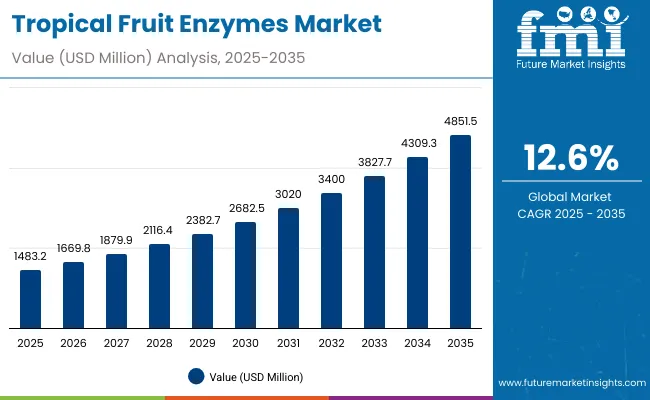
The global Tropical Fruit Enzymes Market is poised for remarkable growth over the next decade, with its valuation expected to soar from USD 1,483.2 million in 2025 to an impressive USD 4,851.5 million by 2035. This reflects a staggering 227% growth, translating to a Compound Annual Growth Rate (CAGR) of 12.6%, showcasing the increasing consumer demand for natural and sustainable skincare solutions.
Both established giants and innovative newcomers in the skincare industry are racing to capitalize on this booming trend. The market’s dynamic landscape is driven by breakthroughs in enzyme stabilization technology, multi-functional formulations, and digital commerce, creating new avenues for growth and competition.
Explore comprehensive market trends, regional outlooks, and competitive intelligence – Get a Sample Copy Now
Market Overview and Growth Drivers
The rise in health-conscious consumers’ preference for natural, eco-friendly skincare products is the primary catalyst for the tropical fruit enzymes market surge. Enzymes derived from tropical fruits like papaya, pineapple, and mango offer gentle yet effective exfoliation, brightening, and anti-aging benefits—making them highly desirable alternatives to harsh chemical ingredients.
In addition, digital-first skincare brands and subscription-based personalized regimens leveraging AI and influencer marketing are accelerating product adoption globally. Leading players such as L’Oréal, Drunk Elephant, and Glow Recipe are blending dermatologist-tested efficacy with eco-conscious positioning, while emerging companies focus on vegan, sustainable, and AI-personalized beauty platforms.
Key Market Segments
- By Function:
- Exfoliation (Leading with 56.6% market share in 2025)
- Brightening
- Anti-aging
- Skin renewal
- By Product Type:
- Masks (Dominating with 49.5% share in 2025)
- Serums
- Cleansers
- Creams/Lotions
- By Claim:
- Natural/Organic (51.5% share in 2025)
- Vegan
- Clean-label
- Dermatologist-tested
- By Channel:
- E-commerce (fastest-growing distribution)
- Pharmacies
- Specialty beauty stores
- Mass retail
- By Region:
- Asia-Pacific (fastest growing: China 20.3% CAGR, India 20.5% CAGR)
- North America
- Europe
- Latin America
- Middle East & Africa
Regional Insights: Asia-Pacific Leads the Charge
The Asia-Pacific region is expected to dominate the market growth story, fueled by rising disposable incomes, urbanization, and expanding e-commerce infrastructure. China and India, in particular, show exceptional potential with projected CAGR values exceeding 20%, driven by rising awareness of natural skincare and a surge in middle-class consumers seeking premium and clean-label enzyme-based products.
Japan’s focus on technologically advanced enzyme formulations and Europe’s steady adoption of clean-label products also underpin the global market’s stability and premiumization trends. The United States market is expanding steadily with a strong focus on multifunctional skincare and premium enzyme formulations, valued at USD 322.47 million in 2025 and expected to reach nearly USD 1 billion by 2035.
Innovation and Technology: The Future of Tropical Fruit Enzymes
- Innovation is at the heart of the tropical fruit enzymes market evolution. Leading manufacturers are investing heavily in enzyme stabilization technologies, such as advanced encapsulation and laser triangulation for precise enzyme activity measurement, ensuring enhanced product efficacy and user safety.
- New entrants are leveraging AI-driven personalization tools, subscription models, and digital diagnostics to offer tailored skincare solutions that match consumer preferences for natural, vegan, and dermatologist-tested products.
- These technological advances are also enabling integration into professional and clinical settings, expanding applications beyond consumer skincare into dermatology clinics and cosmetic labs, broadening market opportunities.
Competitive Landscape: Established Giants and Emerging Innovators
The market exhibits moderate fragmentation. The top player, Drunk Elephant, commands an 8.2% global value share by 2025, backed by its strong natural and enzyme-based product lines. Other significant players include Elemis, Peter Thomas Roth, Murad, The Ordinary, Glow Recipe, Tatcha, Dermalogica, L’Oréal, and Pacifica.
While legacy brands leverage their extensive R&D and global distribution networks, new entrants are carving niches by focusing on sustainability, vegan claims, and digital-native marketing strategies. Competitive advantages increasingly hinge on:
- Sustainability and clean-label credentials
- Digital ecosystem strength and consumer engagement
- Multi-functional, high-performance enzyme formulations
- Personalized skincare experiences enabled by AI and e-commerce platforms
Market Challenges and Opportunities
Despite strong growth, the market faces challenges such as:
- High production costs related to sourcing and stabilizing tropical fruit enzymes
- Seasonal variability and supply chain complexities
- Price sensitivity in emerging markets limiting widespread adoption
However, these are balanced by significant opportunities:
- Rising consumer demand for multi-functional skincare products combining exfoliation, brightening, hydration, and anti-aging benefits
- Expansion of enzyme-based skincare into professional and clinical segments
- Growing digital commerce platforms that enable faster product innovation cycles and deeper customer insights
Key Takeaways for Manufacturers and Investors
- Focus on innovation: Investing in enzyme stabilization and delivery technologies will differentiate brands.
- Expand digital presence: E-commerce and AI-driven personalization are critical growth enablers.
- Leverage clean-label trends: Certifications and sustainability must be prioritized to meet consumer expectations.
- Explore emerging markets: Asia-Pacific, particularly China and India, offer unparalleled growth potential.
- Collaborate across sectors: Opportunities exist in clinical skincare, professional services, and product bundling with tech-enabled diagnostics.
Why FMI: https://www.futuremarketinsights.com/why-fmi
About Future Market Insights (FMI)
Future Market Insights, Inc. (FMI) is an ESOMAR-certified, ISO 9001:2015 market research and consulting organization, trusted by Fortune 500 clients and global enterprises. With operations in the U.S., UK, India, and Dubai, FMI provides data-backed insights and strategic intelligence across 30+ industries and 1200 markets worldwide.
Contact Us:
Future Market Insights Inc.
Christiana Corporate, 200 Continental Drive,
Suite 401, Newark, Delaware – 19713, USA
T: +1-347-918-3531
For Sales Enquiries: sales@futuremarketinsights.com
Website: https://www.futuremarketinsights.com
LinkedIn| Twitter| Blogs | YouTube