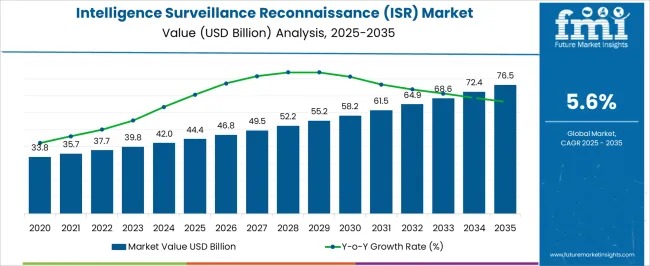
The global Intelligence, Surveillance, and Reconnaissance (ISR) market is entering a sustained growth phase, underpinned by rising defense investments, rapid technological advancement, and escalating demand for real-time situational awareness across military and security operations. The market is projected to expand from USD 44.4 billion in 2025 to USD 76.5 billion by 2035, registering a compound annual growth rate (CAGR) of 5.6% and generating an absolute dollar opportunity of USD 32.1 billion over the forecast period.
ISR systems have become mission-critical assets for modern defense forces, enabling intelligence gathering, battlefield awareness, border security, maritime surveillance, and strategic decision-making. Increasing geopolitical tensions, evolving threat landscapes, and the growing complexity of multi-domain warfare are compelling governments to prioritize advanced ISR capabilities that integrate hardware, software, and analytics into unified intelligence networks.
Defense Modernization and Unmanned Systems Drive Market Momentum
Growth in the ISR market is being strongly supported by expanding defense budgets and large-scale modernization programs across North America, Europe, and Asia Pacific. Military and defense applications account for approximately 50% of total market demand, as armed forces increasingly rely on ISR platforms to enhance threat detection, mission planning, and operational coordination. Homeland security and law enforcement contribute nearly 20%, deploying ISR systems for border monitoring, counter-terrorism, and public safety operations.
The accelerating adoption of unmanned aerial vehicles (UAVs), autonomous platforms, and satellite-based surveillance systems is reshaping ISR deployment strategies. These platforms provide extended endurance, reduced operational risk, and enhanced coverage across land, air, sea, and space domains. Airborne ISR currently represents 40% of global deployments, followed by ground-based systems at 30%, naval ISR at 20%, and space-based ISR at 10%.
Get access to comprehensive data tables and detailed market insights — request your sample report today!
Technology Integration Enhances Intelligence Value
Technological innovation remains central to ISR market expansion. Advances in artificial intelligence, machine learning, real-time analytics, and sensor fusion are transforming raw data into actionable intelligence with unprecedented speed and accuracy. AI-enabled analytics are now integrated into an estimated 30–35% of deployed ISR systems, enabling automated threat recognition, predictive analysis, and faster decision cycles.
Multi-sensor ISR platforms combining electro-optical, infrared, radar, and signal intelligence (SIGINT) technologies account for roughly 25–30% of deployments, significantly improving detection reliability and operational effectiveness. Miniaturization of sensors and low-power hardware designs are further expanding ISR deployment flexibility, particularly for drones, portable ground units, and tactical reconnaissance missions.
Hardware Segment Anchors Market Value
From a solution perspective, hardware remains the dominant segment, accounting for 38.7% of global ISR market revenue in 2025. High-performance sensors, radars, imaging systems, and data acquisition modules form the backbone of ISR architectures, valued for their durability, precision, and ability to operate in harsh environments. Defense agencies continue to favor long-term investments in advanced hardware that can be upgraded with evolving software and analytics capabilities.
By application, military operations represent the largest segment, capturing 42.5% of market revenue. ISR systems deployed in combat and strategic planning environments deliver real-time intelligence, enhance situational awareness, and support coordinated multi-domain operations. On the platform front, land-based ISR systems lead with 44.8% market share, reflecting their extensive use in border surveillance, mobile command centers, and ground force modernization programs.
Regional Growth Patterns Reflect Strategic Priorities
Regionally, North America leads the ISR market with 38% share, driven primarily by the United States, which continues to invest heavily in AI-enabled ISR, satellite reconnaissance, and network-centric defense systems. Europe accounts for 27%, supported by NATO-aligned modernization initiatives in Germany, France, and the UK. Asia Pacific holds 25%, with China and India emerging as high-growth markets due to defense expansion, border security priorities, and domestic ISR manufacturing capabilities.
Country-level growth rates highlight this momentum. China is projected to grow at a 7.6% CAGR, followed by India at 7.0% and Germany at 6.4%, all outpacing the global average. These markets are characterized by strong investment in UAVs, radar systems, and AI-assisted surveillance platforms, alongside increasing deployment volumes across military and maritime applications.
Competitive Landscape Focused on Integration and Performance
The ISR market is highly competitive, shaped by innovation in sensor precision, data fusion, and platform interoperability. Leading players including Lockheed Martin, BAE Systems, Boeing, Northrop Grumman, Raytheon Technologies, Thales, Saab, Rheinmetall, and Elbit Systems are strengthening their positions through advanced multi-domain ISR solutions, strategic partnerships, and sustained R&D investment. Competitive differentiation increasingly centers on real-time analytics, secure communications, autonomous operation, and scalability across diverse mission profiles.
Outlook: Intelligence Superiority as a Strategic Imperative
Looking ahead, the ISR market is expected to benefit from continued defense modernization, rising homeland security requirements, and expanding use of autonomous and AI-driven surveillance systems. While high procurement costs, regulatory complexity, and cybersecurity requirements present challenges, ongoing innovation and system integration are expected to mitigate these constraints over time.
As intelligence superiority becomes a defining element of national security strategy, ISR solutions will remain at the forefront of defense investment. The projected USD 32.1 billion opportunity through 2035 underscores the market’s strategic importance and signals strong long-term potential for stakeholders seeking deeper insight into this rapidly evolving industry.
About Future Market Insights (FMI)
Future Market Insights, Inc. (FMI) is an ESOMAR-certified, ISO 9001:2015 market research and consulting organization, trusted by Fortune 500 clients and global enterprises. With operations in the U.S., UK, India, and Dubai, FMI provides data-backed insights and strategic intelligence across 30+ industries and 1200 markets worldwide.