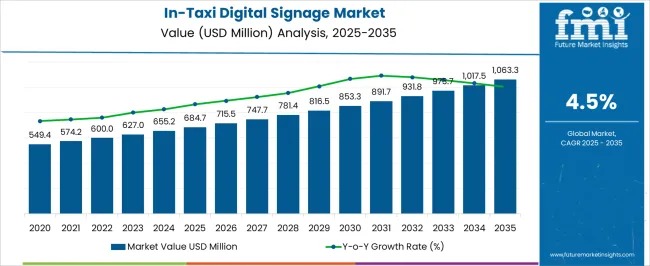
The global in-taxi digital signage market is on a steady growth trajectory, projected to expand from USD 684.7 million in 2025 to USD 1,063.3 million by 2035, registering a compound annual growth rate (CAGR) of 4.5%. Over the ten-year forecast period, the market is expected to generate an absolute dollar opportunity of USD 378.6 million, reflecting the increasing monetization of passenger attention and the digital transformation of urban mobility ecosystems.
In-taxi digital signage has evolved from a niche advertising format into a strategic platform that combines real-time advertising, infotainment, navigation assistance, and passenger communication. Growth is being underpinned by rising urbanization, expanding ride-hailing fleets, and the growing appeal of captive-audience advertising within high-traffic city corridors. Advances in display technologies, connectivity, and cloud-based content management systems are further strengthening the value proposition for fleet operators, advertisers, and solution providers.
Predictable Growth Curve Signals Long-Term Market Stability
Analysis of the market growth curve highlights a balanced and predictable expansion pattern. From 2025 to 2028, adoption progresses gradually, driven by retrofitting of taxi fleets in mature markets such as North America and Europe, where operators leverage digital screens to unlock incremental advertising revenue.
Between 2029 and 2032, the curve steepens as Asia Pacific and Latin America deploy large-scale digital signage networks, supported by rapid urbanization, growth of ride-hailing services, and increasing demand for interactive passenger experiences. In the 2033–2035 period, growth moderates as penetration levels rise and replacement cycles gain importance, with innovation shifting toward content personalization, analytics, and interactivity rather than pure hardware expansion. This trajectory reflects a market transitioning from early adoption to scalable maturity.
Get access to comprehensive data tables and detailed market insights — request your sample report today!
Urban Transportation and Advertising Anchor Demand
Urban transportation remains the backbone of market demand, accounting for approximately 42% of total revenue, as taxi and ride-hailing fleets integrate digital displays to enhance passenger engagement and monetize dwell time. The advertising and media segment contributes nearly 28%, leveraging in-taxi screens for targeted brand campaigns in densely populated metropolitan areas.
Public transportation networks represent close to 15% of adoption, using digital signage for route updates and passenger information, while the hospitality and tourism sector (10%) deploys signage in taxis and shuttles to deliver travel-related promotions. The remaining 5% comes from logistics and corporate shuttle services, highlighting the market’s diversified application base.
Hardware Leadership Reflects Focus on Reliability
By component, hardware dominates with a 49.6% market share in 2025, underscoring the importance of durable, high-performance displays capable of operating under constant vibration, temperature fluctuations, and long service hours. Fleet operators prioritize robust screens, advanced processors, and reliable connectivity modules to ensure uninterrupted advertising delivery and passenger interaction.
The modular nature of modern hardware systems allows selective upgrades without full system replacement, reducing total cost of ownership and supporting long-term deployment strategies. This focus on reliability and scalability is expected to sustain hardware’s leading position even as software and services gain importance.
Economy Taxis and LED Displays Lead Adoption
By vehicle type, economy and budget taxis account for 54.1% of market revenue, reflecting their widespread presence in urban transport networks and high passenger turnover. These fleets offer advertisers consistent exposure and enable operators to deploy standardized, cost-effective digital signage solutions at scale.
In terms of display technology, LED screens lead with a 52.8% share, favored for their superior brightness, energy efficiency, and long operational lifespans. Advances in high-resolution panels and adaptive brightness controls ensure clear visibility across varying lighting conditions, while flexible form factors allow seamless integration into diverse vehicle interiors.
Asia Pacific Drives Volume, OECD Markets Focus on Efficiency
Regionally, Asia Pacific leads adoption with 36% share, driven by China, Japan, and India, where rapid urban mobility expansion and ride-hailing growth are accelerating deployments. Europe accounts for 30%, supported by smart city initiatives and data-driven advertising models, while North America contributes 28%, anchored by steady fleet upgrades in major metropolitan areas.
Country-level analysis highlights China (6.1% CAGR) and India (5.6%) as high-growth markets, benefiting from large taxi fleets and rising demand for targeted in-vehicle advertising. Germany (5.2%) demonstrates strong momentum through technology-led deployments, while the UK (4.3%) and USA (3.8%) show stable, infrastructure-driven growth.
Technology and Partnerships Shape the Competitive Landscape
The competitive environment is defined by display clarity, content management sophistication, analytics, and integration with ride-hailing platforms. Leading players including Samsung Electronics, 42 Gears Mobility Systems, Adflow Digital, Apple Inc., Curb Mobility, LYFT, Navori SA, Swipe Technologies, TOPAZ, and VeriFone Holdings are strengthening market positions through advanced hardware, cloud-based software platforms, and scalable deployment models.
Partnerships between fleet operators, advertisers, and technology providers are enabling real-time, location-based, and programmatic advertising, transforming taxis into data-enabled media assets. Interactive touchscreens, IoT integration, and multi-language content support are becoming standard features, particularly in tourist-heavy and high-income urban markets.
Outlook: Monetizing Mobility Through Digital Engagement
As cities continue to densify and mobility becomes increasingly digitized, in-taxi digital signage is emerging as a strategic interface between passengers, brands, and urban infrastructure. While challenges remain—including installation costs, regulatory compliance, and content management complexity—the long-term fundamentals remain strong.
With advertising, infotainment, and passenger information converging into a single in-vehicle platform, the in-taxi digital signage market is set to remain a compelling growth opportunity through 2035. Stakeholders that align hardware reliability with intelligent content delivery and analytics-driven engagement are best positioned to capture value as this market transitions from deployment scale-up to experience-led optimization.
About Future Market Insights (FMI)
Future Market Insights, Inc. (FMI) is an ESOMAR-certified, ISO 9001:2015 market research and consulting organization, trusted by Fortune 500 clients and global enterprises. With operations in the U.S., UK, India, and Dubai, FMI provides data-backed insights and strategic intelligence across 30+ industries and 1200 markets worldwide.