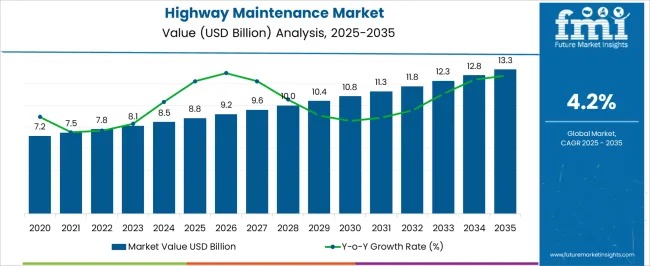
The global highway maintenance market is projected to expand from USD 8.8 billion in 2025 to USD 13.3 billion by 2035, registering a steady compound annual growth rate (CAGR) of 4.2%. This growth reflects the market’s transition from early adoption and pilot deployments into a mature, standardized infrastructure service segment supporting long-term road durability, safety, and operational reliability.
During the early adoption phase (2020–2024), the market grew from USD 7.2 billion to USD 8.8 billion, driven by pilot programs and trials of modern maintenance practices, materials, and equipment across national and regional road networks. Governments and private operators evaluated cost efficiency, performance durability, and operational feasibility, laying the groundwork for wider implementation.
By 2025, broader adoption is underway as highway authorities increasingly integrate structured maintenance schedules, resurfacing programs, and repair techniques to extend road lifecycles and reduce accident risks. From 2025 to 2030, the market enters a scaling phase, with value expected to surpass USD 10.4 billion by 2030, supported by increased public funding, multi-year maintenance contracts, and expanded application across highways, expressways, and arterial roads.
Between 2030 and 2035, the market progresses into a consolidation phase, where growth moderates as leading contractors strengthen their positions, smaller operators consolidate or exit, and maintenance services become embedded as a routine component of transportation infrastructure planning. By 2035, the market stabilizes at USD 13.3 billion, reflecting its role as a core infrastructure service rather than a discretionary expenditure.
Get access to comprehensive data tables and detailed market insights — request your sample report today!
Key Growth Drivers
Market expansion is primarily driven by:
- Rising investments in road infrastructure modernization
- Increasing vehicle density and traffic load, accelerating surface wear
- Shift from reactive to preventive and predictive maintenance
- Stronger safety, durability, and quality regulations
- Public–private partnerships (PPPs) supporting long-term maintenance contracts
Technological advancements—including mechanized resurfacing, advanced asphalt and concrete formulations, and software-driven asset management systems—are improving repair efficiency while minimizing traffic disruption and lifecycle costs.
Segmental Performance Highlights
- Road Surface Repair and Resurfacing leads the market, accounting for 46.8% of revenue in 2025, driven by its direct impact on safety, vehicle operating costs, and traffic efficiency.
- Outsourced Maintenance Contracts dominate with a 58.1% share, reflecting the preference of governments to leverage specialized expertise, modern equipment, and performance-based accountability.
- National Highways represent the largest highway type segment at 54.6%, due to high traffic volumes, heavy commercial vehicle usage, and strategic economic importance.
Regional Outlook
- North America and Europe lead adoption through advanced equipment usage, predictive maintenance systems, and strict regulatory compliance.
- Asia-Pacific represents the fastest-growing region, supported by expanding highway networks, urbanization, and large-scale government infrastructure programs.
- Emerging markets in South Asia, East Asia, and the Middle East continue to generate incremental demand through network expansion and modernization initiatives.
Country-level growth is led by China (5.7%) and India (5.3%), while mature markets such as Germany (4.8%), the UK (4.0%), and the US (3.6%) exhibit stable, maintenance-driven demand.
Competitive Landscape and Market Maturity
The highway maintenance market is moderately consolidated, with established players such as Colas Group, AECOM, Balfour Beatty, Eurovia, Skanska, Kier Group, and Jacobs Engineering leveraging scale, long-term contracts, and advanced technologies. Competitive differentiation increasingly depends on:
- Use of durable and sustainable materials
- Deployment of automated and precision-driven equipment
- Integration of smart monitoring and predictive maintenance tools
- Compliance with environmental and safety regulations
Outlook Summary
With a 4.2% CAGR through 2035, the highway maintenance market is transitioning into a stable, recurring-revenue infrastructure service sector. Growth is no longer driven by experimentation but by institutionalized maintenance cycles, long-term contracts, and data-driven road management frameworks. As governments prioritize asset longevity, safety, and cost optimization, highway maintenance is expected to remain a resilient and strategically important market across both developed and emerging regions.
About Future Market Insights (FMI)
Future Market Insights, Inc. (FMI) is an ESOMAR-certified, ISO 9001:2015 market research and consulting organization, trusted by Fortune 500 clients and global enterprises. With operations in the U.S., UK, India, and Dubai, FMI provides data-backed insights and strategic intelligence across 30+ industries and 1200 markets worldwide.