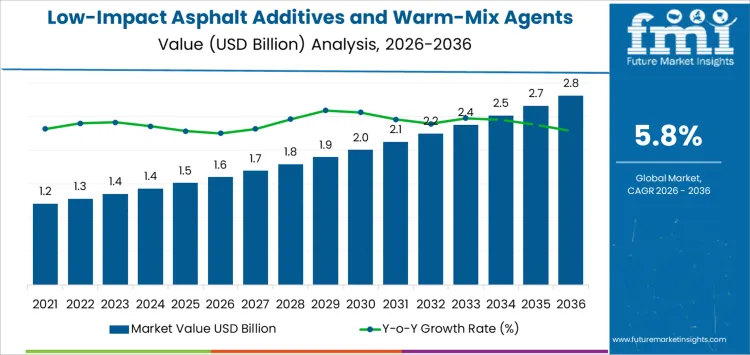
The global market for low-impact asphalt additives and warm-mix agents is poised to reach an estimated USD 1.6 billion in 2026, reflecting strong demand for environmentally responsible paving solutions that simultaneously enhance performance and operational efficiency. As infrastructure investment continues to accelerate worldwide, key industry players and a wave of technologically forward new entrants are aligning to redefine the future of road construction with advanced additives that reduce energy consumption, lower emissions, and support broader sustainability goals.
Warm-mix asphalt technologies and specialized additive systems are increasingly recognized as essential tools in the transition toward cleaner and more cost-effective infrastructure development. These solutions allow asphalt to be mixed and compacted at lower temperatures than traditional hot-mix methods, yielding significant reductions in fuel usage and greenhouse gas emissions while preserving or improving pavement quality. With governments and contractors focused on strict environmental standards and lifecycle cost savings, the adoption of warm-mix and low-impact asphalt technologies has grown from niche applications into mainstream infrastructure practice.
Market Dynamics and Growth Opportunities
The growth of the low-impact asphalt additives and warm-mix agents market is driven by multiple converging forces. Rapid urbanization, expanding highway networks, and heightened emphasis on sustainability in construction procurement are incentivizing the use of products that can deliver both environmental and economic benefits. As road builders and public agencies seek to minimize carbon footprints and meet tighter regulatory requirements, warm-mix agents and additives are increasingly specified in contracts for highways, municipal roads, and airport pavements.
Beyond regulatory influence, contractors are attracted to these technologies for their potential to cut fuel costs and extend the paving season into cooler months. Lower mixing and compaction temperatures translate into reduced plant energy use, improved worker safety, and expanded logistics flexibility, especially on large-scale infrastructure projects. In many regions, additive manufacturers are also developing formulations that improve moisture resistance, enhance adhesion, and boost the performance of reclaimed asphalt pavement blends, further broadening the applications of warm-mix systems.
Established Leaders Powering Innovation
Several long-standing chemical and materials companies maintain leadership positions in this space, leveraging decades of research and global supply networks to serve a wide range of infrastructure stakeholders. These established manufacturers distinguish themselves through deep technical expertise, rigorous testing protocols, and comprehensive support services that help contractors optimize mix designs and field performance.
Major players are investing in additive technologies that not only reduce mixing temperatures but also address performance challenges associated with increasingly complex pavement specifications. Their product portfolios include wax-based warm-mix agents, surfactant and emulsifier-based chemical additives, polymer modifiers for improved low-temperature flexibility, and specialty adhesion promoters to enhance durability. Through partnerships with paving contractors and direct engagement with government agencies, these firms are driving broader adoption of low-impact asphalt solutions across global markets.
To access the complete data tables and in-depth insights, request a sample report here
New Innovators and Next-Generation Technologies
Alongside established players, a vibrant cohort of newer entrants and technology specialists is emerging with cutting-edge approaches that elevate warm-mix additive performance. Some of these innovators are exploring bio-based and renewable feedstocks for additive production, responding to rising demand for greener construction materials. Others are developing multifunctional additives that integrate warm-mix functionality with moisture mitigation or recycled material compatibility, providing contractors with more versatile solutions tailored to specific project needs.
These emerging manufacturers are also embracing digital tools and smart construction technologies to differentiate their offerings. By integrating additive dosing systems with plant automation and data analytics, they aim to optimize material usage, improve consistency, and provide real-time insights that enhance project outcomes. This convergence of chemical innovation and digital capability is helping to broaden the appeal of warm-mix technologies, particularly among forward-thinking infrastructure developers and contractors looking to future-proof their operations.
Regional Markets Reflect Strong Adoption Trends
Across diverse regions around the world, the transition to low-impact asphalt additives and warm-mix agents is underway. In fast-growing markets, infrastructure spending on highways and urban roads is accelerating the uptake of sustainable paving technologies. At the same time, established markets continue to refine construction standards to prioritize energy-efficient practices and reduce environmental impact. This global momentum underscores the role of additive innovation in shaping next-generation road construction and maintenance.
Outlook and Industry Impact
As the global construction sector places greater emphasis on sustainability and cost efficiency, the trajectory for low-impact asphalt additives and warm-mix agents appears increasingly positive. Both incumbent manufacturers and new entrants are expanding their technological capabilities and geographic reach to meet rising demand. Their combined efforts are contributing to a market environment where performance, environmental stewardship, and economic value go hand in hand.
With the market anticipated to grow steadily in the coming decade, stakeholders across the infrastructure value chain are positioned to benefit from advancements that make roads safer, longer-lasting, and more environmentally friendly.