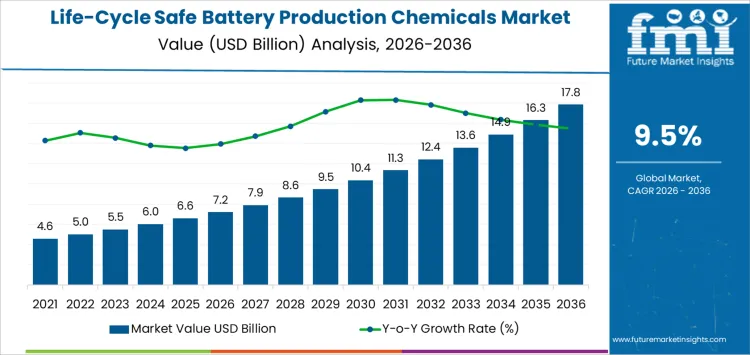
The global Life-Cycle Safe Battery Production Chemicals market is projected to expand robustly from an estimated USD 7.2 billion in 2026 to USD 17.8 billion by 2036, driven by surging demand for safer, greener, and more efficient battery production chemicals across electric vehicles (EVs), renewable energy storage, and portable electronics industries. This growth trajectory aligns with global sustainability goals and the rapid transformation of battery value chains, positioning life-cycle safe chemical solutions as essential enablers of tomorrow’s energy ecosystem.
As the world accelerates its transition to clean energy, manufacturers — both well-established chemical giants and rising innovators — are actively reimagining battery production chemistry to optimize safety, performance, and environmental sustainability. These advancements reflect a broader industry shift toward minimizing hazardous emissions, unlocking new technology pathways, and meeting the evolving expectations of regulators, OEMs, and end users alike.
Established Leaders Responding to Industry Demands
Major global chemical manufacturers, including BASF, Mitsubishi Chemical, Solvay, Albemarle, and Celanese, continue to lead the market with diversified portfolios that balance performance, safety, and sustainability. These legacy players are scaling production of low-toxicity binders, low-VOC (volatile organic compound) solvents, recyclable electrolyte formulations, and other life-cycle safe chemical solutions tailored to modern battery manufacturing challenges.
By leveraging decades of research and industrial experience, these companies are enabling battery producers to enhance electrode stability, reduce environmental risk, and extend battery lifespans — all while complying with increasingly stringent international regulations governing worker safety and emissions. Their investments in safer chemical alternatives are driving faster adoption of eco-friendly processes throughout the battery supply chain.
New Entrants and Technology Disruptors Shake Up the Market
Alongside traditional names, a new wave of innovative manufacturers and technology developers are entering the life-cycle safe battery chemicals arena. Start-ups and specialty chemical firms are pioneering bio-derived binders, water-based solvents, and recyclable electrolyte systems that offer high performance with reduced toxicity profiles. These novel formulations are increasingly appealing to battery makers focused on sustainable production methods and circular economy goals.
Emerging players are also forging strategic partnerships with battery manufacturers and research institutions to bridge the gap between laboratory breakthroughs and commercial scale-up. By introducing agile R&D capabilities and forward-looking technology stacks, these companies are accelerating the adoption of safe, next-generation chemical solutions that emphasize recyclability and life-cycle performance.
To access the complete data tables and in-depth insights, request a sample report here
Technology Trends Driving the Future of Safe Battery Chemistry
Several key technological trends are shaping the life-cycle safe battery production chemicals market. First, there is growing emphasis on water-processable and low-residue chemistries that reduce hazardous solvent use and simplify manufacturing workflows. Water-based electrode formulations, for example, are gaining traction for their potential to reduce cost and environmental impact without compromising performance.
Advancements in recyclable electrolyte formulations are also emerging, enabling easier recovery and reuse of critical materials at the end of battery life. These innovations support both environmental stewardship and the economic viability of large-scale battery recycling efforts.
Digital tools and monitoring systems are increasingly integrated into chemical usage and safety oversight, offering real-time insights into process efficiency and regulatory compliance. These technologies help manufacturers optimize chemical consumption and reduce waste, reinforcing safe production standards across facilities.
Regional Growth Opportunities and Strategic Expansion
The market’s expansion is not only global but also geographically differentiated. Asia Pacific and North America are anticipated to be leading growth regions, propelled by substantial investment in EV manufacturing infrastructure, renewable energy deployment, and clean technology mandates. In particular, fast-growing economies are scaling battery production capacity rapidly, creating fresh demand for life-cycle safe chemical solutions that can meet local and international sustainability benchmarks.
Europe too remains influential, with advanced automotive and industrial sectors driving adoption of green battery chemistries. Across all regions, both established manufacturers and new entrants are strategically expanding their production footprints, forging collaborations, and enhancing distribution networks to capture emerging opportunities.
Outlook: Sustainable Growth Through Collaboration and Innovation
Looking ahead, the life-cycle safe battery production chemicals market is positioned for sustained growth as the energy sector continues to evolve. Collaboration between legacy chemical producers and agile innovators will be central to solving complex challenges in battery safety, sustainability, and cost efficiency.
The industry’s collective focus on developing safer materials, coupled with advancements in battery technology, promises to transform how batteries are designed, manufactured, and repurposed at scale. As manufacturers continue to innovate and expand, the ripple effects will be felt across the entire energy landscape — empowering cleaner transportation, smarter energy storage, and a more resilient global economy.