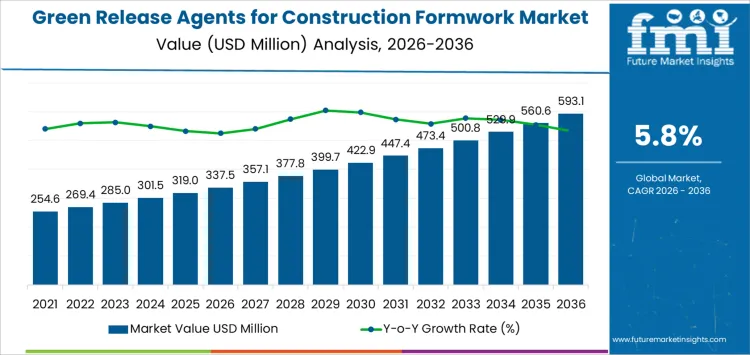
The global green release agents for construction formwork market is projected to be valued at approximately USD 337.5 million in 2026, with strong momentum expected through the next decade as construction companies increasingly embrace eco-friendly materials and technologies. This growth reflects a broader shift across the industry toward products that support sustainability without compromising performance, durability, or efficiency in concrete formwork applications.
Green release agents — specialized chemical formulations used to enable the easy separation of concrete from formwork — are rapidly gaining prominence as builders, contractors, and formwork system providers seek solutions that reduce environmental impact and improve jobsite conditions. Traditionally, release agents contained solvents or petroleum derivatives that posed health and ecological risks. Today’s green alternatives leverage water-based, low-VOC, biodegradable, and plant-derived chemistries engineered to balance environmental considerations with high performance.
Industry Leaders Driving Standards and Innovation
Established global manufacturers such as Sika AG, BASF (Master Builders Solutions), Fosroc International, Mapei, WR Meadows, and Fuchs Lubricants continue to anchor the market with extensive product portfolios, global distribution networks, and decades of technical expertise. These companies have introduced advanced eco-friendly formulations that not only meet stringent environmental standards but also deliver clean release, minimal staining, and improved concrete surface quality across a wide range of formwork materials.
Sika AG and BASF have led efforts to innovate new water-based, low-VOC release agents that integrate seamlessly with green building standards and sustainability goals. At the same time, Fosroc International’s products are gaining traction in heavy infrastructure projects where environmental credentials are increasingly factored into procurement decisions. Mapei and WR Meadows have strengthened their competitive positions through region-specific offerings and customer-centric support services, while Fuchs Lubricants has carved out a niche through tailored solutions and technical backing that appeal to precision-oriented contractors.
To access the complete data tables and in-depth insights, request a sample report here
Emerging Players and New Technologies Expand Competitive Landscape
Beyond the established leaders, a dynamic crop of emerging manufacturers and regional innovators is reshaping market dynamics with differentiated products and niche expertise. Smaller producers are introducing high-performance vegetable-oil or ester-based agents, rapeseed and soy blends that maximize sustainability without sacrificing performance, and hybrid chemistries that bridge traditional and green formulations for broader applicability. These companies are gaining recognition for their agility in responding to local market needs and regulatory shifts.
Innovative technologies are also entering the market. Next-generation biodegradable agents are formulated to break down more efficiently after use, reducing long-term ecological impact. Specialist agents designed to enhance formwork protection — extending the life of timber, steel, and composite systems — are becoming preferred choices among formwork rental and system providers concerned with lifecycle cost savings. Additionally, producers are incorporating digital tools and smart packaging to deliver safety information, application guidance, and performance data directly to field personnel, increasing adoption and consistency in application.
Market Trends Reflect Sustainability and Performance Priorities
Recent developments indicate several key trends pushing market expansion. Water-based, low-VOC bio-emulsion release agents are emerging as the dominant formulation segment, valued for minimal emissions and strong performance in high-demand applications. Meanwhile, hybrid and solvent-free polymer-modified agents are gaining interest for their compatibility with a wide array of concrete types and climatic conditions.
The demand for agents with enhanced performance characteristics — such as reduced formwork cleaning time, improved concrete finish, and compatibility with architectural concrete surfaces — underscores how performance priorities are converging with green objectives. Large contractors and infrastructure developers now account for a notable portion of market demand, driven by green procurement policies, corporate sustainability targets, and the pursuit of green building certifications.
Regional Growth Opportunities and Strategic Focus Areas
While established markets in North America and Europe continue to adopt green release agents at scale, high growth rates are being recorded in Asia Pacific and South Asia, where rapid infrastructure development and strong regulatory pushes toward sustainable construction are expanding opportunity. In these regions, both multinational firms and regional manufacturers are actively expanding production capacities, strengthening distribution channels, and tailoring products to local construction practices.
To capitalize on the momentum, forward-looking companies are prioritizing strategic partnerships with construction firms, formwork system suppliers, and industry associations. Collaborative initiatives include co-development of customized solutions for unique project specifications, joint educational campaigns to raise awareness about sustainable alternatives, and enhanced technical support to ensure consistent product performance under diverse field conditions.
Outlook: Green Chemistry Meets Construction Performance
As the global construction industry continues its transition toward sustainability, the green release agents for construction formwork market is positioned for long-term growth. The blend of established manufacturers, emerging innovators, and advancing technologies is creating a competitive yet opportunity-rich landscape. Forward-thinking companies that successfully leverage green chemistry and performance-driven innovation will be best placed to lead this transformation and support the construction sector’s evolving environmental and operational goals.