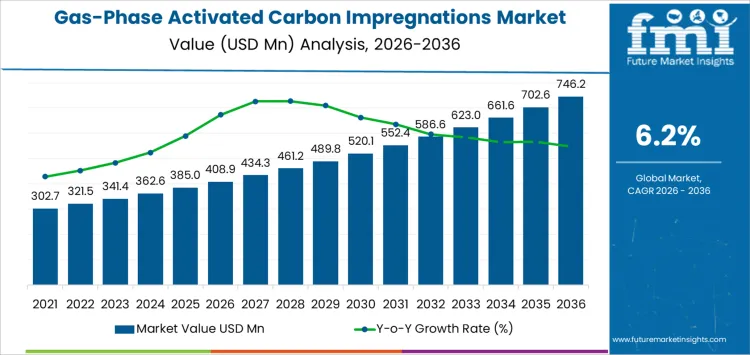
The global gas-phase activated carbon impregnations market is on a strong growth trajectory, projected to expand from an estimated USD 408.9 million in 2026 to about USD 746.2 million by 2036 at a healthy compound annual growth rate (CAGR) of approximately 6.2%. This growth underscores the rising demand for advanced filtration solutions that ensure cleaner air and enhanced industrial safety, driven by mounting environmental regulations and rapid industrialization in key markets. The expanding adoption of innovative technologies in gas purification and odor control further reinforces the market’s robust potential.
As manufacturers both established and emerging seek to broaden their global footprints, the market is witnessing strategic investments in R&D, capacity expansions, and collaborations to deliver tailored impregnated carbon solutions that meet evolving industry needs.
Market Dynamics Fueling Growth
The primary driver behind this expansion is the increasing emphasis on air quality management across industries such as chemical processing, oil refining, wastewater treatment, and environmental protection. Gas-phase activated carbon impregnations play a critical role in adsorbing harmful gases, volatile organic compounds (VOCs), odors, and other contaminants from industrial emissions and indoor environments. As air purity standards become more stringent worldwide, the need for high-performance, application-specific carbon products continues to escalate.
Key industrial applications account for a significant share of market demand, with industrial air purification leading the way. These impregnated carbons are indispensable in settings where toxic gases and odor emissions must be effectively controlled to comply with environmental mandates and ensure workplace safety.
Innovation and Technology Shaping the Competitive Landscape
Leading players in the gas-phase activated carbon impregnations market are intensifying their focus on innovation to improve adsorption efficiency, product longevity, and versatility for complex gas streams. Traditional impregnation methods such as potassium hydroxide (KOH) treatment remain dominant due to their effectiveness in capturing acidic and hazardous gas molecules. However, newer impregnation chemistries and multifunctional blends are emerging to address challenges posed by mixed contaminants and advanced industrial processes.
Manufacturers are also developing proprietary formulations that offer enhanced catalytic activity and performance in demanding environments such as biogas purification and odor abatement in wastewater treatment. These innovative solutions are helping companies differentiate their offerings and cater to customers seeking more sustainable, cost-effective filtration technologies.
To access the complete data tables and in-depth insights, request a sample report here
Established Players Strengthen Market Leadership
The competitive landscape remains led by established specialist firms with deep technical expertise and global supply networks. These companies are leveraging their experience to offer comprehensive product portfolios spanning granular and pellet activated carbons impregnated for specific industrial applications.
By combining robust R&D capabilities with a clear understanding of regulatory trends, established manufacturers are extending their market reach across North America, Europe, and the Asia Pacific. Regional expansion efforts are especially notable in fast-growing economies where industrialization is boosting demand for advanced air treatment solutions.
Emerging Participants and Strategic Partnerships Drive Expansion
In parallel, new and emerging manufacturers are entering the market with differentiated value propositions and regional strengths. Some are focusing on sustainable raw materials such as coconut-shell-based activated carbon, which appeals to environmentally conscious buyers who prioritize renewable feedstocks and strong adsorption properties. Others are investing in modular service offerings, including filtration-as-a-service models that position suppliers as long-term partners rather than mere product vendors.
Partnerships and collaborations are gaining traction as companies seek to combine technical know-how and market access to accelerate product innovation and deployment. These alliances are helping bridge technology gaps and foster the development of next-generation impregnated carbon materials for niche applications, such as capturing trace contaminants in biogas streams or industrial HVAC systems.
Regional Growth Trends Highlight Diverse Opportunities
Market growth is uneven but robust across major geographies. Rapid industrial development combined with heightened environmental awareness is powering strong expansion in Asian markets, with particularly high growth rates in nations undergoing significant manufacturing and infrastructure development. Meanwhile, mature markets in North America and Europe are demonstrating steady demand, driven by ongoing upgrades to industrial facilities and growing public and private investment in air quality solutions.
As the global community prioritizes sustainability and cleaner industrial processes, demand for impregnated activated carbon products is expected to grow steadily across diverse end-use sectors.
Future Outlook and Strategic Priorities
Looking ahead, the gas-phase activated carbon impregnations market is poised to undergo continued transformation as stakeholders embrace smarter, more efficient technologies that address both regulatory and environmental imperatives. Manufacturers focusing on innovation, customization, and strategic scaling will be best positioned to capture growth opportunities in existing and emerging markets.
With ongoing advancements in impregnation technologies and expanded applications in commercial, industrial, and environmental sectors, the market is set to play a pivotal role in global efforts to improve air quality and minimize contaminant exposure across industries.