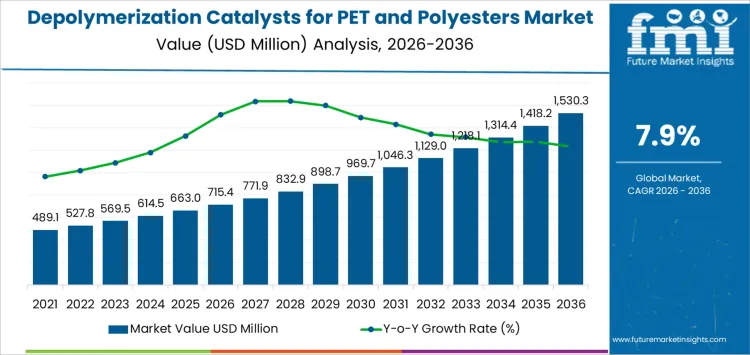
The global Depolymerization Catalysts for PET and Polyesters Market, valued at USD 715.4 million in 2026, is projected to nearly double to an estimated USD 1,530.3 million by 2036, driven by robust adoption of chemical recycling technologies, evolving regulatory frameworks, and rising sustainability goals across industries. This rapid expansion reflects an anticipated compound annual growth rate (CAGR) of approximately 7.9% over the next decade, underscoring strong momentum for both established and emerging catalyst manufacturers.
The growing emphasis on environmental stewardship and the circular economy has accelerated interest in depolymerization catalysts — specialized materials that enable the efficient breakdown of polyethylene terephthalate (PET) and other polyesters into high-quality monomers for reuse. As global demand for sustainable plastics solutions rises, these catalysts are becoming essential to recycling systems that can keep pace with circularity objectives across packaging, textiles, automotive and specialty chemical sectors.
Industry leaders have traditionally focused on glycolysis — particularly BHET monomer recovery — as the dominant depolymerization route, accounting for the largest share of the market due to its relative efficiency and proven performance in producing high-purity monomers suitable for food-grade packaging. However, alternative processes such as methanolysis, enzymatic hydrolysis and novel solvolysis methods are gaining traction, introducing new technological dimensions and enabling broader applications beyond traditional recycling streams.
Innovative New Technologies Lead Next-Gen Growth
The market’s evolution is propelled by a wave of technological advancements that bring greater efficiency, lower energy consumption and enhanced catalyst performance. Enzyme-based catalysts, for example, represent a transformative approach that operates under milder conditions and with improved selectivity — opening doors for recycling complex or contaminated polyester waste. Other next-generation catalysts leverage bio-inspired chemistries or heterogeneous supports that enhance catalyst recovery and reuse, reducing overall operational costs for recycling facilities.
These innovations have attracted venture funding and strategic partnerships, creating fertile ground for both legacy chemical manufacturers and new entrants who are eager to expand their roles in the depolymerization value chain. Established players continue to refine and scale proven catalyst systems, while emerging technology developers are introducing disruptive solutions that challenge conventional paradigms and accelerate commercialization of chemical recycling at industrial scale.
To access the complete data tables and in-depth insights, request a sample report here
Expanding Market Opportunities for Sustainable Plastics
As consumer and corporate commitments to circular plastics intensify, the demand for depolymerization catalysts is expected to grow across diverse end-use applications. Bottle-grade PET monomer recovery remains a leading segment, driven by stringent requirements for food contact materials and growing procurement policies that mandate recycled content. Meanwhile, textile-grade polyester feedstock and high-value specialty chemicals derived from recycled monomers are garnering significant interest as brands seek innovative ways to enhance material sustainability.
Geographically, the Asia Pacific region is emerging as a powerhouse for catalyst adoption, fueled by rapid industrial growth and supportive environmental policies. North America and Europe also continue to drive deployment through stringent recycling regulations and strong corporate sustainability agendas. Together, these regional markets offer a broad landscape for catalyst manufacturers to scale operations and diversify offerings.
New and Established Players Shaping Competitive Dynamics
The competitive landscape of the depolymerization catalyst market is notable for its combination of seasoned industry leaders and agile innovators. Established firms are leveraging decades of chemical expertise to optimize catalyst performance and integrate solutions into existing recycling infrastructures. At the same time, startups and technology pioneers are gaining visibility with breakthrough catalytic processes and tailored solutions for challenging polyester waste streams.
This mix of experience and fresh thinking is fostering a collaborative ecosystem where partnerships and co-development models are increasingly common. Such collaborations enhance access to new markets and accelerate the deployment of cutting-edge recycling technologies. From multinational corporations with global footprints to nimble regional players focused on niche applications, the market reflects a dynamic environment where innovation and strategic expansion go hand in hand.
Sustainability at the Forefront of Industry Transformation
With global plastic waste concerns reaching critical mass, depolymerization catalysts represent more than a technological breakthrough — they are foundational tools for achieving scalable, cost-effective chemical recycling. By enabling the recovery of high-quality monomers that can compete with virgin materials, these catalysts support closed-loop systems that reduce dependency on fossil resources and minimize environmental impact.
Looking ahead, continued advancements in catalyst design, processing efficiency and cross-industry collaboration are expected to drive deeper adoption of chemical recycling solutions. For manufacturers eager to capitalize on this growing demand, the depolymerization catalysts market presents compelling opportunities to lead in sustainable innovation while expanding business horizons.