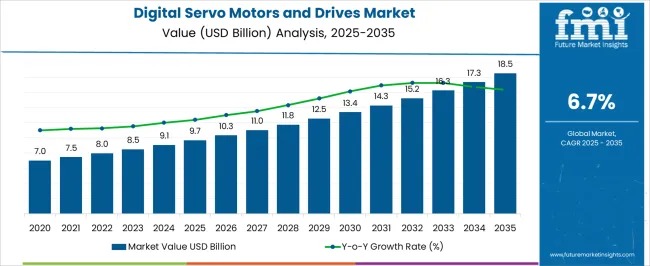
The global digital servo motors and drives market is entering a decisive phase of sustained expansion, driven by accelerating industrial automation, robotics adoption, and the transition toward smart, data-driven manufacturing systems. Valued at USD 9.7 billion in 2025, the market is projected to reach USD 18.5 billion by 2035, advancing at a compound annual growth rate (CAGR) of 6.7%. This growth trajectory underscores the increasing role of digital servo technologies as foundational enablers of precision motion control across multiple industries.
During the early adoption phase between 2020 and 2024, the market expanded from USD 7.0 billion to USD 9.7 billion as manufacturers cautiously introduced digital servo systems into automation lines, robotics platforms, and precision equipment. Pilot deployments during this period focused on validating performance accuracy, energy efficiency, and long-term reliability. By 2025, these trials have translated into broader acceptance, positioning digital servo motors and drives for integration into standardized industrial operations.
Transition from Scaling to Market Consolidation
Between 2025 and 2030, the market is expected to scale rapidly, surpassing USD 12.5 billion by 2030. Growth during this phase is being fueled by expanding use cases in industrial automation, packaging, and material handling systems, where digital servo motors and drives are increasingly installed to support high-speed, high-precision processes. Manufacturing environments are prioritizing repeatability, uptime, and energy optimization, all of which are enabled by digitally controlled servo systems.
From 2030 to 2035, the market is anticipated to enter a consolidation phase, reaching USD 18.5 billion. While growth moderates, the period will be defined by stronger positioning of established suppliers, mergers and acquisitions, and the gradual phasing out of smaller, less differentiated players. The sustained 6.7% CAGR over the decade reflects a structurally resilient market rather than cyclical demand, confirming digital servo motors and drives as long-term assets within industrial ecosystems.
Get access to comprehensive data tables and detailed market insights — request your sample report today!
Industrial Automation and Robotics Anchor Demand
The market’s expansion is closely linked to its parent industries. Industrial automation accounts for approximately 30% of demand, as servo systems are deployed across assembly lines, automated machinery, and flexible manufacturing cells. Robotics contributes around 20%, driven by the integration of servo drives into robotic arms, collaborative robots, and autonomous systems that require precise, repeatable motion control.
Packaging and material handling equipment represents 15% of the market, supported by servo-driven conveyors, pick-and-place units, and labeling machines. Machine tools and CNC systems contribute 10%, leveraging servo drives for high-speed accuracy. Electronics and semiconductor manufacturing accounts for 8%, while automotive manufacturing contributes 7%, particularly in welding, painting, and precision assembly operations. Aerospace and defense applications represent 5%, reflecting demand for precision control in testing and assembly, with maintenance and aftermarket services contributing an additional 5%.
AC Drives Dominate Through Versatility and Efficiency
By drive type, AC drives lead the digital servo motors and drives market, accounting for 57.6% of revenue in 2025. Their dominance stems from superior efficiency, robust performance, and the ability to deliver high torque across wide speed ranges. AC drives are increasingly favored in smart manufacturing environments due to their compatibility with software-based motion control platforms, reducing downtime and simplifying maintenance.
Their scalability across motor sizes and applications makes AC drives particularly attractive for manufacturers expanding or reconfiguring production lines. As energy efficiency and digital integration become procurement priorities, AC drives are expected to maintain their leadership position throughout the forecast period.
Robotics Emerges as the Largest Application Segment
From an application perspective, robotics commands 44.8% of market revenue in 2025, making it the largest single segment. The rapid deployment of robotics in manufacturing, logistics, and assembly operations has elevated the need for servo systems capable of delivering precise, repeatable, and responsive motion control.
Advanced control algorithms, real-time sensor feedback, and monitoring capabilities have enhanced the performance of digital servo motors in robotic systems. As robotics expands into collaborative, service, and specialized industrial applications, demand for compact, energy-efficient, and software-configurable servo solutions is expected to remain strong.
Regional Dynamics Reflect Automation Priorities
Regionally, North America, Asia-Pacific, and Europe remain the primary growth centers. Asia-Pacific leads in momentum, driven by large-scale manufacturing and smart factory initiatives. China, growing at a 9.0% CAGR, is integrating digital servo systems across automotive, electronics, and packaging industries, supported by government-backed automation programs. India, with 8.4% CAGR, is rapidly adopting servo technology in automotive, textiles, and packaging as industrial automation accelerates.
In Europe, Germany’s 7.7% CAGR reflects its leadership in Industry 4.0 and precision engineering, while the UK’s 6.4% growth is supported by adoption in manufacturing, aerospace, and packaging sectors. The United States, expanding at 5.7%, represents a mature yet stable market, with steady demand across robotics, CNC machinery, and smart factory deployments.
Connectivity, Efficiency, and Compliance Shape Competition
Market growth is increasingly shaped by connectivity and smart integration. Digital servo systems equipped with industrial IoT connectivity, predictive diagnostics, and real-time monitoring are gaining preference, particularly in North America and Europe. Energy efficiency, compact design, and compliance with stringent safety and regulatory standards further influence adoption decisions.
Suppliers that deliver globally compliant, software-integrated, and energy-optimized solutions are gaining competitive advantage, while regional manufacturers focus on cost-effective, application-specific offerings.
Competitive Landscape Driven by Innovation
The competitive landscape features global leaders such as Siemens, ABB, Yaskawa, Mitsubishi Electric, Rockwell Automation, Schneider Electric, Bosch Rexroth, and Beckhoff Automation, alongside a strong group of regional and emerging players. Strategies center on R&D investments in smart motion control, modular designs, and predictive maintenance capabilities. Strategic collaborations, portfolio expansion, and geographic growth remain key levers for strengthening market presence.
Outlook
As industries worldwide pursue higher productivity, precision, and energy efficiency, digital servo motors and drives are transitioning from specialized components to core infrastructure within automated systems. The market’s steady expansion through 2035 reflects its critical role in enabling next-generation manufacturing, robotics, and precision operations. The full market report offers in-depth insights into technology evolution, competitive strategies, and regional growth opportunities shaping this dynamic sector.
About Future Market Insights (FMI)
Future Market Insights, Inc. (FMI) is an ESOMAR-certified, ISO 9001:2015 market research and consulting organization, trusted by Fortune 500 clients and global enterprises. With operations in the U.S., UK, India, and Dubai, FMI provides data-backed insights and strategic intelligence across 30+ industries and 1200 markets worldwide.