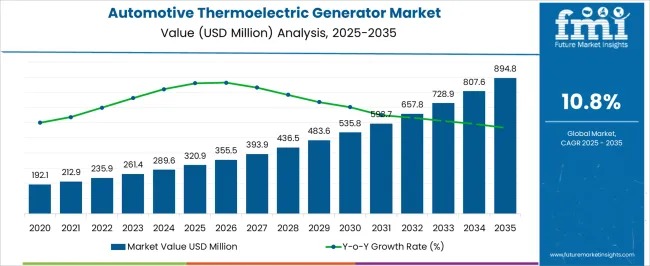
The global automotive thermoelectric generator (ATEG) market is entering a decisive growth phase as vehicle manufacturers increasingly prioritize energy efficiency, emission reduction, and intelligent power management. Valued at USD 320.9 million in 2025, the market is projected to reach USD 894.8 million by 2035, expanding at a robust compound annual growth rate (CAGR) of 10.8%. This trajectory reflects the market’s evolution from experimental deployments toward structured, large-scale integration across passenger and commercial vehicle platforms.
Between 2020 and 2024, the market experienced moderate but meaningful expansion, growing from USD 192.1 million to USD 320.9 million. During this early adoption phase, automotive OEMs and technology providers focused on pilot installations and prototype testing to validate the feasibility of converting exhaust waste heat into usable electrical energy. These early programs demonstrated tangible benefits in fuel efficiency improvement, alternator load reduction, and overall vehicle energy optimization, laying the foundation for broader commercialization.
By 2025, the automotive thermoelectric generator market reaches a critical inflection point. Achieving a market size of USD 320.9 million signals growing confidence among automakers in the technology’s reliability and return on investment. Increasing interest is being observed from OEMs seeking complementary power solutions for internal combustion engine (ICE) vehicles and hybrids, where waste heat remains an underutilized energy source. As regulatory scrutiny around fuel economy and emissions intensifies globally, thermoelectric generators are emerging as a practical solution that enhances efficiency without fundamentally altering existing powertrain architectures.
From 2025 to 2030, the market is expected to enter a clear scaling phase, surpassing USD 483.6 million by 2030. Growth during this period is driven by wider deployment across passenger cars and commercial vehicles, supported by improvements in manufacturing capabilities, material efficiency, and system integration. Between 2030 and 2035, the market transitions into a consolidation phase, during which leading suppliers strengthen their positions, supply chains mature, and smaller players increasingly align with established technology ecosystems. By 2035, the market is forecast to approach USD 894.8 million, reinforcing thermoelectric generation as a standardized component within advanced automotive energy management strategies.
Market Structure Anchored by Strong Parent Industries
The automotive thermoelectric generator market is supported by a diverse ecosystem of parent industries. The broader automotive sector contributes approximately 35% of market influence, as vehicle production volumes directly shape adoption potential. Automotive powertrain systems account for around 20%, providing the foundational platforms for integration. Vehicle energy management and battery systems contribute 15%, enabling effective utilization of recovered electrical energy.
Additional influence comes from automotive component manufacturing (10%), aftermarket services (7%), transportation and logistics fleets (5%), and the electronics and semiconductor industry (5%), which supplies sensors and control units critical for system optimization. Software and monitoring platforms (3%) further enhance adoption by enabling real-time diagnostics and performance tracking. Together, these interconnected markets create a resilient growth environment for automotive thermoelectric generators.
Get access to comprehensive data tables and detailed market insights — request your sample report today!
Bismuth Telluride Leads Material Innovation
From a material perspective, bismuth telluride dominates the market, accounting for 47.6% of revenue in 2025. Its leadership is driven by high thermoelectric conversion efficiency, proven thermal stability, and reliable performance under automotive operating conditions. Ongoing advancements in material processing and cost-efficient manufacturing have improved scalability while maintaining performance benchmarks. As waste heat recovery becomes a strategic priority for OEMs, bismuth telluride-based modules are expected to retain their leadership position throughout the forecast period.
Passenger Cars and Waste Heat Recovery Drive Demand
By vehicle type, passenger cars represent the largest segment, contributing 51.3% of market revenue in 2025. Standardized engine layouts, consistent exhaust heat availability, and growing consumer demand for fuel-efficient vehicles make passenger cars an ideal platform for thermoelectric generator integration. The ability to implement these systems with minimal engine redesign further accelerates adoption.
By application, waste heat recovery stands out as the leading segment, holding 44.8% of market share in 2025. Capturing energy that would otherwise be lost through exhaust systems aligns directly with global efficiency and emission reduction goals. Advances in lightweight module design and seamless integration with vehicle electronics continue to strengthen this segment’s growth outlook.
Regional Growth Accelerates Across Major Automotive Hubs
Regionally, Asia-Pacific, Europe, and North America are the primary growth engines. China leads global expansion with a 14.6% CAGR, supported by high vehicle production volumes, government incentives, and aggressive emission reduction targets. India follows closely at 13.5% CAGR, driven by rapid automotive industrialization and tightening emission norms. Among developed markets, Germany posts 12.4% growth, reflecting strong adoption in hybrid vehicles and advanced automotive engineering, while the United States grows at 9.2%, supported by steady demand for energy-efficient vehicle technologies.
Competitive Landscape Strengthens Through Innovation
The competitive landscape is defined by established automotive suppliers and specialized thermoelectric technology providers, including Gentherm Incorporated, Alphabet Energy, Faurecia, Valeo, European Thermodynamics, II-VI Marlow, KELK Ltd., and Laird Thermal Systems. These companies are investing heavily in material innovation, system integration, and scalable manufacturing. Strategic collaborations with OEMs, along with advances in thermal management and energy recovery efficiency, are positioning leading players to capture long-term value as adoption widens.
Outlook: From Efficiency Enhancement to Strategic Differentiator
As the automotive industry advances toward cleaner, more efficient mobility, thermoelectric generators are transitioning from niche experimentation to strategic deployment. Their ability to recover wasted energy, improve fuel economy, and support auxiliary vehicle systems positions them as a compelling solution in both conventional and hybrid vehicles. With strong regulatory tailwinds, material innovation, and expanding OEM interest, the automotive thermoelectric generator market is set to play an increasingly influential role in shaping the future of automotive energy efficiency.
About Future Market Insights (FMI)
Future Market Insights, Inc. (FMI) is an ESOMAR-certified, ISO 9001:2015 market research and consulting organization, trusted by Fortune 500 clients and global enterprises. With operations in the U.S., UK, India, and Dubai, FMI provides data-backed insights and strategic intelligence across 30+ industries and 1200 markets worldwide.