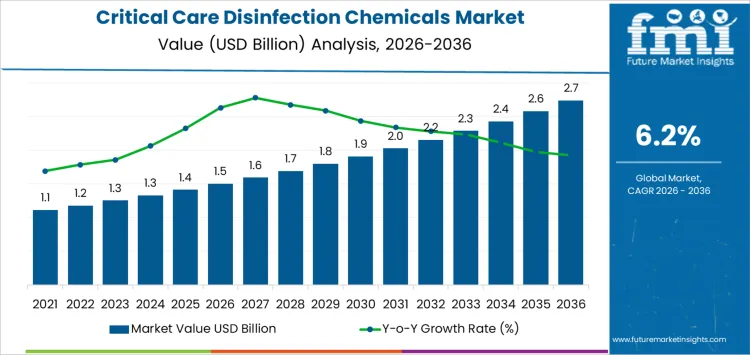
The critical care disinfection chemicals market is poised for significant expansion through the end of the decade, underpinned by rising infection control priorities in healthcare settings and an influx of both established and new manufacturers focused on advanced technologies. Valued at approximately USD 1.5 billion today, the sector is projected to register robust growth in the coming years as hospitals, clinics, and intensive care units increasingly adopt next-generation disinfection solutions to combat healthcare-associated infections and enhance patient safety.
Demand for high-performance critical care disinfectants has surged as healthcare providers worldwide intensify efforts to create sterile environments in high-risk areas such as ICU and CCU patient rooms. This heightened focus on preventing infections has created opportunities for globally recognized chemical manufacturers to expand their footprints while enabling emerging companies to introduce differentiated products that meet evolving clinical and regulatory needs.
Market Leaders Expand Through Innovation and Strategic Investment
Several established players with deep roots in healthcare hygiene and infection control are driving market momentum. These leading companies are heavily investing in research and development to refine their chemical portfolios and introduce innovative disinfectants with broader efficacy, faster action, and improved safety profiles. Their strategic growth efforts are helping healthcare facilities stay ahead of emerging pathogen challenges and stringent sanitation standards.
Notable multinational firms are expanding their presence through new product lines, enhanced distribution networks, and strategic partnerships with healthcare systems. These companies emphasize broad-spectrum disinfectant solutions tailored for critical care environments, where rapid pathogen elimination and compatibility with sensitive medical equipment are essential. Their offerings increasingly feature advanced formulations — including hydrogen peroxide-based systems, quaternary ammonium compound blends, and environmentally conscious chemistries that balance effectiveness with reduced toxicity.
In addition to expanding product portfolios, many established manufacturers are investing in technologies that streamline disinfection workflows. This includes automated dispensing systems, smart monitoring tools, and eco-friendly solutions that address both operational efficiency and environmental sustainability. By leveraging digital integration and automation, these companies are helping healthcare providers achieve consistent sanitation protocols with minimized manual intervention.
To access the complete data tables and in-depth insights, request a sample report here
Emerging Players Bring Fresh Perspectives and Technologies
Alongside market incumbents, a new wave of regional and niche manufacturers is entering the critical care disinfection chemicals arena, bringing fresh innovation and competitive energy. These emerging firms are targeting underserved segments of the market with differentiated offerings such as eco-certified disinfectants, specialty formulations designed for specific clinical scenarios, and scalable solutions suitable for small and mid-size facilities.
By focusing on product features that address specific healthcare challenges — such as reduced surface corrosion, fast kill times, and compatibility with automated disinfection platforms — these new entrants are carving out meaningful positions. Their agility allows them to respond rapidly to shifts in healthcare practices, including heightened demand for biodegradable products and non-toxic alternatives that align with sustainability goals.
Many smaller players are also exploring subscription models and service-based offerings that simplify procurement and ensure regular supply replenishment for critical care environments. This approach resonates with healthcare facilities seeking predictable cost structures and reliable access to essential disinfectants.
Technology Trends Reshaping the Market
The landscape for critical care disinfection chemicals is also being transformed by emerging technologies that enhance both performance and user experience. Automation and connectivity are at the forefront of innovation, with hospitals increasingly adopting intelligent dispensers and no-touch systems that reduce handling errors, improve compliance, and deliver precise chemical dosing. These tools are particularly valuable in high-traffic clinical zones where maintaining stringent hygiene standards is vital.
Chemistry itself is evolving, with manufacturers exploring formulations that offer broad-spectrum antimicrobial activity while minimizing environmental impact and irritation to healthcare staff. Eco-friendly disinfectants formulated without harsh solvents are gaining traction as healthcare systems seek to balance patient safety with sustainability goals. Some companies are integrating advanced chemistries that provide rapid pathogen eradication without compromising material compatibility, enabling their use on delicate equipment and high-touch surfaces alike.
Another key trend involves enhanced formulation stability and longer shelf life, which improve operational logistics for healthcare facilities. These technological shifts not only elevate the effectiveness of disinfection protocols but also contribute to reduced waste, lower overall costs, and greater ease of use for frontline staff.
Global Growth Outlook and Strategic Expansion
Market growth is not uniform across regions, but strong expansion is observed in areas where public health investment and healthcare infrastructure development are on the rise. Emerging markets are showing particularly strong uptake as hospitals upgrade facilities and integrate sophisticated disinfection solutions into standard infection control programs. Established players are responding by expanding manufacturing capabilities and forming strategic distribution alliances to meet growing regional demand.
As critical care disinfection continues to be a cornerstone of infection prevention strategies worldwide, the sector’s evolution will be shaped by collaborative efforts between veteran industry leaders and innovative newcomers. Together, they are driving a safer, more resilient healthcare ecosystem through advanced chemical solutions and forward-looking technologies that prioritize patient safety and operational excellence.